
Production Capacity: 25~240m³/h
Aggregate Feeding Type: Bucket/Belt
Concrete Mixer: Twin-shaft/Vertical-shaft
EPDAS offers a full range of concrete batching plants designed to meet the diverse needs of construction projects. Whether you’re operating in urban areas, remote locations, or need flexibility between job sites, our concrete batching plants deliver efficient and consistent concrete production.
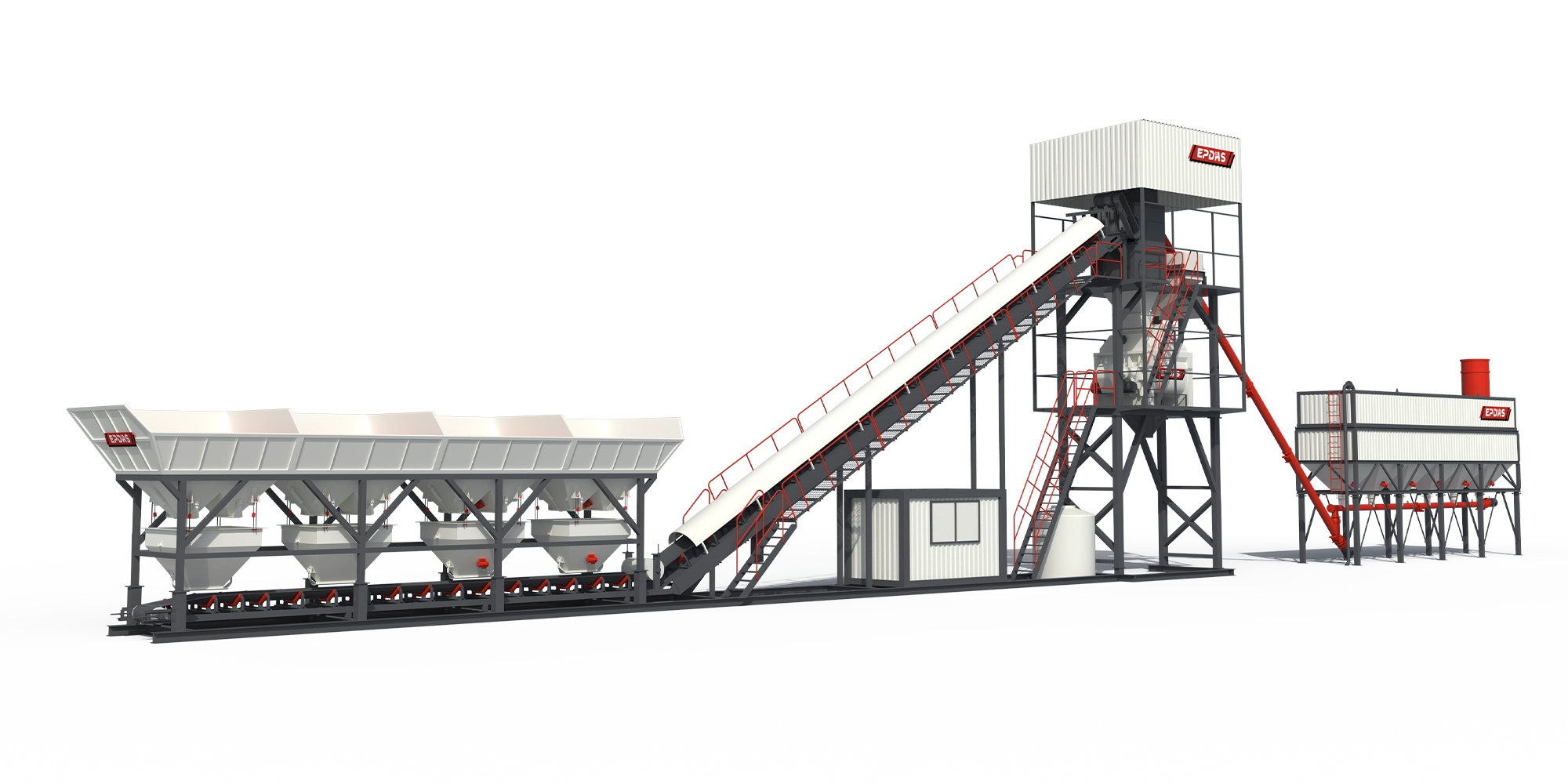
Concrete batching plant is not just equipment, but a set of production system of concrete. Its core function is to replace manual batching and mixing and attain industrial-scale production, whenever uses it in small building decoration or construction large basic infrastructure.

A complete concrete batching plant is made up of a full range of dedicated systems, each of which is a critical and irreplaceable component.

It consists of silos and hoppers, and is designed for storing aggregates such as sand and gravel. Different materials are stored in separate silos to prevent cross-contamination. While silo capacity is matched to production capacity of batching plant to make sure stable material supply.
It is available in two operation modes: automatic and manual. Industry mainstream is automatic type, which can accurately measure the dosage of each raw material due to preset concrete mix proportions and measurement error can be controlled within a extremely narrow range.
The most common types are twin-shaft mixers and planetary mixers. Twin-shaft mixers achieve uniform mixing, high operational efficiency making them ideal for large-scale production projects. Planetary mixers produce a more homogeneous concrete and are therefore better suited for projects requiring high-quality concrete.
It is responsible for transporting raw materials from storage to batching and mixing machines and is configured with both belt conveyors and screw conveyors. Belt conveyors are ideal for conveying aggregates like sand due to their large conveying capacity, while screw conveyors are primarily used to transport cement and other powder materials to prevent leakage.
Nowadays, the industry widely adopts PLC control paired with touch screen operation. Operators can set concrete mix formula and monitor production process. They can also check real-time operational status of all equipment. The whole process is intuitive and straightforward.
It is used for storing and conveying cement and other powder materials, ensuring a stable supply and reducing dust pollution.
Production Capacity: 25~240m³/h
Aggregate Feeding Type: Bucket/Belt
Concrete Mixer: Twin-shaft/Vertical-shaft

Production Capacity: 20~100m³/h
Concrete Output Height: 1.0~3.9m
Concrete Mixer: Twin-shaft/Vertical-shaft/Drum
Production Capacity: 20~150m³/h
Central Concrete Mixer: NONE
Chassis Type: Stationary/Mobile
Usage: Ready-mix Concrete Production/Sale
Production Capacity: 60~150m³/h
Advantage: Convenient Installation/Foundation
Storage Volume: 30~500t
Structure Type: Vertical/Horizontal
Foundation Type: Stationary/Mobile
Function: Pumping cement/powder into silo
Pumping Capacity: 3~8m³/min
Tank Volume: 3.9~6.5t
The working process of a concrete batching plant is not complicated, which can be summarized in four core steps: Feeding – Metering – Mixing – Discharging. We have already learned about several components of a complete concrete batching plant, which will help us gain a better understanding of its work process better.
Aggregates are transported to storage by belt conveyors; powder materials are transported to
cement silo at the metering stage via screw conveyors. Water and other admixtures are separately stored in dedicated tanks for production.
Aggregates, water and admixtures are dosed in strict accordance with preset concrete mix formula, each raw material’s dosages are precisely controlled to make sure an accurate matching of proportions.
All materials are fed into mixer and mixed for a preset duration. Actual mixing time will be adjusted due to the project demand and concrete type until the concrete meets specified quality standards.
Homogeneously mixed concrete is discharged through discharge port and directly transferred into concrete mixers, and then transport it to construction site.
Here is a step-by-step explanation of how a concrete batching plant works and there are mainly four steps in the whole concrete production process: feeding, batching, mixing, and discharging.
Usage life and operation stability of concrete batching plant depend on not only equipment quality, but daily maintenance. Doing well daily maintenance can reduce fault, belong its using life. It is straightforward the key point is you should insist and be careful from basic works.

Check electrical, control and conveying systems before startup: ensure secure wiring, no abnormal equipment noise and intact components.
Clean the mixer, conveyor belts, silos etc. promptly after production; focus on clearing concrete residue on mixer blades and liners to avoid caking and blockage.
Lubricate moving parts (mixer bearings, gears, conveyor rollers) with specified oil regularly to reduce friction and wear.
Conduct weekly inspections of lubrication status, component wear, and electrical system connections;
Conduct monthly inspections of the overall equipment structure to confirm that silos/cement silos are free from damage and material leakage, mixer blades and liners are without severe wear, and belt conveyors have no cracks or deviation;
Conduct annual disassembly inspections of core components, replace aged parts, and complete a full equipment commissioning.
Choosing an ideal concrete batching plant is the most vital step. Never blind purse high efficiency or low price. The key point is the equipment can match actual project needs. Wrong models will lead to serious construction problems in practice.
First, confirm your project scale and concrete demand.
Then, check the construction site’s working and power supply conditions for normal operation.
Definite concrete types—dry-mixed concrete or wet-mixed concrete. If the local has a high requirements of environmental protection, choose an environmentally friendly batching plant.
Choose reliable core components with premium material and fine craftsmanship.
Check manufacturers’ service system for timely fault solving and spare parts supply.
Steer clear of blind selection and focus on practical project demand matching.
Many customers think higher capacity means better equipment, yet such equipment costs far more upfront.
Avoid chasing low prices because cheap models lack component quality guarantees, suffer frequent malfunctions, and lead to excessive maintenance costs, ending up far from economical.
A premium concrete batching plant features precisely dosing, uniform mixing and effective elimination of human errors, so that every batch concrete’ quality is consistent. You won’t have to worry about common construction defects such as concrete cracking or insufficient structural strength.
It boasts a higher level of automation, eliminating the need for a large workforce. What’s more, it enables continuous production and drastically shortens production cycles. Therefore, for projects with tight schedules, it ensures on-time project completion.
On the one hand, its precise proportioning minimizes raw materials waste; on the other hand, excellent stability of one equipment reduces the risk of malfunctions, cutting down on costly maintenance and downtime costs significantly.
It is capable of producing all types of concrete—including normal concrete, high-strength concrete and self-compacting concrete—without the need for additional equipment modification or purchase, greatly enhancing the equipment’s adaptability to diverse construction demands.
Most high-quality concrete batching plant comply with domestic and international building industry standards. The concrete produced is of compliant and high specification, which directly ensures stable concrete quality and facilitates smooth project acceptance.
High-quality concrete batching plants adopt durable core components and advanced manufacturing processes, which extend the equipment’ s service life. It can maintain stable performance for a long time, bringing long-term operational value to your projects.

The entire installation and commissioning cycle only takes 15-20 days, over 60% shorter than traditional equipment, achieving significant cost and time savings.
Capacity:theoretical production rate of 180m³/h
Application:various large-scale infrastructure projects
Specialization:adapted to Indonesia's tropical environmental conditions
To choose the right concrete batching plant, consider factors such as required output capacity, project duration, site size, and budget. Mobile concrete batching plants are suitable for temporary or remote projects, while stationary batching plants are ideal for long-term, high-capacity concrete production. We are a Professional supplier and can help you select the most efficient solution.
Concrete batching plants can be equipped with twin-shaft mixers, planetary mixers, pan mixers, or single-shaft mixers. Twin-shaft mixers are widely used in stationary concrete batching plants due to their high output and strong mixing performance, while planetary mixers are ideal for precast concrete and high-quality concrete production. Choosing the right mixer depends on concrete grade, production capacity, and project requirements.
Yes. The batching plant control system can be fully customized, including PLC brand, interface language, automation level, and data management functions. Advanced options include remote monitoring, automatic reporting, and production data storage, making the concrete mixing plant easier to operate and manage.
Concrete batching plants can be designed to match different international electrical standards, such as 380V 50Hz, 415V 50Hz, or 440V 60Hz. Electrical components are selected according to local power conditions to ensure safe and stable operation.
Yes. Customized concrete batching plants can be designed for hot, cold, dusty, or humid environments. Options include thermal insulation, heating systems, dust collectors, and corrosion-resistant materials to ensure reliable performance in harsh working conditions.
The production time for a concrete batching plant usually ranges from 15 to 45 days, depending on capacity and customization requirements. Shipping time varies by destination. EPDAS can provide clear delivery schedules and export support.
If you notice weighing errors, stop production immediately and do not force the machine to run. Check these common issues first: Calibrate the sensors regularly: Weighing sensors can drift slightly over time. Calibrating them once a month will ensure continuous accuracy. Check for moisture and loose wiring: Inspect the sensors to see if they are damp or if the cables are loose. Fix any wiring issues right away. Prevent material buildup: Avoid overloading the aggregate bins. Leftover material can press against the weighing hopper and ruin the measurement. Clean out the bins daily.
The core wearable parts are mainly located in the mixing and conveying systems. These include mixer blades, liners, conveyor belts, seals, and screw conveyor flights. Under normal use and proper daily maintenance, the estimated replacement intervals are as follows: Mixer blades and liners: 6 to 12 months Conveying belts: 1 to 2 years Seals and lubrication components: Inspect and replace every 3 to 6 months The exact lifespan depends on your production frequency and the abrasiveness of your materials. We highly recommend keeping a small stock of these wear parts in advance to prevent unexpected downtime and project delays.
Transportation is highly convenient and generally split into two types based on the equipment design: Towed (Trailer-mounted) models: These units are built on a heavy-duty chassis with wheels and can be easily towed directly to the job site by a standard truck head. Self-propelled models: These units are equipped with their own driving power system and can move independently around the site or short distances without requiring extra towing vehicles. Both options are engineered for rapid relocation and can be quickly prepared for transport to keep your project moving efficiently.
Yes, it is definitely more cost-effective for temporary projects or jobs that require frequent relocation. While the initial equipment purchase prices are similar, the foundation-free model eliminates the expensive civil engineering costs of pouring a permanent concrete foundation. The entire setup can be reused at next job sites, which saves a significant amount of money over the long term. On the other hand, if you are running a long-term, fixed-location factory, a traditional batching plant might offer slightly better long-term stability.
Yes. You can store any dry, powder-like materials such as fly ash, lime, and slag powder without major modifications. Just make sure to avoid cross-contamination by keeping different materials in separate silos. Note: If storing highly corrosive materials, a specialized anti-corrosion coating is required.
Yes, but only for short distances. Vertical transport requires short-pitch screw flights and strict feed rate control to prevent material backflow. Because vertical transport consumes much more power, we recommend using an inclined conveyor instead if space permits to reduce energy costs and mechanical wear.
Stop the machine and check these three main causes to troubleshoot the issue: Blade-to-trough friction: Check the alignment of the screw shaft. Adjust its level and straightness to stop the blades from scraping the trough wall. If blades are unevenly worn, grind or replace them. Damaged bearings: Turn off the power and check the bearings for wear. Replace any damaged bearings immediately and apply fresh lubricant. Material jamming: Clear out any blocked material inside the trough. Control the feeding speed to prevent overloading, and inspect the screw flights for any deformation.
Motor overheating is usually caused by four common issues. Follow these steps to fix them: Overloading: Reduce the feeding speed and clear any jammed material inside the trough. If the conveyor regularly operates under heavy loads, consider upgrading to a motor with higher power. Poor heat dissipation: Clean off any dust and debris from the motor surface to ensure the cooling vents are clear. Avoid running the motor in high-temperature environments for too long. Jammed bearings: Inspect the bearings for wear and tear. Apply fresh grease, and replace them immediately if they are damaged. Wiring faults: Check the electrical connections for loose wiring or aging cables. Repair or replace the damaged wiring right away.
Material leakage is usually caused by seal failures or structural wear. Check these three areas to fix it: Damaged seals: Inspect the trough seals and O-rings. Replace any aging or broken sealing components immediately to restore a tight seal. Trough or blade wear: Check for holes or thinned areas on the trough walls and screw flights. Repair or replace the worn sections right away, and set up a regular inspection schedule. Inlet/Outlet leaks: Adjust the sealing mechanisms at both the feeding inlet and discharge outlet. Install extra gaskets or sealing pads to stop materials from escaping.
Service Process: