
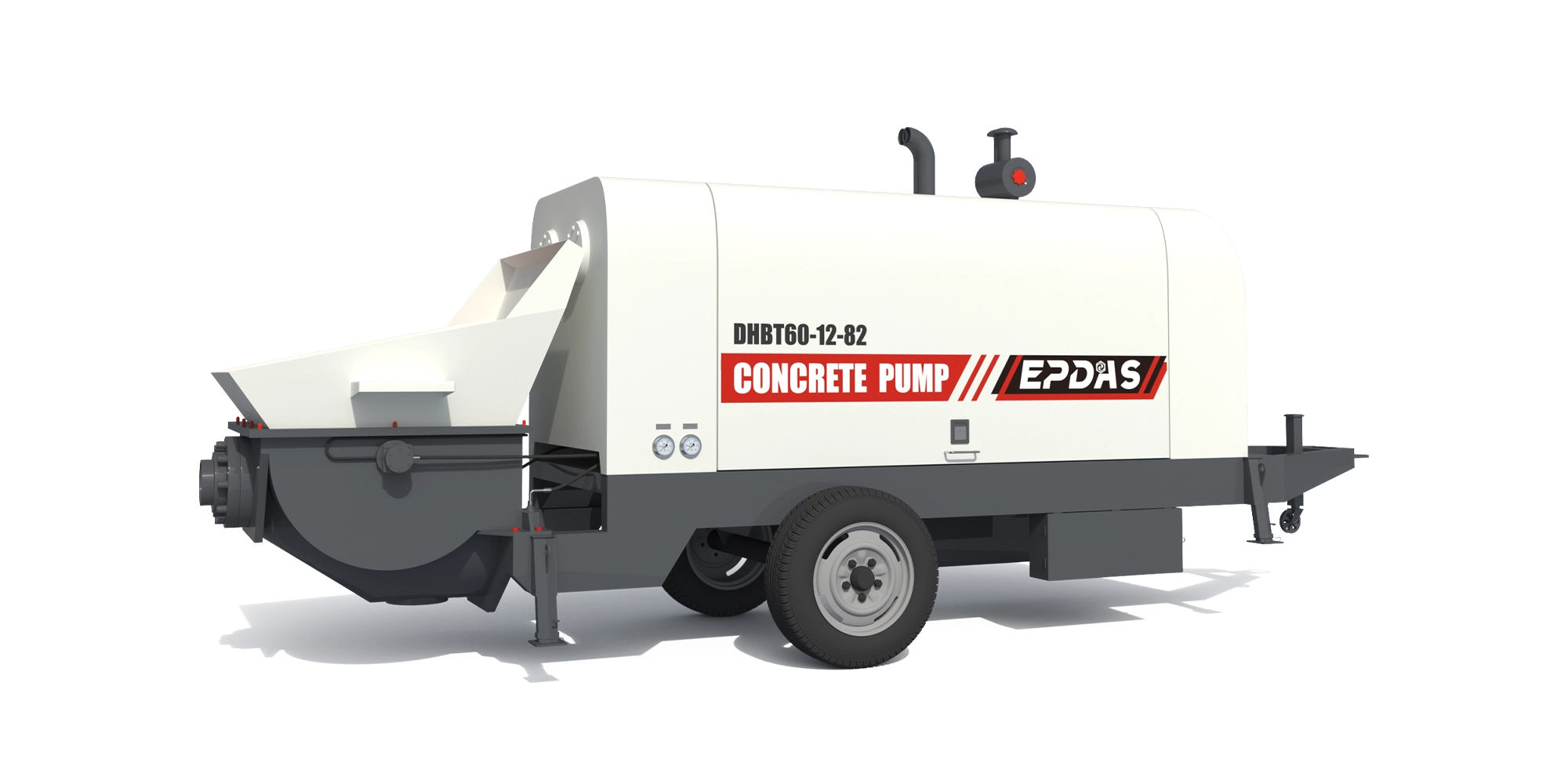
Trailer Concrete Pump
Compact yet powerful, EPDAS trailer concrete pumps are the ultimate stationary solution for delivering ready-mixed concrete to challenging, inaccessible sites. Easily towed by light trucks, these rugged line pumps excel in high-rise floors, tunnels, and rural projects. Built with reinforced chassis and elite hydraulics, they ensure a continuous, high-pressure pour, drastically reducing job-site labor and pipe clogging.
- Concrete Pumping:40~80m³/h
- Pumping Distance:300~700m
What is a Trailer Concrete Pump
Trailer concrete pumps are stationary conveying equipment. Since they cannot move on their own, they must be towed by pickup trucks or light trucks. Its main usage is to convey ready-mixed concrete to areas inaccessible to people or vehicles via pipelines, such as high-rise floors, remote sites, tunnels and narrow places. Once the pipelines are laid in the right place, you don’t need to move them anymore.
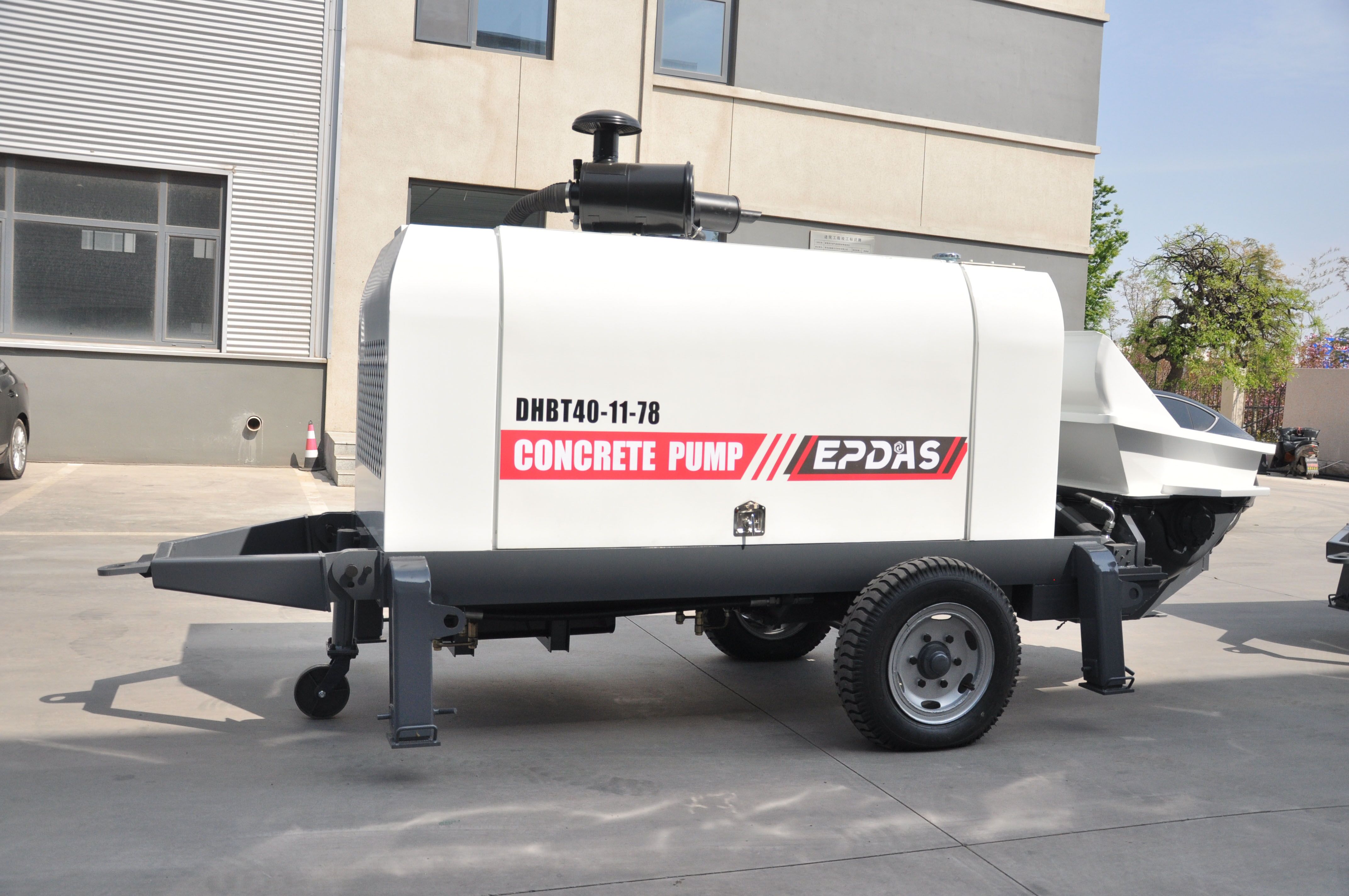
- Electric-motor Trailer Concrete Pump
- Diesel-engine Trailer Concrete Pump
Electric-motor Concrete Pump (EHBT40-11-45/EHBT60-13-90/EHBT80-16-110)
Cheaper and cleaner to run, making them perfect for high-density urban projects with access to a stable power grid.
| Items | Units | HBT40S-10-45 | HBT50S-12-55 | HBT60S-13-90 | HBT80S-13-110 |
| Theoretical max. discharging volume | m³/h | 40 | 50 | 60 | 80 |
| Theoretical max. delivery pressure | Mpa | 10 | 12 | 12.5 | 12.5 |
| Delivery distance Vertical | m | 120 | 150 | 180 | 180 |
| Delivery distance Horizontal | m | 300 | 350 | 700 | 700 |
| Distribution valve type | S valve | S valve | S valve | S valve | |
| Hopper capacity | L | 600 | 600 | 600 | 600 |
| Feeding height | mm | 1400 | 1400 | 1400 | 1400 |
| Inner dia. of delivery pipe | mm | Φ125 | Φ125 | Φ125 | Φ125 |
| Main motor power | Kw | 45 | 55 | 90 | 110 |
| Dimension (length ×width ×height) | mm | 4970×1680×2580 | 5270×2000×1840 | 6170×1800×2100 | 6170×1930×2100 |
| Overall weight | Kg | 3200 | 3500 | 5100 | 5200 |
Diesel-engine Concrete Pump (DHBT40-10-66/DHBT40-10-82/DHBT60-12-82/DHBT80-16-129/DHBT80-16-176)
Fuel-powered and exceptionally rugged, built to handle remote, powerless job sites and heavy-duty pumping across rough mountain terrain.
| Items | Units | DHBT60-13-118 | DHBT60-16-145 | DHBT80-13-145 | DHBT80-16-174 |
| Max. Theoretic delivery volume | m³/h | 60 | 60 | 80 | 80 |
| Max. Theoretic delivery pressure | Mpa | 12.5 | 15.7 | 12.5 | 15.7 |
| Max. Theoretic delivery height | m | 180 | 250 | 180 | 250 |
| Max. Theoretic delivery distance | m | 700 | 1000 | 700 | 1000 |
| Type of distribution valve | S valve | S valve | S valve | S valve | |
| Hopper capacity | L | 600 | 600 | 600 | 600 |
| Inner diameter of delivery pipe | mm | Φ125 | Φ125 | Φ125 | Ф125 |
| Diesel engine power | Kw | 118 | 145 | 145 | 174 |
| Max. Oil pressure of main system | MPa | 32 | 32 | 32 | 32 |
| Max. Oil pressure of mixing system | MPa | 14 | 14 | 14 | 14 |
| Dimension (length ×width ×height) | mm | 6600×1930×2190 | 6600×1930×2190 | 6600×1930×2190 | 6600×1930×2190 |
| Overall weight | Kg | 5500 | 6000 | 6000 | 6500 |
Applications of Trailer Concrete Pump
The advantages of trailer concrete pumps lie in their adaptability to all kinds of scenarios, from rural self-building houses to high-rise building projects. They are widely used and highly practical both domestically and overseas, almost covering most construction requirements.

- Residential Pours & Mid-Rise Housing
Trailer concrete pumps are always used in multi-storey residential buildings and small high-rise residences. The building height is typically 12 to 15 stories, and its vertical height is 36-40 meters. In this situation, a common model 40/60 can handle it and you don’t need to worry about being restricted by the site size whenever you do foundation pouring, beam and column pouring or floor leveling.
- Tunnels, subways and underground engineering
When the project involves tunnels, the distance of conveying concrete is not a big problem, on the contrary, the key challenge is that there are too many turns. Especially when working in an underground pipe gallery, if the angle design of the bent pipe is not reasonable, it might cause partial material clogging. In order to avoid this situation, a trailer concrete pump is a better choice for long-distance pouring due to its compact size and continuous pipe laying.
- Bridges, roads and water conservancy projects
There are so many projects that need trailer concrete pumps, including bridge piers, bent caps,
road slopes, water channels and dam construction. All of these have high demands for pressure and stability due to their long distance and large elevation difference. Therefore, trailer concrete pumps can satisfy these needs completely. - Construction in rural and remote sites
When working in mountainous areas, mining areas or remote villages, people always face challenges with transportation and electric power. In some harsh construction sites, they don’t even have three-phase power and have to rely on diesel fuel.
On the other hand, many mountain roads and dirt road conditions are poor. If the equipment’s chassis ground clearance is insufficient, it may deform and that’s why many of our models feature a strengthened frame and suspension structure. - Special Concrete Construction
Except for standard concrete, a trailer concrete pump can also transport:
Fine aggregate concrete (flooring heating backfill, lightweight leveling)
Lightweight concrete
Mortar and grout for secondary structure
As long as the size of the aggregate is not over the equipment’s allowable range (maximum 40mm), it all can all be pumped stably.
How to choose a suitable Trailer Concrete Pump
When purchasing this machinery, we can’t only focus on price or other people’s choice. The key lies in our actual project situations. In practice, besides product parameters, we should take into account our construction environment, project needs, power matching, later maintenance costs and so on.
Rigid matching
- Ensure aggregate particle size. Small and simple trailer concrete pumps can only pump fine aggregate below 20mm. But for heavy infrastructure or harsh mixes, an S-valve concrete pump for 40mm aggregate would be a better choice.
- Evaluate your actual pouring height, horizontal laying length and construction site road conditions. The most suitable trailer concrete pump should be selected according to the actual vertical and horizontal distance to minimize pipeline resistance, prevent flash setting and ensure a smooth pour.
- An electric motor concrete pump is a preferred choice in urban areas with stable power supply systems. Electric trailer concrete pumps are more cost-effective and more environmentally friendly. In some situations without stable power supply system, such as mountainous areas, open fields, and so on, diesel engine concrete pump can avoid pumping failures.
Traction and transportation
- A torsion bar suspension and reinforced load-bearing frameare essential configurations. Given poor road conditions, if the chassis is too thin and lacks sufficient rigidity, crushed stones will easily cause major problems. Long-term uneven stress will loosen hydraulic joints and lead to oil leakage, and can even result in the wear of precision valve spools.
- A qualified concrete pump shall be fitted with a road-suitable chassis and height-adjustable traction hook to match various types of towing vehicles.
- Please don’t overlook taillights, mudguards and reflective markings. Though they seem to be insignificant accessories, they are actually essential for legal road use and cross-border transportation to avoid hefty fines.
Core hydraulic and pumping system
- Ask manufactures whether they use well-know brands such as Rexroth or Kawasaki. The hydraulic system serves as the power core of the whole machine. Low-cost units cannot withstand long-term operation, as the oil temperature rises rapidly. Once the hydraulic system cannot maintain stable working conditions, it may cause a shutdown or weak pumping power. By contrast a qualified and mature hydraulic system can maintain stable performance even in harsh working conditions.
- S-valvesand wear-resistant parts are the most vulnerable parts of the whole equipment. So, it is necessary to check whether the cutting ring and spectacle plate adopt high-hardness alloy materials.
- Heat dissipation performance directly decides whether your machine can work continuously, so you should pay more attention to effective heat dissipation area and the cooling mode of the radiator. Insufficient heat dissipation design will cause hydraulic oil to dilute rapidly at high temperatures and result in system pressure drop. Once the oil temperature exceeds the warning limit, the machine will shut down to protect itself, which will delay the entire project schedule.
After-sales response and spare parts
Make sure manufacturers include common seals and filter elements with the machine, so you won’t have to wait an entire week for international logistics just for low-cost sealing rings. Meanwhile, watch out for suppliers who provide you with non-standard joints and screws, which lock you into their brand and raise your long-term maintenance costs.
Material adaptability and material saving
- In different construction sites, aggregate quality is variable. If the equipment cannot adapt to such changes, it may lead to construction problems such as poor feeding or pipeline blockage.
- A reasonably designed hopper structure can greatly reduce residual materials after each construction operation and avoid wasting mixed concrete during washing.
Environmental adaptability
- Many construction sites in Southeast Asia and Africa suffer from extremely unstable voltage.If the motor is not equipped with a wide voltage range protection or under-voltage protection, it is easy to burn out the PCB or motor.
- There are plenty of dust particles on construction sites. If dust sneaks into an unsealed control cabinet, it can easily lead to short circuits or contactor faults in rainy and humid weather.
- Fuel sulfur content adaptability(Diesel exclusive): If the engine needs high-grade diesel which is unavailable locally, the fuel injectors are prone to clogging. To prevent this situation, you need to ask whether the manufacturer equips with a reinforced primary fuel filter.
Price and Customization of Trailer Concrete Pump
When first getting quotations, many customers find that the prices vary greatly. Some are much lower while others can be several times higher. In fact, apart from displacement, the major differences stem from the engine, hydraulic system, export configuration and subsequent maintenance costs.

- Engine brands & global service network
Choosing an engine cannot be based solely on ‘initial power’, instead, you should pay closer attention to its long-time running stability. Although Cummins and Yuchai are undeniably more expensive than other brands, both of them have mature after-sales networks and easily accessible spare parts overseas, which effectively minimizes downtime losses caused by a shortage of spare parts.
- Core hydraulic system
We must recognize the crucial role of the hydraulic system, as it is the primary factor driving the price difference. Poor hydraulic systems are prone to hydraulic pressure fluctuation or insufficient pressure when the pumping stops.
- Working condition customization and non-standard modification
There are two detailed examples to show you why it affects the price.
If your trailer concrete pump needs to pump aggregate larger than 40mm, you need to strengthen the S-valves and hopper simultaneously. This requires changing not only the original components, but other related systems.
In high-temperature environments like the Middle East or high-altitude construction sites in South America, the engine and heat dissipation system need to be adjusted in advance to better adapt to local environment and temperature. - Transportation modes and logistics support
Do not underestimate transportation costs. Some models allow parts to be disassembled for loading into high-cube (HQ) containers to save on freight. However, if the trailer concrete pump is too big, you have to transport it via a flat rack container, which will obviously raise freight costs.
In addition, anti-rust and salt-spray proof packaging for sea shipment is very important. Especially in coastal high-humidity areas, the machine is prone to rust corrosion without professional packaging.
Buy or Rent a Trailer Concrete Pump
Many small and medium-sized construction teams are easily tempted to buy a machine just by following the trend, without considering their true needs. Finally, the equipment won’t be used very often, which leads to higher costs. So, how do you choose between buying or renting such equipment? You don’t need to calculate everything with a complex formula, just rely on your usage frequency.
- 01
Short-term rental
If your projected usage is under 500 hours, renting usually makes more sense. On the one hand, we need to focus on the cash flow pressure of buying a whole machine. Even if the rental rate seems high, it is still much less than the full purchase price.
On the other hand, most customers only consider whether they can make money by owning a trailer concrete pump but ignore other ‘invisible costs’, when they first get in touch with this machine. We have also seen cases where some buyers purchased a trailer concrete pump, but only used it for 2-3 months in a year.
The rest of the time, this equipment just sits in an open yard gathering rust. When they want to use it again, the hydraulic oil has emulsified and the circuit connectors have become damp. As a result, before construction even starts, they have to pay a maintenance bill. - 02
Self-owned machinery
Owning a trailer concrete pump is worthwhile if you use it very frequently and have continuous projects. For example, many construction teams face intense pressure to accelerate schedules during the dry season in Indonesia and Philippines.
Some construction teams prefer to rent a trailer concrete pump in good condition, even though they might have to delay their construction schedule by more than ten days to wait for available equipment.
But if they have their own trailer concrete pump, they don’t need to worry about such situations. - 03
The bottom line
If you have stable project contacts for more than one year and a high demand for a fast construction pace, we suggest you to buy your own trailer concrete pump.
By contrast, if your projects are unstable now, or the construction on-site is scattered, or you are still in the trial operation stage. We advise that renting would be a better choice, which will also reduce early-stage operational risks.
Advantages and Disadvantages of Trailer Concrete Pump
- 01 Advantage
Due to their compact structure, trailer concrete pumps can move freely on narrow construction sites and country roads.
- 02 Advantage
They have adaptive pumping modes that allow operators to adjust the feeding pace according to material consistency, which effectively reduces the pipe clogging rate.
- 03 Advantage
Post-purchase maintenance is cost-effective and straightforward. Even regular workers can complete routine inspection and maintenance. Spare parts are easy to purchase, so there is no need to rely on customized accessories.
- 01 Disadvantage
Standard models of the equipment can handle aggregate with a maximum size of up to 40mm. If your aggregate size exceeds the common standard, customization is the only way to meet your demand.
- 02 Disadvantage
Because they lack boom assistance for pouring, trailer concrete pumps need to have delivery pipelines laid manually. This increases labor costs, especially for high-rise work.
- 03 Disadvantage
The weight of the unit mostly exceeds 4 tons and since it lacks self-propulsion, its mobility and operating efficiency can be limited when operating.
EPDAS Trailer Concrete Pump Projects
Equipment Details Display of Trailer Concrete Pump
The trailer concrete pump excels in providing steady concrete supply across diverse job sites. Its high-pressure pumping system enables long-distance and elevated delivery, while its robust design ensures continuous operation and consistent flow. This equipment keeps work moving efficiently, reducing manual handling and optimizing on-site productivity.
Trailer Concrete Pump FAQs
- What are the main types of concrete pumps available for sale?
The main types of concrete pumps include trailer concrete pumps, stationary concrete pumps, and truck-mounted concrete pump trucks. Trailer concrete pumps are cost-effective and flexible, while pump trucks are ideal for large-scale, high-rise construction. Stationary concrete pumps are commonly used for fixed or long-term projects.
- How do I choose the right concrete pump for my project?
Choosing the right concrete pump depends on project size, required pumping distance, concrete output, and site conditions. Small to medium projects often use trailer concrete pumps, while large infrastructure projects may require high-capacity concrete pump trucks. EPDAS can help match the right model to your needs.
- What is the maximum pumping distance of a concrete pump?
The pumping distance depends on the concrete pump model, hydraulic pressure, and pipeline configuration. Trailer concrete pumps can reach horizontal distances of 300–500 meters, while concrete pump trucks may achieve vertical heights of over 150 meters. Proper pipeline diameter and concrete mix design are critical for long-distance pumping performance.
- What concrete pump capacity do I need?
Concrete pump capacity is measured in cubic meters per hour (m³/h). Small projects may need 30–60 m³/h, while large commercial or infrastructure projects often require 80–120 m³/h or more. Selecting the correct capacity improves efficiency and reduces operating costs.
- What wear parts require regular replacement in concrete pumps?
Common wear parts in concrete pumps include delivery cylinders, cutting rings, wear plates, S-valves, and rubber hoses. Regular inspection and timely replacement of these components help maintain stable concrete pumping performance and extend the equipment's service life.
- What hydraulic systems are used in modern concrete pumps?
Modern concrete pumps typically use closed-loop or open-loop hydraulic systems with high-pressure piston pumps. These systems provide stable pumping pressure, precise flow control, and improved energy efficiency. High-quality hydraulic components significantly reduce wear and enhance the durability of concrete pumping machines in demanding job sites.
- How high can a concrete boom pump truck reach for building construction?
The vertical pumping height depends entirely on the equipment model and boom length: Small models (30-38m): These trucks have a vertical reach within 36 meters. They are perfect for rural self-built houses and low-rise infrastructure projects. Medium models (39-48m): These trucks can cover heights up to around 46 meters. They are the standard choice for regular urban commercial and residential buildings. Large models (50-62m and above): These heavy-duty trucks can exceed a vertical height of 60 meters. They are specifically engineered for high-rise buildings and massive bridge pier concrete pouring.
- Are your hydraulic and pipeline fittings easy to purchase overseas like in South America or Southeast Asia?
Yes. All hydraulic pipe fittings, seal rings, pipeline clamps, and basic valves on our equipment are strictly built to international DIN and ISO standards.
- Is the equipment prone to pipeline clogging when handling large aggregate sizes or high-grade (C50/C60) concrete?
We increase the tungsten carbide wear-resistant layer of the core S-valve and wear plate by 2 to 3 mm. At the same time, our engineering team optimizes the anti-clogging switching logic within the full hydraulic control system. This fully utilizes the high pressure of the constant-pressure, large-displacement variable pump to smoothly and forcefully push thick, heavy concrete mixes through without blockages.
- What is the difference between a spider boom and a regular boom?
The main difference lies in the chassis and outrigger design: Regular boom: These usually feature wheeled chassis, making them bulkier with higher ground pressure. They are designed strictly for operating on flat, hard ground. Spider boom: These utilize a compact crawler track chassis and four flexible outriggers. This setup provides a smaller footprint and extremely low ground pressure, allowing them to work flexibly in tight spaces, on steep slopes, and on delicate indoor or outdoor surfaces.
- Do you offer OEM services?
Yes. We provide full-scale OEM and industrial customization services. Whether it is custom paint schemes, brand logos, or specific component interfaces, our engineering team can deeply customize the equipment to perfectly fit your local market and special operational requirements.
- How should daily maintenance be performed on the equipment?
The core of daily maintenance involves regularly checking hydraulic oil levels, cleaning air filters, verifying track tension, and lubricating key moving parts. To make this easy for your team, every machine comes with a detailed preventive maintenance manual.
- How can I judge the quality of a trailer concrete pump?
You can ignore surface cosmetics like premium paint finishes or fancy housing designs. Instead, focus entirely on the core mechanical and hydraulic components. High-quality trailer pumps are strictly built with industry-recognized, global-brand components.
- What basic cleaning is required for a trailer pump after each construction session?
You must thoroughly flush the hopper and delivery pipelines with water immediately after every pour. If concrete residue is allowed to dry and harden inside, it will severely accelerate the wear on the pistons and wear plates.
- Which systems of a trailer pump require regular inspection and maintenance? Are there any special requirements for summer?
A: Regular maintenance should focus on three core areas, with extra attention paid during high-temperature seasons: Centralized lubrication system: Check this system regularly to ensure continuous and proper oil supply to all mechanical friction points and bearings. Hydraulic system: Change the hydraulic oil strictly based on the equipment operating hours to maintain system pressure and protect internal valves. Special summer maintenance: During hot summer months, you must frequently clean dust and debris off the radiator surface to ensure maximum heat dissipation. This simple step prevents high-temperature system shutdowns and stops the hydraulic oil from thinning out under extreme heat.
Related Products
Customize Your Solutions
Contact us now via Email:info@epdas.com, or Whatsapp:+86 188 38115507 , or fill in the form below.
FEW TIPS:
- Please describe the output capacity per hour (e.g., 30m³/h-80m³/h).
- Please confirm the power type (e.g., diesel type / electric type).
- Please provide the maximum concrete delivery distance (e.g., horizontal 100m / vertical 50m).
- Please tell the applicable project and site conditions (e.g., rural building / urban construction site).
- If you are interested in becoming our distributor, please let us know.
Service Process:
- Business negotiation
- Solution development
- Manufacturing and commissioning
- Operational production