
Driven Type: Diesel/Electric
Concrete Mixing: 22.5m³/h
Concrete Pumping: 30~50m³/h
A concrete pump is a professional construction equipment for efficient concrete transfer. It optimizes on-site material handling, slashes manual labor needs and material loss, and ensures precise, consistent pouring in all kinds of construction environments.
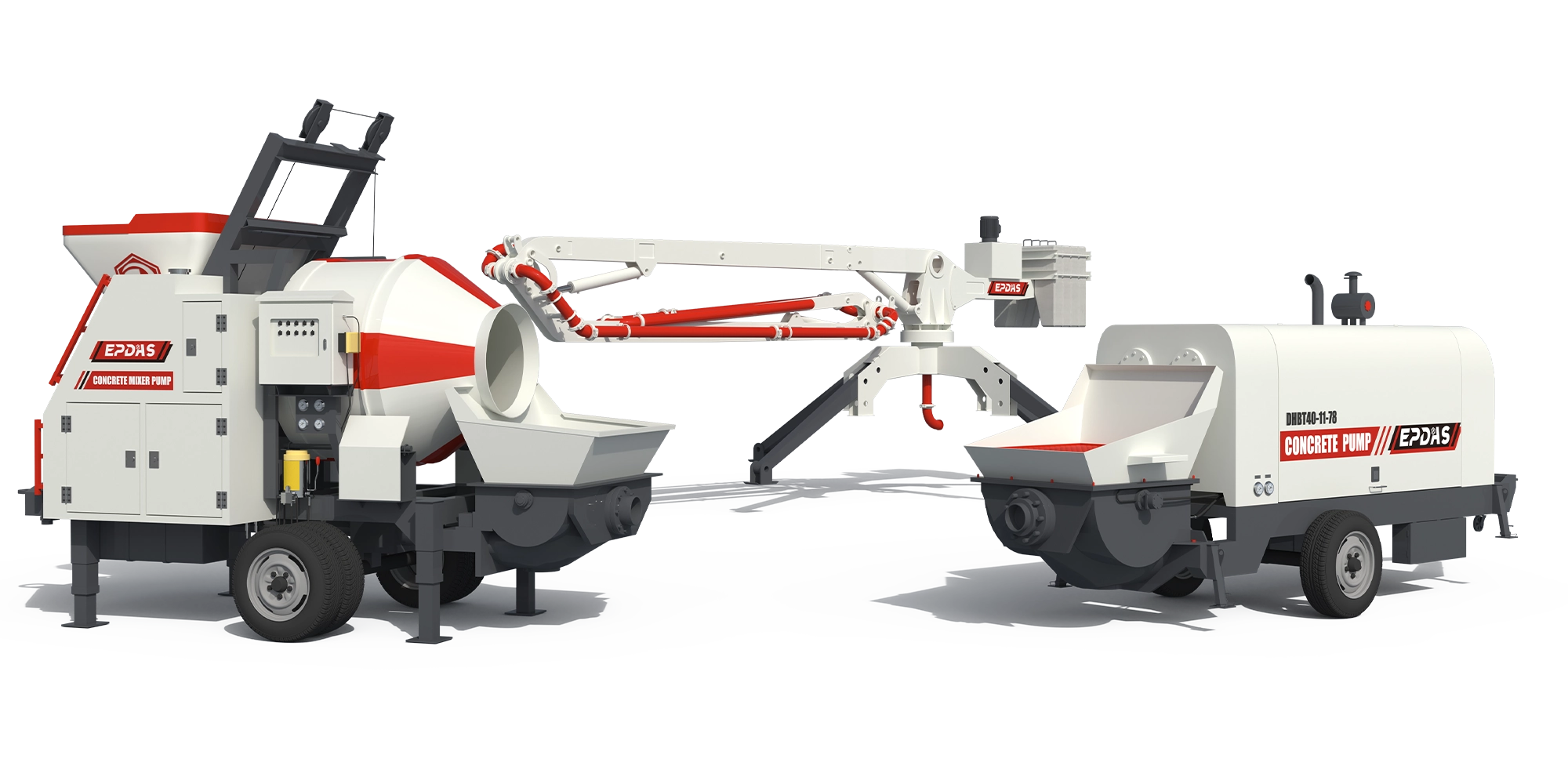
A concrete Pump is a construction machine that conveys ready-mixed concrete from a concrete mixer truck or batching plant to designated pouring position via its built-in hydraulic power and pipeline conveying system. Its core function is to achieve continuous and stable delivery, overcoming spatial constraints related to the construction site, height and delivery distance.
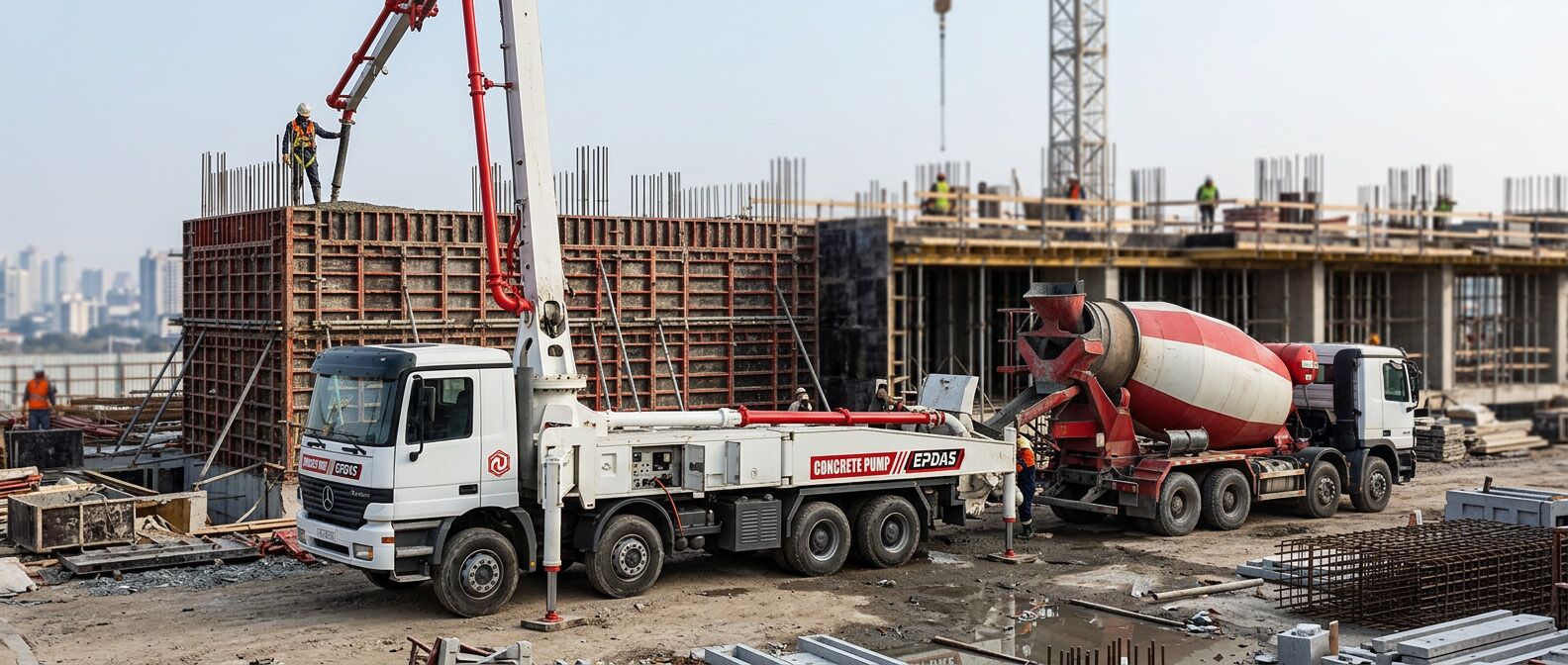
Before using a concrete pump, the first thing is to learn about its core component. Pumping capacity and operational stability depend on the coordinated operation of all systems, and the pump consists of three key core components: the hopper, the piston pumping system and the pipeline & hose system — these form the fundamental basis for concrete conveyance.

When pouring ready-mixed concrete into hopper, the internal agitator operates continuously to avoid concrete setting and segregation before pumping. Anti-clog design reduces aggregate accumulation to ensure smooth follow-up operations.
It generates pumping pressure by means of reciprocating motion of hydraulic piston, which pushes flow through the pipeline. A high-quality piston pumping system can enhance the equipment’s pumping pressure and reduce piston wear. Even with concrete mixtures of low slump and large aggregates, it can still achieve stable conveying performance.
The structure and material of the pipeline, along with the flexibility of the hose, directly determine the concrete’s delivery distance, height and flow rate. The pipeline structure is matched to the size of concrete aggregates to prevent clogging. Hose is mainly used for final-stage transportation due to its flexibility to adapt to various pouring operation requirements. All pipeline types all engineered with excellent sealing performance to prevent concrete leakage.
Driven Type: Diesel/Electric
Concrete Mixing: 22.5m³/h
Concrete Pumping: 30~50m³/h
Driven Type: Diesel/Electric
Concrete Pumping: 40~80m³/h
Pumping Distance: 300~700m
Boom Placing Height: 28~47m
Concrete Pumping: 70~140m³/h
Chassis Truck: HOWO/JAW/DONGFENG/ISUZU...
Boom Placing Radius: 14~21m, 360°
Boom Rotation Speed: 0.3~0.8r/min
Control Type: Panel/ Wireless-remote
The work principle of concrete pump is straightforward. Its core operation relies on hydraulic power and valve control system to realize continuous material suction and pressure delivery. This enables stable pouring over long distances and to great heights, even with no manual intervention throughout the entire process.
Concrete mixer truck discharges fresh and workable concrete into hopper, where the agitating device operates continuously at a low rotational speed to avoid solidification that causes subsequent pipeline clogging.
When concrete enter in pumping cylinder through feed inlet, hydraulic piston performs a reciprocating motion. As the piston retracts, a negative pressure is created inside the pumping cylinder, drawing concrete from hopper into the cylinder; as the piston advances, the valve system shifts to force the concrete from the pumping cylinder into the conveying pipeline.
Driven by hydraulic pressure, concrete is pushed into pipeline, flows along with pipeline or boom and ultimately reaches designated pouring position via end hose finally. Actual operation varies slightly across different models. For detailed operating instructions of a specific model, please click to view.
Concrete pumps are classified as heavy construction machinery. Their daily maintenance is related to equipment’s service life and pumping efficiency. Maintenance operations are simple and effective as long as establish a fixed maintenance procedure, ensuring the equipment remains in optimal working condition at all times.
After each work shift or 8 consecutive hours of operation, equipment must undergo a set of basic inspection and maintenance.
Firstly, lubricate the rear of the pump body to make sure the flexibility of each rotating parts. Next, check liquid levels of various fluids, including hydraulic oil, diesel, power steering oil, coolant and top them up in a timely manner if fluid levels are low.
The hydraulic oil level must be maintained above 3/4 of the oil gauge; if the level is too low, the hydraulic pump will draw in air, leading to pressure loss and equipment wear. When replenishing hydraulic oil, it is imperative to use clean oil of the same brand and model as the original to avoid chemical reactions caused by mixing different types of oil, which would impair oil performance.
Hydraulic oil must be filtered regularly. It is recommended to use a filtration device with a 20μm filtration precision to remove impurities from the oil and prevent abrasive damage to hydraulic components. The quality of the oil should also be inspected on a regular basis: 30 minutes after shutdown, take 0.5 liters of hydraulic oil with a clean graduated cup. Normal hydraulic oil should be a clear pale yellow. If the oil emulsifies, becomes turbid or blackens, or if sediment accumulates at the bottom after standing for several hours, it indicates oil contamination, and the entire volume must be replaced immediately.
Common wearing parts of a concrete pump include pistons, S-valves, conveying pipelines and rubber hoses. Pistons are in direct contact with concrete and are prone to wear due to long-term reciprocating motion; a decline in piston sealing performance will cause pumping pressure loss. S-valves are responsible for switching between suction and pressure delivery channels; wear on an S-valve can lead to material leakage and unstable pressure. If the wall of a conveying pipeline or rubber hose thins or cracks, immediate replacement is required to prevent pipeline rupture during pumping.
Concrete pumps are used in all construction projects requiring concrete pouring, from residential buildings to commercial structures, and from municipal engineering to large-scale infrastructure. Different types of concrete pumps are precisely matched to the requirements of various projects.

Pouring work for core tubes, shear walls, elevator shafts and floor slabs in high-rise buildings places high demands on the vertical concrete conveying capacity of the equipment. For this application, truck-mounted boom pump is the optimal choice, because its hydraulic boom extends up to 56 meters, enabling direct concrete delivery to heights of tens of meters without the need for additional vertical pipeline installation. It not only saves the time and cost of pipeline laying, but also enables precise positioning for high-altitude pouring.
For large-scale infrastructure projects such as bridges, dams, tunnels and airport runways, concrete pouring is characterized by long delivery distances, large construction volumes and scattered pouring points. Boom pumps and high-pressure stationary concrete pumps can be combined for such scenarios as required. High-pressure concrete pumps enable the stable delivery of concrete with large aggregates and low slump, meeting the project requirements for concrete strength and continuous pouring.
Pouring for foundations, walls and floor slabs in multi-storey residential and rural self-built houses with small volumes, narrow sites and scattered pouring points, suits stationary concrete pumps or mixing-pumping integrated machines. Integrated machines enable one-stop batching and pumping for projects without mixing plants, while stationary pumps adjust pipelines to finish multi-point pouring in space-limited urban residential construction.
For large-area floor slab and atrium pouring in malls, complex buildings and other commercial structures requiring high pumping efficiency, high-displacement boom pumps are optimal for fast, continuous pouring and shorter construction periods. For factories, warehouses and other industrial facilities with limited space and poor large-equipment access, stationary concrete pumps deliver concrete indoors via pipelines for equipment foundations, ground and wall pouring.
High-pressure concrete pumps are ideal for special construction scenarios such as shotcrete support, slope reinforcement and water tank pouring. High-pressure pumps can deliver concrete mixtures to the construction surface via high-pressure spraying. They are also adaptable to the pouring of enclosed spaces such as water tanks and septic tanks, ensuring the compactness of the poured concrete.
A middle-size concrete pump can convey concrete 60-80h/m³,which is far faster than manual efficiency. Pouring work for large areas and large construction volumes, it can reduces construction period, especially in tight-schedule project.
A single concrete pump can replace the manual concrete transportation work of dozens of workers, significantly reducing labor costs. Meanwhile, the enclosed conveying method minimizes concrete segregation and waste, lowering the material loss rate. Additionally, boom pumps can replace the coordinated operation of equipment such as cranes, cutting the costs of equipment rental and usage.
Concretes are delivered in enclosed pipelines to avoid decreasing concrete’s quality in transportation. Continuous pumping and pouring can avoid construction joints by pouring interruptions to enhance integrity and compactness of concrete’s structure.Precise pouring positioning ensures concrete is delivered accurately into formworks, reducing construction defects such as grout leakage, honeycombing and pitting.
It enables concrete pouring in various challenging and space-restricted conditions – whether for 1000-meter horizontal delivery, 150-meter vertical delivery, or in narrow and high-altitude construction sites. Concrete pumps can achieve precise concrete delivery by laying pipelines or adjusting the boom.
Operations can be completed by professionally trained operators, and the equipment features high stability and reliability. Proper daily maintenance ensures continuous operation during construction and reduces unplanned downtime due to malfunctions. For construction teams, the equipment’s ease of operation and high reliability lower the difficulty of construction management and improve the overall smoothness of construction work.
Concrete pump realizes mechanized and pipeline-based concrete conveying, which completely replaces the traditional manual carrying and hoisting of concrete with simple tools. This effectively eliminates potential safety hazards such as falling, collision and heavy object injury caused by manual transportation at high altitudes, narrow sites or large construction areas.
Capacity:50m³/h mixing capacity, with a single batch of 0.5m³ concrete mixable in 5 minutes
Problem:scattered construction sites, insufficient manpower and no fixed power supply
Advantage:table operation in high-temperature, high-dust and complex terrain conditions
Capacity:enables stable long-distance pumping of hundreds of meters
Problem:adapted to high altitudes, rugged terrain and underdeveloped local infrastructure facilities
Service:provides spare parts supply, technical guidance and remote fault diagnosis
The main types of concrete pumps include trailer concrete pumps, stationary concrete pumps, and truck-mounted concrete pump trucks. Trailer concrete pumps are cost-effective and flexible, while pump trucks are ideal for large-scale, high-rise construction. Stationary concrete pumps are commonly used for fixed or long-term projects.
Choosing the right concrete pump depends on project size, required pumping distance, concrete output, and site conditions. Small to medium projects often use trailer concrete pumps, while large infrastructure projects may require high-capacity concrete pump trucks. EPDAS can help match the right model to your needs.
The pumping distance depends on the concrete pump model, hydraulic pressure, and pipeline configuration. Trailer concrete pumps can reach horizontal distances of 300–500 meters, while concrete pump trucks may achieve vertical heights of over 150 meters. Proper pipeline diameter and concrete mix design are critical for long-distance pumping performance.
Concrete pump capacity is measured in cubic meters per hour (m³/h). Small projects may need 30–60 m³/h, while large commercial or infrastructure projects often require 80–120 m³/h or more. Selecting the correct capacity improves efficiency and reduces operating costs.
Common wear parts in concrete pumps include delivery cylinders, cutting rings, wear plates, S-valves, and rubber hoses. Regular inspection and timely replacement of these components help maintain stable concrete pumping performance and extend the equipment's service life.
Modern concrete pumps typically use closed-loop or open-loop hydraulic systems with high-pressure piston pumps. These systems provide stable pumping pressure, precise flow control, and improved energy efficiency. High-quality hydraulic components significantly reduce wear and enhance the durability of concrete pumping machines in demanding job sites.
The vertical pumping height depends entirely on the equipment model and boom length: Small models (30-38m): These trucks have a vertical reach within 36 meters. They are perfect for rural self-built houses and low-rise infrastructure projects. Medium models (39-48m): These trucks can cover heights up to around 46 meters. They are the standard choice for regular urban commercial and residential buildings. Large models (50-62m and above): These heavy-duty trucks can exceed a vertical height of 60 meters. They are specifically engineered for high-rise buildings and massive bridge pier concrete pouring.
Yes. All hydraulic pipe fittings, seal rings, pipeline clamps, and basic valves on our equipment are strictly built to international DIN and ISO standards.
We increase the tungsten carbide wear-resistant layer of the core S-valve and wear plate by 2 to 3 mm. At the same time, our engineering team optimizes the anti-clogging switching logic within the full hydraulic control system. This fully utilizes the high pressure of the constant-pressure, large-displacement variable pump to smoothly and forcefully push thick, heavy concrete mixes through without blockages.
The main difference lies in the chassis and outrigger design: Regular boom: These usually feature wheeled chassis, making them bulkier with higher ground pressure. They are designed strictly for operating on flat, hard ground. Spider boom: These utilize a compact crawler track chassis and four flexible outriggers. This setup provides a smaller footprint and extremely low ground pressure, allowing them to work flexibly in tight spaces, on steep slopes, and on delicate indoor or outdoor surfaces.
Yes. We provide full-scale OEM and industrial customization services. Whether it is custom paint schemes, brand logos, or specific component interfaces, our engineering team can deeply customize the equipment to perfectly fit your local market and special operational requirements.
The core of daily maintenance involves regularly checking hydraulic oil levels, cleaning air filters, verifying track tension, and lubricating key moving parts. To make this easy for your team, every machine comes with a detailed preventive maintenance manual.
You can ignore surface cosmetics like premium paint finishes or fancy housing designs. Instead, focus entirely on the core mechanical and hydraulic components. High-quality trailer pumps are strictly built with industry-recognized, global-brand components.
You must thoroughly flush the hopper and delivery pipelines with water immediately after every pour. If concrete residue is allowed to dry and harden inside, it will severely accelerate the wear on the pistons and wear plates.
A: Regular maintenance should focus on three core areas, with extra attention paid during high-temperature seasons: Centralized lubrication system: Check this system regularly to ensure continuous and proper oil supply to all mechanical friction points and bearings. Hydraulic system: Change the hydraulic oil strictly based on the equipment operating hours to maintain system pressure and protect internal valves. Special summer maintenance: During hot summer months, you must frequently clean dust and debris off the radiator surface to ensure maximum heat dissipation. This simple step prevents high-temperature system shutdowns and stops the hydraulic oil from thinning out under extreme heat.
Service Process: