
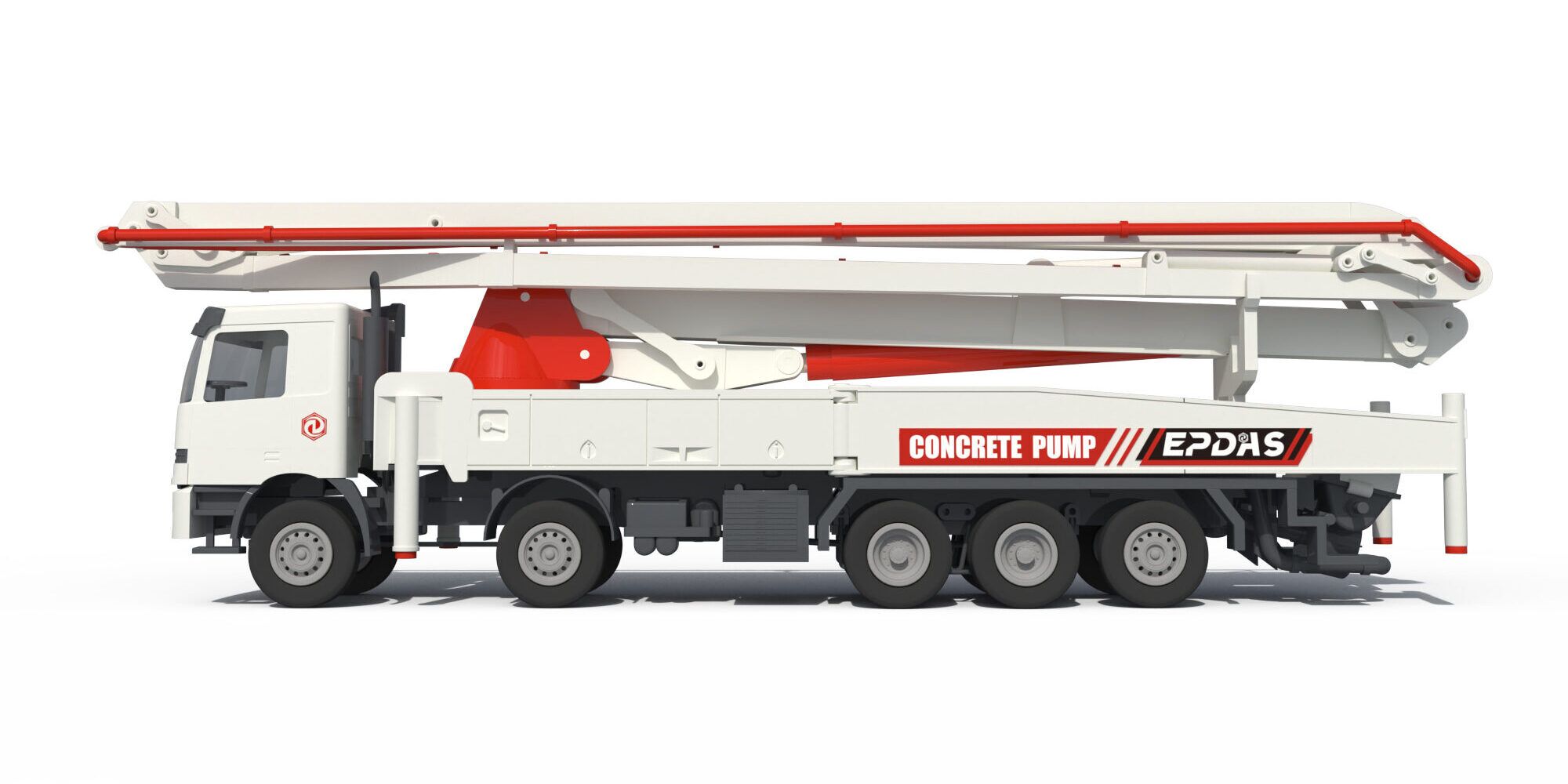
Concrete Boom Pump
A concrete boom pump is a vehicle-mounted machine that efficiently delivers concrete to hard-to-reach locations. Equipped with a hydraulic pumping system and a flexible, remote-controlled boom, it ensures precise placement, reduces labor, and accelerates construction. Ideal for high-rise buildings, large slabs, and complex construction projects, it combines reliability, speed, and operational safety.
- Concrete Pumping:70~140m³/h
- Boom Placing Height:28~47m
What is a Concrete Boom Pump
Concrete boom pumps are vehicle-mounted construction machinery units that integrate a pumping system and a folding boom. Today, they are widely used in modern concrete pumping operations. They enable automated concrete delivery and precise concrete placement, powered by a hydraulic system and controlled by a remote-operated boom.
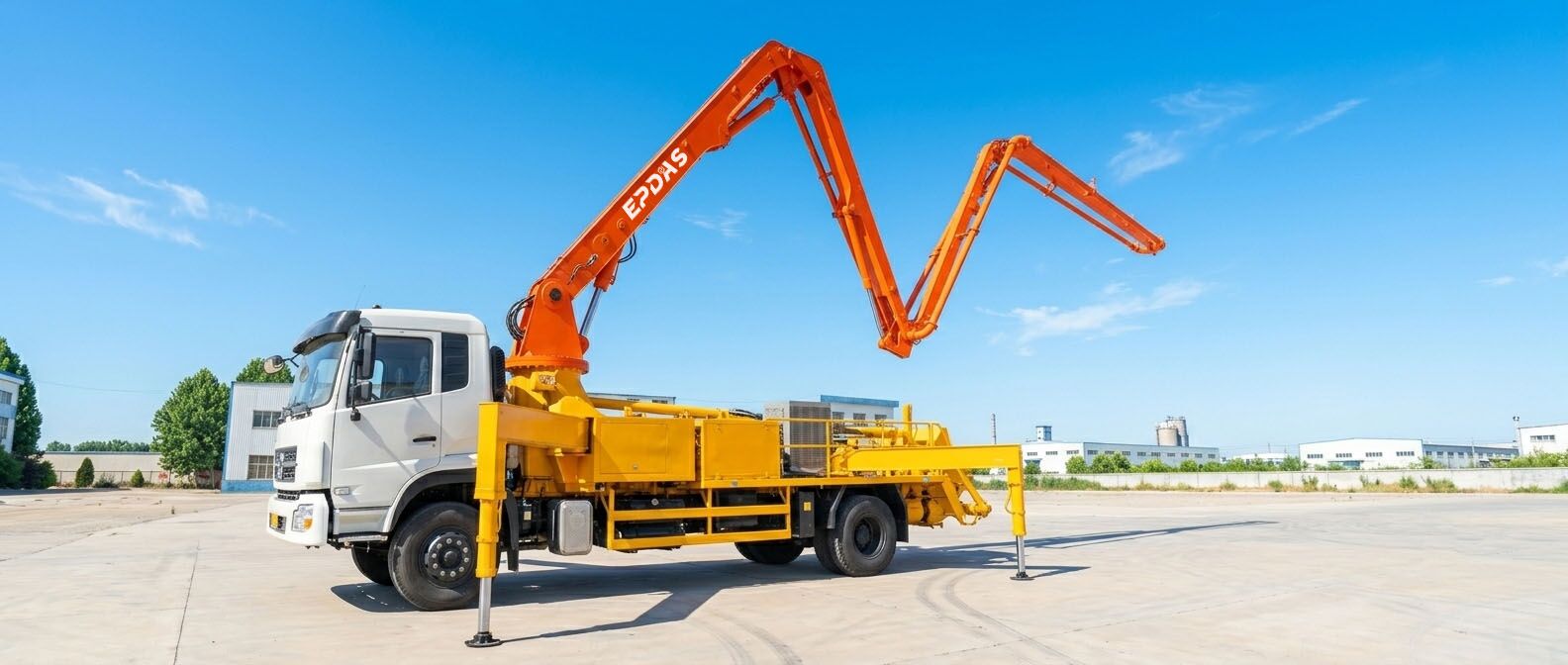
Compared with conventional methods, concrete boom pumps can transport concrete directly to the discharge points. This reduces on-site handling work, such as setting up ground delivery pipelines and manual material handling on site.
- Concrete Boom Pump
More efficient and flexible to operate, making them ideal for high-rise and urban construction projects that require fast, continuous, and precise concrete placement.
| Model | HBC28 | HBC33 | HBC37 | HBC47 | ||
| Item | Unit | Parameters | Parameters | Parameters | Parameters | |
| Pumping system
| Max. theory output | m3/h | 68-90 | 60-92 | 80-120 | 140 |
| Theoretic pumping pressure | MPa | 7-8 | 7-8 | 8-14 | 8.5 | |
| Theoretical Pumping Times | 26, 24 times/min | 26, 24 times/min | 28,18 times/min | 25 times/min | ||
| Concrete Cylinder Diameter * Stroke | mm | φ230*1600 | φ230*1600 | φ230*1650 | φ260*1800 | |
| Distribution valve | S valve | S valve | S valve | S valve | ||
| Placing boom
| Placing height | m | 27.3 | 32.2 | 36.5 | 46.3 |
| Horizontal distance | m | 23.95 | 28 | 30.9 | 41.2 | |
| Placing depth | m | 16.9 | 20.8 | 25.1 | 32 | |
| Boom Qty. & Folding Type | 4 & M | 5 & RZ | 5 & RZ | 5 & RZ | ||
| End hose length | mm | 2800 | 3000 | 3000 | 3000 | |
| Chassis and the whole machine
| Chassis brand | DONGFENG | DONGFENG | SINOTRUK | SINOTRUK | |
| Wheelbase | mm | 5000 4*2 | 5100 4*2 | 4700+1350 6*4 | 4750+1350 6*4 | |
| Engine power | HP/ KW | 236/ 174 | 270/ 198 | 310/ 228 | 350/ 257 | |
| Engine emission | EU-VI | EU-VI | EU-VI | EU-VI | ||
| Total weight | kg | 19850 | 20000 | 23000 | 35000 | |
| (L×W×H) Overall dimension | mm | 10000×2450×3650 | 10120×2450×3700 | 9800×2500×3530 | 11700×2500×3900 | |
Applications of Concrete Boom Pump
The core value of this equipment is to tackle various concrete pouring problems in complex working conditions. Different types of concrete boom pumps are suitable for different projects and they have specific operational focuses.

- High-rise building construction
They are ideal for high-rise residences, office buildings and projects requiring high pumping height and stable delivery. A 50m+ boom pump is typically used for such projects, because it can stretch the boom to high working areas for accurate and uniform concrete placement without additional manpower. It not only largely reduces the risks of working at height, but also ensures consistent concrete placement.
- Bridge engineering construction
Bridge pouring involves multiple pouring areas such as piers, bridge decks and abutments. At the same time, due to multiple and dispersed pouring locations, concrete cannot be poured through traditional concrete pumping systems.
Thus, medium and large boom pump trucks are a good choice. They can flexibly adjust the boom angle, allowing access to different bridge sections easily. They can also maintain stable pouring pressure to reduce the risk of concrete segregation during long-distance pumping and improve overall structural integrity of the bridge. - Municipal and infrastructure engineering
Most municipal projects have complex working environments such as urban roads, tunnels, pipeline supporting facilities and public facilities, as they are often located in areas with dense pedestrian and vehicle traffic. In this situation, a medium concrete boom pump can meet the needs with its flexible body, compact footprint and stable operation. It can also adjust boom positioning to adapt to low and narrow operation spaces better.
- Commercial building construction
Shopping malls, factory buildings and warehousing centers cover large floor areas and require large-volume concrete pouring. A medium size is typically sufficient for these applications and it can meet the continuous casting demand of large-area floor slabs, beams, columns and foundation base slabs, matching construction schedules efficiently.
- Rural small-scale construction projects
They don’t have large construction scales, and their pouring locations are scattered, especially for rural self-built houses, rural roads, and small water conservancy facilities. A small concrete boom pump is suitable for them. Whether navigating muddy or narrow road conditions, it can perform efficiently on site due to its easy operation and lower operating costs.
Selection Guide: In-depth Comparison Between Concrete Boom Pump and Concrete Line Pump
Concrete boom pumps and concrete line pumps share similar component designs regarding their pumping principle, yet they exhibit fundamental differences in terms of transit mobility, labor dependency, on-site adaptability, and long-term comprehensive return on investment (ROI).
Transit Efficiency vs. Rapid Placement
Concrete boom pump: It offers the unique advantage of being ready for immediate operation. Once positioned on the jobsite, it can begin to work within a short time using its outriggers. In this process, there is no need to set up or test complex ground pipelines manually, allowing for rapid pouring operations.
Concrete line pump: Compared with boom pumps, line pump operations are less efficient. Because line pumps lack an integrated placement boom, workers have to spend several hours on manual pipe connection, pipeline stabilization, and pressure testing. Meanwhile, every change of the pouring location requires pipeline disassembly and reassembly, which slows down the overall construction pace.
Labor dependency and cost threshold
Concrete boom pump: It represents high mechanization and automation. In practical construction, it significantly reduces labor requirements, usually requiring only a single operator to manage the entire pumping process.
Concrete line pump: On the contrary, this equipment relies heavily on manual labor. Every operational phase, including pipeline laying, connection, dismantling, and relocation, requires a crew of 3 to 5 workers, which increases indirect labor costs, especially in regions with high labor rates or manpower shortages.
Adaptability to spatial span and complex terrain
Concrete boom pump: It can overcome spatial limitations. Its high-strength folding boom can easily reach across complicated scaffolding, dense rebar matrices, and elevated barriers on jobsites. Regardless of the structural height, this machine can deliver precise concrete placement.
Concrete line pump: Due to the lack of an independent boom, its conveying path is entirely restricted by rigid pipelines that cannot easily bypass obstacles. Therefore, it is highly constrained on tight or multi-level jobsites without the help of an external concrete distributor.
Initial investment and long-term comprehensive operating costs
Concrete boom pump: It is a long-term investment. Higher utilization rates translate to better cost efficiency due to minimized labor costs, reduced wear from ground pipeline setups, and faster project turnover.
Concrete line pump: This equipment has a lower initial purchasing price. However, in practical projects, the frequent wear on pipe couplings and pipeline walls, along with accumulated labor expenses, will lead to higher overall operating costs.
Customized Concrete Boom Pump for Different Projects
Different construction conditions, sites, and scales vary widely. Ignoring practical construction scenarios and needs may lead to low adaptability and a waste of production capacity. EPDAS consistently provides tailored engineering solutions, and our engineering team will design the ideal equipment according to your specific demands.
- Custom-built for confined space
For jobsites with narrow road conditions or limited space, we can shorten the vehicle wheelbase and deploy a more compact chassis with short front and rear overhangs. Multiple boom configurations are available, including Z-fold and RZ-fold designs, and the footprint of single-side extendable outriggers is reduced by 30%.
- Custom-built for extreme environments
For harsh environments, such as regions in the Middle East and Africa where temperatures exceed 50°C, we equip our boom pumps with large-displacement independent hydraulic oil radiators and high-capacity dual filtration systems.
For infrastructure projects in mountainous areas of South America and Southeast Asia, these locations always have steep slopes and rainy weather. We recommend a concrete boom pump that utilizes a multi-axle heavy-duty dedicated chassis with wheel reducers to avoid chassis scraping during heavy-load climbing. - Custom-built for aggregate and concrete grade requirements
Considering practical high-grade concrete pouring (such as C50, C60, and above) or the handling of large-size irregular aggregates, we increase the thickness of the tungsten carbide wear-resistant coating on wearing parts by 2-3 mm, and optimize the pumping system configuration to reduce the risk of blockage and premature wear.
- Custom-EPDAS services
In order to help you choose the most suitable machine, please provide your project type, practical pouring height, construction environment, and destination country. The EPDAS engineering team will provide you with a unique, customized equipment design proposal and precise quotation within 24 hours. We aim to help you avoid any model selection risks, ensuring you acquire a robust and suitable concrete boom pump.
Manufacturing and Quality Control of Concrete Boom Pump
The stability and service life of the equipment are entirely determined by the production process and quality control standards. EPDAS insists on full-process independent production control, from raw material screening to final product delivery, ensuring excellent adaptability of each concrete boom pump on construction sites.
- 01
The most times that be used
The boom, as a cantilever structure subjected to heavy loads and high-frequency vibration at heights, has a high demand for structural support. EPDAS uses high-strength alloy steel plates and fully automatic robotic high-precision welding technology. Meanwhile, all critical stress-bearing welds undergo strict stress relief treatment and non-destructive testing to ensure uniform stress distribution inside the structure before delivery. Even under mechanical resonance caused by long-term and high-pressure pumping, the boom structure can still maintain high structural stiffness and toughness, eliminating hidden risks of early fatigue cracking.
- 02
The core part of concrete boom pump
For the hydraulic system and core pumping components, EPDAS uses top-tier brand components, like Rexroth hydraulic valve blocks and dual-pump dual-circuit switching systems. Every joint undergoes precise torque-controlled tightening management to ensure a zero-leakage hydraulic system and airtight assembly. This design also optimizes the hydraulic circuit to reduce system pressure losses and heat generation.
- 03
Details of delivery
Before delivery, every concrete boom pump must pass strict, comprehensive factory testing. For example, the protocols simulate high-temperature continuous pumping and frequent start-stop impact loads to inspect pressure stability and hydraulic thermal balance.
EPDAS strictly implements transportation standards for different countries and offers professional protective packaging and cross-border logistics support to protect your equipment.
Advantages of Concrete Boom Pumps
- DIN & ISO universal standard parts
Vehicle-wide hydraulic pipe joints, sealing rings, pipe clamps and basic valves use universal components complying with DIN/ISO standards, avoiding any proprietary restrictions. This ensures that wherever you are based—whether in South America, Southeast Asia, or other regions—you can easily source spare parts from local repair shops or industrial supply markets.
- Core parts made of tungsten carbide alloy
The abrasive wear from concrete flow in pipes and valves is similar to abrasive grinding. Therefore, we upgraded the S-tube valve, spectacle plate and cutting ring using a thickened tungsten carbide hard alloy inlay welding process, and we also reinforced the inner walls of delivery cylinders and high-pressure pipes, which have undergone overall quench hardening.
- Fully externalized centralized maintenance layout
The whole design of the concrete boom pump is practical. For instance, we put all the main maintenance parts together, like lubrication points, pressure detection ports, and filter cleaning positions, which are located within easy reach on the outside of the machine body so that the maintenance process is simple and time saving, typically completed within 15 minutes.
- High-strength heavy-duty folding boom
The booms are manufactured from high-strength low-alloy steel plates and welded using automated robotic welding equipment. Following this stage, all structures undergo strict stress relief treatment and non-destructive flaw detection.
- Single-side outrigger limit safety technology
On narrow construction sites of deep foundation pits, one-way streets and lanes in old urban areas, the concrete boom pump can work with one-sided outrigger deployment. The equipment can automatically limit the boom and keep working.
- Constant-pressure full hydraulic control system
EPDAS adopts a full hydraulic control system instead of electronic switching systems which are more prone to electronic failures. Pipeline clogging is a common issue in concrete pumping during on-site pouring. A high-quality system helps ensure continuous operation with stable pressure even in harsh temperatures.
EPDAS Concrete Boom Pump Projects
Equipment Details Display of Concrete Boom Pump
These images showcase the concrete boom pump’s essential role on construction sites: reaching challenging heights, delivering concrete with precision, and maintaining stable flow under high-pressure conditions. Its long, flexible boom allows for accurate placement in complex structures, ensuring continuous pouring, reliable operation, and efficient project progress.
Concrete Boom Pump FAQs
- What are the main types of concrete pumps available for sale?
The main types of concrete pumps include trailer concrete pumps, stationary concrete pumps, and truck-mounted concrete pump trucks. Trailer concrete pumps are cost-effective and flexible, while pump trucks are ideal for large-scale, high-rise construction. Stationary concrete pumps are commonly used for fixed or long-term projects.
- How do I choose the right concrete pump for my project?
Choosing the right concrete pump depends on project size, required pumping distance, concrete output, and site conditions. Small to medium projects often use trailer concrete pumps, while large infrastructure projects may require high-capacity concrete pump trucks. EPDAS can help match the right model to your needs.
- What is the maximum pumping distance of a concrete pump?
The pumping distance depends on the concrete pump model, hydraulic pressure, and pipeline configuration. Trailer concrete pumps can reach horizontal distances of 300–500 meters, while concrete pump trucks may achieve vertical heights of over 150 meters. Proper pipeline diameter and concrete mix design are critical for long-distance pumping performance.
- What concrete pump capacity do I need?
Concrete pump capacity is measured in cubic meters per hour (m³/h). Small projects may need 30–60 m³/h, while large commercial or infrastructure projects often require 80–120 m³/h or more. Selecting the correct capacity improves efficiency and reduces operating costs.
- What wear parts require regular replacement in concrete pumps?
Common wear parts in concrete pumps include delivery cylinders, cutting rings, wear plates, S-valves, and rubber hoses. Regular inspection and timely replacement of these components help maintain stable concrete pumping performance and extend the equipment's service life.
- What hydraulic systems are used in modern concrete pumps?
Modern concrete pumps typically use closed-loop or open-loop hydraulic systems with high-pressure piston pumps. These systems provide stable pumping pressure, precise flow control, and improved energy efficiency. High-quality hydraulic components significantly reduce wear and enhance the durability of concrete pumping machines in demanding job sites.
- How high can a concrete boom pump truck reach for building construction?
The vertical pumping height depends entirely on the equipment model and boom length: Small models (30-38m): These trucks have a vertical reach within 36 meters. They are perfect for rural self-built houses and low-rise infrastructure projects. Medium models (39-48m): These trucks can cover heights up to around 46 meters. They are the standard choice for regular urban commercial and residential buildings. Large models (50-62m and above): These heavy-duty trucks can exceed a vertical height of 60 meters. They are specifically engineered for high-rise buildings and massive bridge pier concrete pouring.
- Are your hydraulic and pipeline fittings easy to purchase overseas like in South America or Southeast Asia?
Yes. All hydraulic pipe fittings, seal rings, pipeline clamps, and basic valves on our equipment are strictly built to international DIN and ISO standards.
- Is the equipment prone to pipeline clogging when handling large aggregate sizes or high-grade (C50/C60) concrete?
We increase the tungsten carbide wear-resistant layer of the core S-valve and wear plate by 2 to 3 mm. At the same time, our engineering team optimizes the anti-clogging switching logic within the full hydraulic control system. This fully utilizes the high pressure of the constant-pressure, large-displacement variable pump to smoothly and forcefully push thick, heavy concrete mixes through without blockages.
- What is the difference between a spider boom and a regular boom?
The main difference lies in the chassis and outrigger design: Regular boom: These usually feature wheeled chassis, making them bulkier with higher ground pressure. They are designed strictly for operating on flat, hard ground. Spider boom: These utilize a compact crawler track chassis and four flexible outriggers. This setup provides a smaller footprint and extremely low ground pressure, allowing them to work flexibly in tight spaces, on steep slopes, and on delicate indoor or outdoor surfaces.
- Do you offer OEM services?
Yes. We provide full-scale OEM and industrial customization services. Whether it is custom paint schemes, brand logos, or specific component interfaces, our engineering team can deeply customize the equipment to perfectly fit your local market and special operational requirements.
- How should daily maintenance be performed on the equipment?
The core of daily maintenance involves regularly checking hydraulic oil levels, cleaning air filters, verifying track tension, and lubricating key moving parts. To make this easy for your team, every machine comes with a detailed preventive maintenance manual.
- How can I judge the quality of a trailer concrete pump?
You can ignore surface cosmetics like premium paint finishes or fancy housing designs. Instead, focus entirely on the core mechanical and hydraulic components. High-quality trailer pumps are strictly built with industry-recognized, global-brand components.
- What basic cleaning is required for a trailer pump after each construction session?
You must thoroughly flush the hopper and delivery pipelines with water immediately after every pour. If concrete residue is allowed to dry and harden inside, it will severely accelerate the wear on the pistons and wear plates.
- Which systems of a trailer pump require regular inspection and maintenance? Are there any special requirements for summer?
A: Regular maintenance should focus on three core areas, with extra attention paid during high-temperature seasons: Centralized lubrication system: Check this system regularly to ensure continuous and proper oil supply to all mechanical friction points and bearings. Hydraulic system: Change the hydraulic oil strictly based on the equipment operating hours to maintain system pressure and protect internal valves. Special summer maintenance: During hot summer months, you must frequently clean dust and debris off the radiator surface to ensure maximum heat dissipation. This simple step prevents high-temperature system shutdowns and stops the hydraulic oil from thinning out under extreme heat.
Related Products
Customize Your Solutions
Contact us now via Email:info@epdas.com, or Whatsapp:+86 188 38115507 , or fill in the form below.
FEW TIPS:
- Please describe the height of the concrete boom pump.
- Please tell us the project location (please specific the city).
- Please tell us your project start-up date.
- Please detail your specific requirements or expectations (e.g., voltage,automation, climate, etc.).
- If you are interested in becoming our distributor, please let us know.
Service Process:
- Business negotiation
- Solution development
- Manufacturing and commissioning
- Operational production