
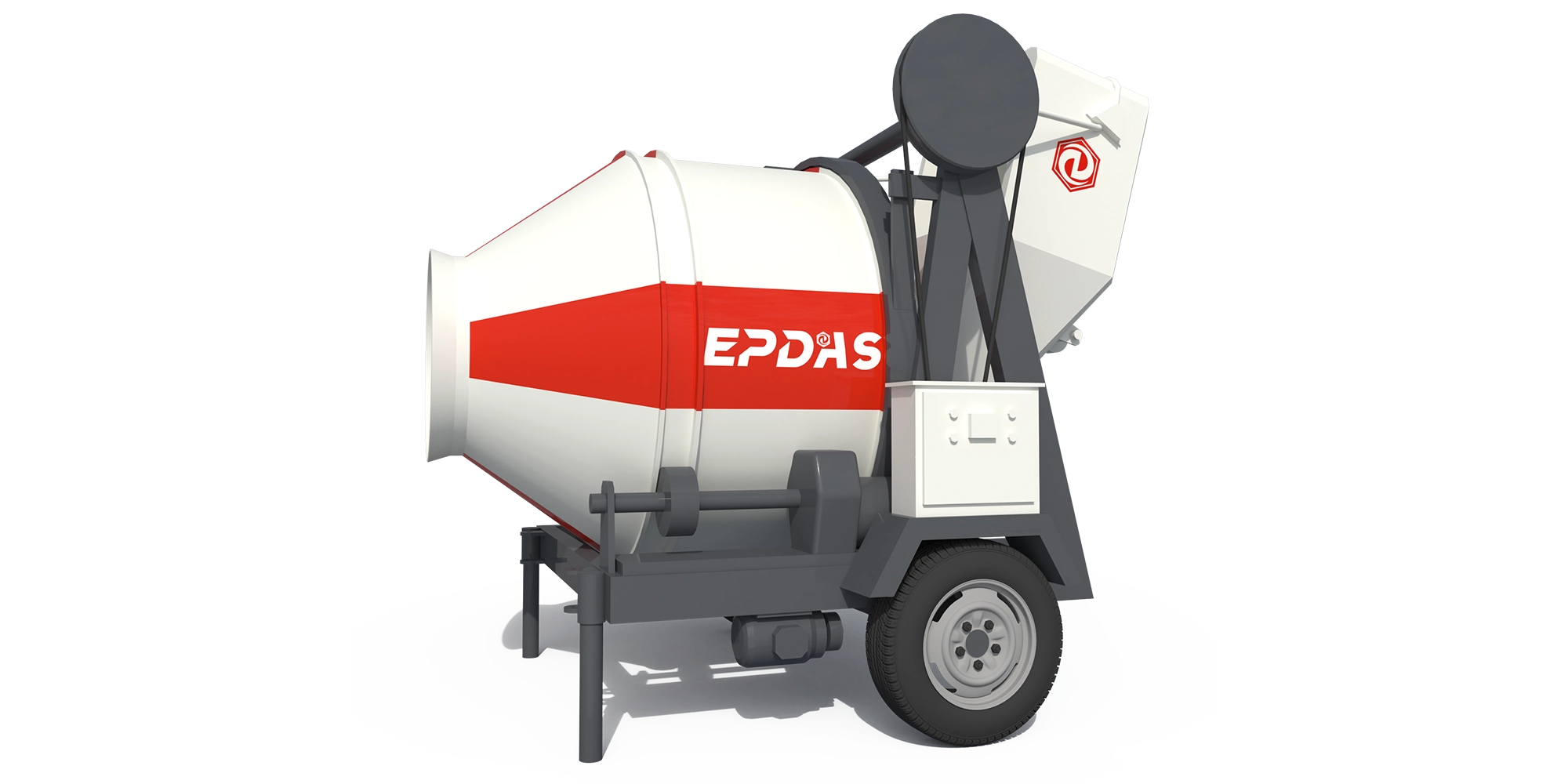
Drum Concrete Mixer
As a core mixer for infrastructure projects, the EPDAS drum concrete mixer features a robust rotating drum with precision blades for uniform consistency. Its simplified mechanical design eliminates complex electronics, ensuring minimal downtime and effortless operation. Whether for experienced crews or new labor, this reliable equipment streamlines your production cycle, maximizes output, and delivers superior quality for every onsite application.
- :
- :
What is Drum Concrete Mixer
A drum concrete mixer is an intermittent mixer on construction sites. It is also the main mixing machine in small and medium infrastructure projects. Its core structure is a rotating drum with special blades inside the drum.
It does not have a complex electric system or a precise transmission system, so it has low rates of mechanical stalls and is easy to operate. Regardless of whether your worker is a sophisticated operator or a non-experienced labor, they can operate the drum concrete mixer in a short time after familiarizing themselves with the operating process.
The Working Principle of Drum Concrete Mixer
The operating mixing of the equipment is rather simple. It completes the aggregate mixing depending on the drum rotating and the gravity. It does not need high-strength forcing cutting and mixing, which reduces the lost of aggregates.
- When working
Operators put sands, cement, aggregates and water into the drum gradually according to the ratio. After starting, it will keep rotating around the center axle and the inner blades will mix the materials evenly and stably to avoid segregation.
- Operating details
When the materials are lifted to the upper place of the drum, they drop, tumbling naturally by the gravity to finish mixing. This process repeats again and again along with the drum continuous rotating.
- Mixing quality
After this process is repeated several times, various materials integrate with each other gradually and the distribution of particles is even. The cement forms the concrete that has an even texture and no obvious clumps under a complete hydration process.
- Finally
The whole unit of the working process is smooth and the mixing power is medium to ensure the basic strength of concrete. It not only satisfies the mixing need of standard-grade concrete, but also does not break the original structure of aggregatess.
Main Types of Drum Concrete Mixers
There are abundant types of drum concrete mixers, classified by capacity, motor types, mobility and the way of discharging. Different types of the equipment are suitable for different construction occasions. It helps simplify the steps of choosing your own machine.
Capacity configuration
- 350L
It is compact and portable but for small-batch mixing. It is mainly engineered for residential construction, small-scale maintenance and spot infrastructure projects.
- 500L
It is a common model in the industry and fits for small to medium-scale residential construction, rural road paving, and minor hydraulic projects. The drum concrete mixer keeps the best balance between mixing efficiency and equipment costs.
- 750L
Compared with model 500L, this machine has a bigger capacity and is ideal for mid-scale construction. Our equipment excels in integrated residential renovation, township infrastructure development, and small-scale bridge projects.
- 1000L
It is the highest capacity model and matches the production capacity of a mini stationary batching plant. It is capable of handling high-volume daily output requirements.
Power configuration
- Diesel-powered
This model is equipped with a diesel engine, ensuring operation is unaffected by limited power infrastructure, power outages, or off-grid locations. It can be used in field sites, mountainous infrastructure projects, and remote rural areas with outstanding flexibility.
- Electric-driven
By contrast, the electric one is more environment-friendly, has low working cost, and is low noise. It is more suitable for urban construction, fixed production facilities, and projects with stable power. It is the preferred solution for urban and indoor construction.
Mobility configuration
- Stationary mixer
The mixer is suitable for long-term construction projects, as its body is stable and frequent moving is inconvenient.
- Towable mobile mixer
The base matches with road-towable wheels and a towing hitch and can be towed directly by vehicle. It is ideal for dealing with high-frequency site work, road maintenance, patch repair, and scattered small-scale construction.
Classification by discharge mechanism
- Tilting drum concrete mixer
It features high-speed discharging with minimal residue via direct drum tilting, reducing labor intensity. (Ideal for rapidly advancing small and medium construction sites)
- Non-tilting drum concrete mixer
The structure is simple and cost-effective. It completes discharging relying on the internal drum structure. (For fixed sites that only need slow-speed and long-term operating)
- Reversing drum concrete mixer
This model features bi-directional rotation, which contributes to increasing the homogeneity of aggregates. It is adaptable to various concrete mix designs with consistent mix quality. (For projects needing high-quality concrete)
Core Applications of Drum Concrete Mixers
The core advantages of drum concrete mixers are low cost, easy operation, and high adaptability, covering almost all small-to-medium construction sites. They are also the first choice for remote locations and small-contractor teams.
- Residential construction
It is the main application scenario, such as custom residential construction, multi-story residential renovation, and luxury villa construction. They do not need large capacity and the schedule is flexible. The drum concrete mixer can satisfy its daily concrete quantity needs.
- Road maintenance & small-scale bridge infrastructure
Patch repair, residential pavement renovation, and farm-to-market road hardening are common applications, as it can be placed nearby and improve the efficiency of on-demand mixing, avoiding long-distance delivery or delaying the setting times.
- Rural and agricultural infrastructure projects
They have a low entry threshold for the equipment. It can be used in irrigation channel casting, agricultural flooring, fence footing, and livestock yard paving.
- Temporary works & small-contractor projects
If your projects are short-term infrastructure projects, temporary hoarding, or on-site temporary structure casting, buying a large concrete batching plant is not cost-effective. A drum concrete mixer is sufficient for this task.
Drum vs. Twin Shafts Concrete Mixers: A Contractor’s Guide to Selection
Many customers are worried about whether they can choose the right machine to match their projects. In fact, both of these machines are excellent, but they are suited for different construction situations. The following table can help you strip away the guesswork and secure the perfect equipment match for your project’s success.
| Comparison | Drum Concrete Mixer | Twin-Shafts Concrete Mixer |
| Budget & Cost | Low investment, fast payback. Best for budget-limited projects. | Higher cost, needs more support. Better for large budgets. |
| Operation | Simple structure, easy to run, no professional training needed. | Complex system, requires skilled operators and maintenance. |
| Mixing Result | Reliable mixing quality. Standard for basic, everyday concrete. | High-precision mixing. Perfect for high-strength, high-spec concrete. |
| Best Used For | Small house builds, rural projects, road repairs, and temporary jobs. | Big projects, commercial batch plants, or continuous high-standard production. |
Simply but, choose the drum concrete mixer for site flexibility and the twin shafts concrete mixer for high-precision quality.
Key Benefits of Drum Concrete Mixers
- Low investment, fast payback
Compared with large concrete batching plants and other mixers, the drum concrete mixer has a lower price so it does not need a large investment initially. When owning a mixer, it can avoid the cost of purchasing concrete and delivery. Most of the projects can pay back in a short time.
- Ready to run, minimize labor cost
It is easy to operate the equipment without a complex process or special training. You do not need to pay much for labor training. It is suitable for small and medium-sized project teams that have minimal labor dependency.
- Reliable and low maintenance
The drive mechanism of the drum concrete mixer is simple, effectively eliminating common mechanical stalls and operational failures. For daily maintenance, it only needs regular cleaning of the inner drum wall and inspection of all fasteners and drive components.
- Universal site versatility
There are plenty of models of drum concrete mixers which offer a wide range of power sources and structural configurations to suit specific project demands.
- Reduce material waste
It supports flexible production capacity and allows you to scale output up or down based on your daily construction progress to avoid aggregate waste.
- Consistent and uniform mixing
Using a straightforward way to achieve thorough mixing without segregation and clumping. The final concrete has good strength and effectively ensures the concrete quality.
EPDAS Drum Concrete Mixer Projects
Drum Concrete Mixer FAQs
- Are concrete mixers and cement mixers the same equipment?
Yes, they are different terms for the same piece of equipment. In daily construction, concrete mixers are often referred to as cement mixers. Their core function is to blend aggregates, cement and water into concrete mixture, with no essential difference between them.
- Can portable concrete mixers be used for large-scale commercial projects?
Not recommended. Portable mixers feature small mixing capacity and low efficiency, only meeting the demand for small-batch concrete. Using portable mixers will severely delay the construction progress. Continuous mixers or concrete batching plants should be adopted instead.
- What is the maximum holding time of concrete in a mixer drum?
It should not exceed 90 minutes at most, and the optimal pouring time is within 60 minutes after water is added for mixing. Concrete begins to initially set once water is added. If the time exceeds 90 minutes, its workability and strength will drop drastically, leading to potential quality issues after pouring.
- Do all concrete mixers come with a water tank?
Not all of them. Small portable mixers are generally not equipped with an independent water tank, and water needs to be measured and added manually in advance. Modern mobile concrete mixers are basically fitted with an independent water tank, which allows water addition during transportation to extend the initial setting time of concrete.
- What are the key tasks for the daily maintenance of concrete mixers?
Inspect and replace wear parts. Check mixing/screw blade wear and replace damaged ones timely. Lubricate transmission components regularly and clear drum residual concrete to avoid hardening/caking.
- What should I do if the pipeline gets clogged during concrete pumping?
Optimize the concrete mix: Adjust the water-cement ratio to improve workability and flowability before pumping. Match the pipe diameter: Always use the correct delivery pipe size that matches your specific concrete aggregate grading. Keep pipelines clean: Flush and wash the pipelines thoroughly after every session to prevent old residue buildup. Emergency troubleshooting: In case of an immediate blockage, try using the reverse pumping function to break the clog, or use a specialized pipeline clean-out tool to clear the pipe safely.
- Is it more cost-effective to buy or rent the equipment?
The best choice depends entirely on your project timeline, workload, and financial strategy: Buying: This is ideal for long-term, high-volume projects. Owning the equipment delivers a much higher long-term ROI and ensures 100% equipment availability whenever you need it. Renting: This is perfect for short-term projects, temporary jobs, or testing out a new machine. It significantly minimizes your upfront capital investment and gives you excellent cash flow flexibility.
- How safe is the Concrete Mixer Pump during operation?
Highly safe, provided operators follow these three baseline rules: Wear PPE: Ensure the team always wears standard safety gear. No overloading: Never pump beyond the rated capacity or height limits. Daily checks: Verify hydraulic pressure, pipe couplings, and outrigger stability before starting.
- What types of concrete can a twin-shaft concrete mixer handle?
It handles almost all concrete types and construction mixes on the market, including: Standard mixes: Commercial ready-mix concrete and precast concrete. Specialty concrete: Dry-hard concrete, roller-compacted concrete (RCC), high-strength concrete, and self-consolidating concrete (SCC). Other materials: Various types of mortar and construction powder blends.
- What is the standard mixing cycle time for twin-shaft concrete mixer?
The standard mixing cycle for regular materials takes only 30 to 60 seconds. You can slightly adjust this timing based on your specific concrete mix design, aggregate size, and hardness.
Customize Your Solutions
Contact us now via Email:info@epdas.com, or Whatsapp:+86 188 38115507 , or fill in the form below.
FEW TIPS:
Service Process:
- Business negotiation
- Solution development
- Manufacturing and commissioning
- Operational production