
Type: Articulated-chassis, 2-wheel Drive(2WD)
Output Capacity: 1.8~4.0m³ per batch
Drum Rotation: 360°(Self)+270°(Slew)
A self-loading concrete mixer is a compact mobile on-site concrete production machine with one-person operability. It integrates material feeding, batching, mixing and discharging in one unit, with strong mobility for scattered and small-scale construction sites. No extra equipment is needed, making it a flexible and practical choice for on-demand fresh concrete production.
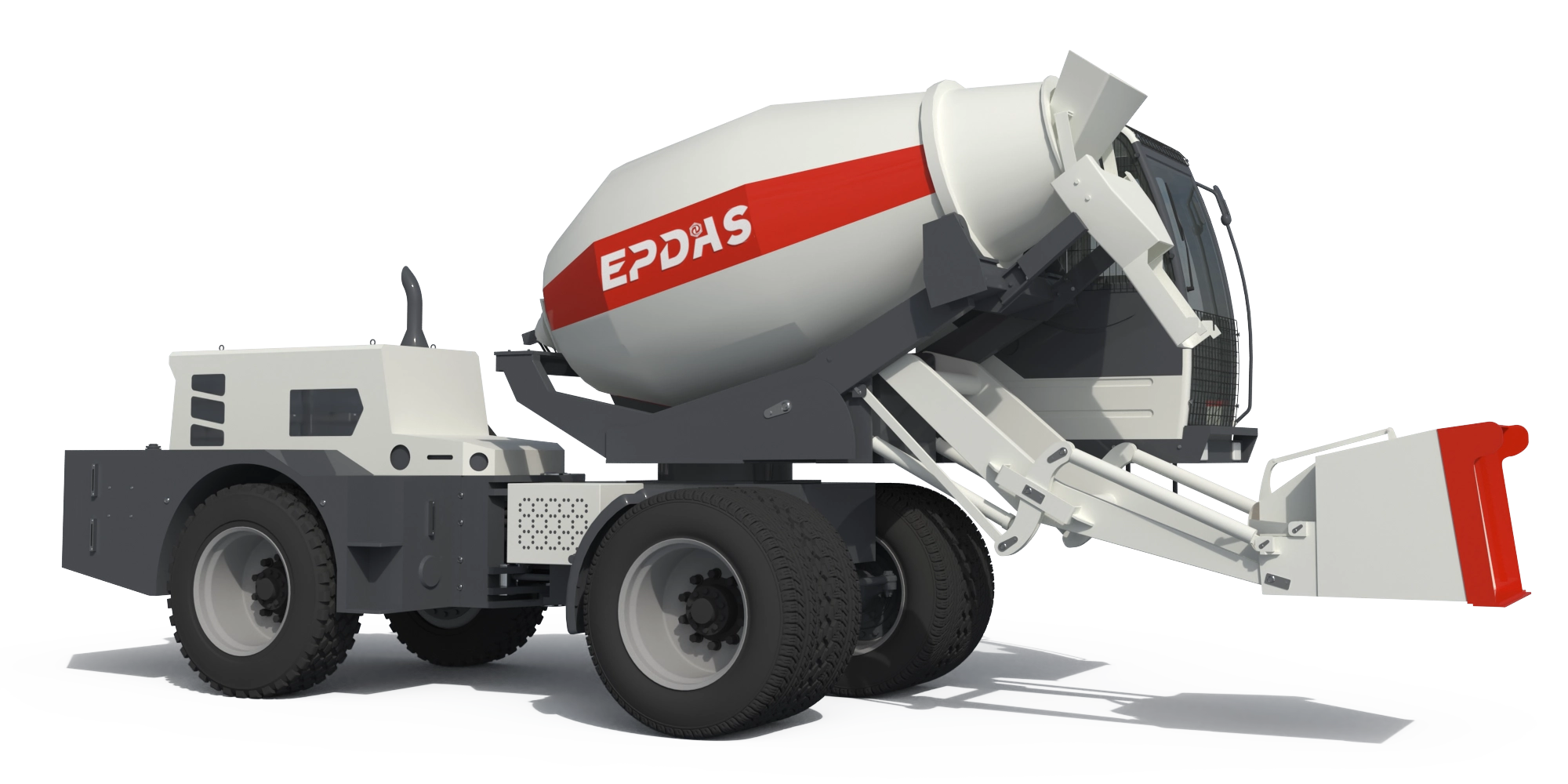
A self-loading concrete mixer is a highly integrated mobile concrete production equipment. It independently completes aggregate loading, precise raw material batching and mixing via cab operation, without additional auxiliary equipment. Mixed concrete after blending can be directly discharged to the designated construction position, which is a highly cost-effective concrete production solution for small and medium-sized construction applications at present.

The integrated operation of a self-loading concrete mixer relies on the coordinated cooperation of various systems. Among them, hydraulic system, pumping system and mixing drum are the core components of entire equipment, and also the key points that need to be focused on when purchasing.

It is the foundation for ensuring concrete quality. Equipped with silo measurement, control weighing technology and dynamic algorithms, combined with a digital formula library and dynamic weighing technology. It can control batching error of concrete raw materials within ±1%, ensuring precision of concrete batching.
The core of mixing system is mixing drum and mixing blades. To cope with abrasive characteristics of concrete raw materials, both mixing drum and blades are made of high wear-resistant materials. Compared with accessories made of ordinary materials, their service life can be increased by 30%, reducing later replacement and maintenance costs. When purchasing equipment, compatibility of accessories directly affects the operational stability and efficiency of the equipment.
It enables flexible mobility of equipment to adapt to transfer needs of different construction points on construction site. Without relying on other transportation equipment, it can independently move from the raw material stacking point to pouring point, greatly improving operational flexibility.
Composed of a discharge hopper, discharge door and hydraulic system, it can realize flexible opening and closing of the discharge door through precise control of hydraulic system. This allows mixed concrete to be discharged to the designated position quickly and evenly, ensuring the quality of pouring construction.
Type: Articulated-chassis, 2-wheel Drive(2WD)
Output Capacity: 1.8~4.0m³ per batch
Drum Rotation: 360°(Self)+270°(Slew)
Type: Integrated-chassis, 4-wheel Drive(4WD)
Output Capacity: 2.5~5.5m³ per batch
Drum Rotation: 360°(Self)+270°(Slew)
Chassis Type: Crawler
Output Capacity: 0.2m³ per batch
Drum Rotation: 360°(Self)
Operational workflow of a self-loading concrete mixer is clear and easy to understand and entire process can be completed by a single operator. The whole process is divided into four core steps: preparation, loading, mixing and discharging. All steps connect so smoothly with low operational difficulty that ordinary operators can get started after simple training.

Preparation is a prerequisite for ensuring normal operation. Before starting, carefully check the status of all components such as sufficiency of hydraulic oil and hydraulic pump, to prevent equipment malfunctions caused by oil shortage. At the same time, confirm that mixing control lever is in neutral position. After a thorough check, start vehicle engine and wait for equipment to enter operational state.
Loading is completed by loading hopper at the front of equipment. Loading hopper automatically adjusts its position through hydraulic system, and operator controls hopper to feed materials into mixing drum at an appropriate speed through control handle. Raw materials such as sand, gravel, cement and aggregates on construction site can be directly collected by loading hopper. Meanwhile, weight of each raw material can be accurately measured with the matching weighing system.
Mixing is core step for concrete production. After loading completed, spiral mixing blades inside mixing drum start to rotate driven by hydraulic system for even mixing. During mixing process, water and other admixtures can be added in a timely manner according to required concrete humidity and fluidity, until concrete meets your construction standards.
After mixing is finished, opening and closing of discharge door are also controlled by hydraulic system. Mixed concrete is directly discharged to construction pouring point through discharge hopper, or conveyed to designated position via delivery arm. After discharging, the next cycle of loading and mixing or equipment cleaning can be carried out as required.
Proper daily maintenance of a self-loading concrete mixer ensures equipment remains in a stable operational state, reduces possibility of malfunction and downtime in order to lower later maintenance costs. At the same time, it can improve safety of construction site operations and extend the overall service life of equipment. The core of maintenance is to do a good job in daily inspection, cleaning and lubrication, forming a fixed maintenance process, which is more cost-effective than post-failure repair.
As the core of equipment power, they need regular inspection. Check operating status of engine for abnormal noise, oil leakage and other issues, inspect fuel filter for blockage and clean or replace it in time to achieve normal supply of fuel. Meanwhile, remember coolant level to ensure heat dissipation effect of engine, avoiding equipment downtime caused by engine overheating.
It is power source for movement of all equipment components and also focus of maintenance. Regularly check hydraulic pipelines for damage and oil leakage, and pipe joints for looseness, handle any problems found in advance to prevent them from affecting equipment operation. Replace hydraulic oil and hydraulic filters regularly to keep hydraulic oil clean, avoiding impurities from entering hydraulic system and causing wear to pump body and valve body.
Components that directly contact with concrete, need to be cleaned immediately after each operation. Remove concrete residue and debris inside drum and hoppers to keep concrete from solidifying and adhering to surface of them, because it may cause equipment wear and even affect batching precision of next operation. When cleaning, avoid directly flushing electrical components such as motors and circuits with water to prevent short-circuit faults.
Moving parts request regular lubrication like bearings, rotating shafts and connecting rods. Select appropriate lubricating oil according to equipment instruction manual and replenish it in a timely manner to ensure smooth operation of moving parts. Reduce wear between components and extend their service life. Pay attention to proper amount of lubrication to avoid excessive lubricating oil attracting dust and forming sludge that impairs component operation.
In addition to daily maintenance, a comprehensive regular inspection of whole equipment is required. Check wear of mixing blades and drum walls, inspect tires and chassis for damage and replace severely worn accessories to solve potential malfunction problems ahead of time and ensure long-term stable operation.
Characteristics of a self-loading concrete mixer determine that it is not suitable for all construction scenarios, but highly adapted to small, medium-sized and decentralized construction needs. Combining cost performance and operational characteristics of equipment, the following types of working environments are its core applicable scenarios.

Face scattered job sites and low single-batch concrete demand. Traditional large-scale concrete production equipment involves high investment and poor flexibility. In contrast, a self-loading concrete mixer features a low upfront investment and a single person. It can be quickly relocated between different construction points, perfectly adapting to on-site construction needs.
Rural road hardening, farmland water conservancy facility construction, rural public toilets and cultural squares are mostly located in towns and villages with poor transportation conditions, where large concrete mixing equipment is hardly accessible. Self-loading concrete mixers feature compact dimensions and can adapt to the complex road conditions in rural areas. Meanwhile, the concrete demand for such infrastructure projects is phased and decentralized, and this machine is perfectly able to meet such demand with its operational mode.
Large concrete mixing plants have a limited coverage area and high transportation costs. If construction companies are equipped with self-loading concrete mixers, they can realize on-site independent concrete production without relying on external mixing plants. This not only reduces concrete transportation costs, but also allows flexible adjustment of production plans according to project plans.
Applications, such as underground roadway construction and building of mining supporting facilities just require a small amount of concrete for support and pouring. Most construction sites are located inside mining areas with complex road conditions and narrow spaces. The mobility and operational flexibility of self-loading concrete mixers can meet decentralized construction needs. At the same time, wear-resistant design of equipment also enables it to adapt to harsh operating environment of mining areas.
Upfront equipment investment is far lower than that of traditional multiple sets of concrete production equipment, reducing initial costs;
Equipment features high operational efficiency, which can quickly complete construction tasks, accelerate project payment collection and achieve a faster return on investment;
High mobility and labor-saving characteristics can reduce labor and transportation costs , boosting the overall construction profit.
We customize equipment selection plans by actual applications, concrete output requirements and operating environment characteristics to accurately match construction needs. This fundamentally avoids equipment idleness or insufficient capacity due to blind purchasing.
Our service covers on-site guidance for entire process of installation, commissioning and operation after equipment delivery. Professional technicians provide on site practical training, enabling operators to quickly master equipment operation skills and ensuring equipment can be put into use immediately upon arrival.
We provide all-day technical consulting services. When encountering operation problems or sudden malfunctions during operation, you can quickly obtain professional assistance and solutions, which greatly shortens equipment downtime and ensures stable operation.
We establish exclusive maintenance files for each piece of equipment and arrange regular return visits by professional technicians. Potential malfunctions of core components such as mixing drums and hydraulic systems are inspected in a targeted manner to avoid equipment malfunction risks in advance and reduce unplanned downtime.
We provide supporting exclusive original genuine spare parts, which fundamentally ensures high compatibility and usage quality of spare parts with equipment. This avoids secondary equipment damage caused by inferior spare parts and effectively extends the overall service life of the equipment.
We have built an efficient spare parts supply channel, to achieve rapid supply of wear-prone core spare parts such as mixing blades and hydraulic pipelines to meets spare parts needs for daily replacement and fault maintenance in time and make sure efficiency of equipment operation and maintenance.

In remote rural areas of central Kenya, construction can proceed normally without electricity. Building rural schools faces challenges such as muddy roads, scattered construction sites and lack of power supply.
Self-loading concrete mixers are powered by diesel engines, requiring no external power supply.
This equipment is equipped with an advanced weighing system, even in high-temperature and dry working conditions, concrete produced maintains.
Building foundation and load-bearing columns of a two-story classroom,with the self-loading mixer, construction task was successfully completed in only 15 days.
In remote mountainous areas of the Philippines, building materials are manually transported by villagers, and concrete is mixed using traditional manual methods.
After automatic weighing, water addition and mixing, fundamentally eliminates concrete quality issues caused by inaccurate manual mixing.
Construction time has been shortened from the original 10 days to just 5 days, and the overall construction period has been advanced by nearly one month.
Self‑loading concretemixer only needs 1–2 operators, cutting labor costs by more than half.
Constructora Andina in Lima, Peru, has recently launched an innovative urban renewal project aimed at revitalizing the Miraflores coastal district.
By reducing manual labor, the equipment minimizes worker fatigue and the risk of accidents. Its design also makes it safer to operate in space-constrained urban environments.
Reducing labor demand and logistics costs enhances the project’s economic viability.
A self-loading concrete mixer eliminates the need for separate loaders, batching plants, and transport vehicles. This reduces labor costs, saves time, and improves flexibility, making it an ideal solution for small to medium construction projects and remote job sites.
When choosing a self-loading concrete mixer, consider mixing capacity, engine power, terrain conditions, and daily concrete output. Smaller models suit residential projects, while larger models are better for infrastructure and commercial construction. EPDAS can help you select the best model.
Self-loading concrete mixer trucks are powered by diesel engines with hydraulic systems that control loading, mixing, steering, and discharging. High-quality hydraulic pumps and valves ensure stable operation, precise control, and long service life even in harsh construction environments.
Yes. Most self-loading concrete mixers are equipped with four-wheel drive, high ground clearance, and articulated steering, allowing them to operate efficiently on rough, muddy, or uneven terrain commonly found at construction sites, rural areas, and mining projects.
Routine maintenance includes checking hydraulic oil, cleaning the mixing drum, inspecting wear parts, lubricating joints, and monitoring engine performance. Proper maintenance ensures stable operation, extends equipment lifespan, and minimizes downtime.
Mixing capacity varies by model, typically ranging from 1.2 m³ to 6.5 m³ per batch. The choice of capacity depends on project size, daily concrete demand, and transportation distance. Larger-capacity self-loading concrete mixers are ideal for medium-scale infrastructure and remote projects.
Service Process: