
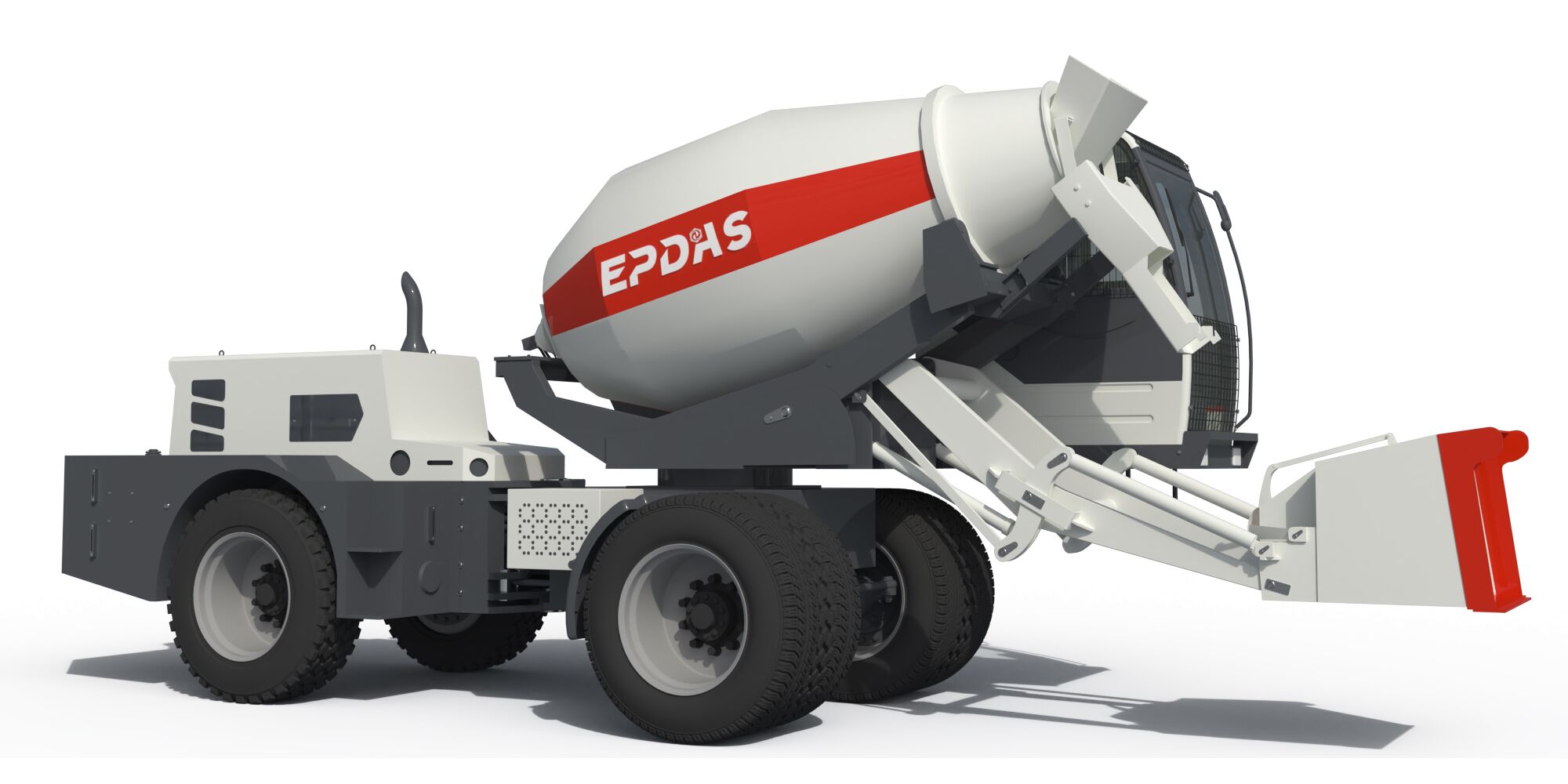
Self Load Concrete Mixer
Articulated self-loading concrete mixer features flexible steering, off-road performance and automatic feeding, mixing and discharging. It integrates full concrete production functions, ideal for narrow construction sites and remote engineering projects.
- Output capacity:1.8~4.0m³
- Mixer Drum Rotation:270°
What is Self Load Concrete Mixer
An articulated self-loading concrete mixer is a mobile concrete mixer truck with a central pivot system, designed for efficient on-site concrete production in narrow or rough terrain.
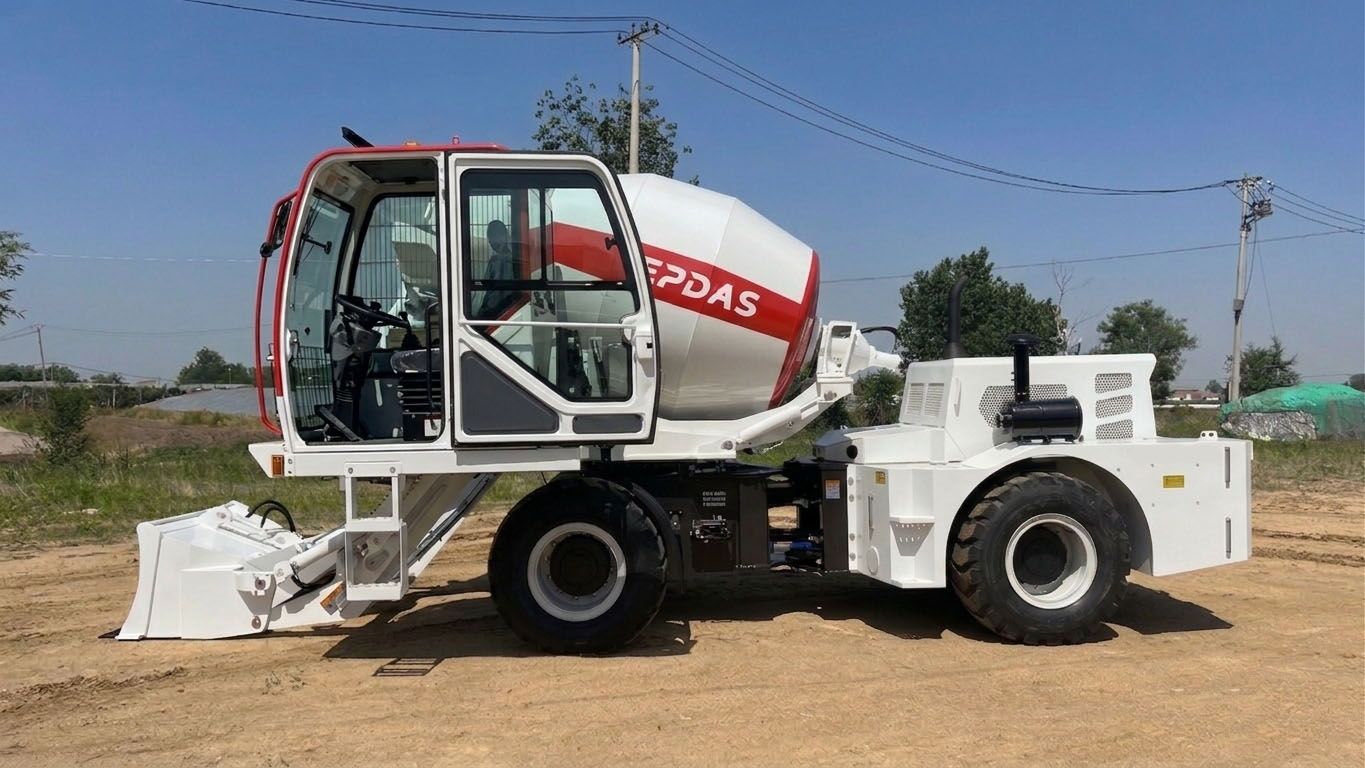
Its most critical design is the hinged structure. The body is connected through the central hinge, which can flexibly adjust the angle of the front and rear bodies. At the construction site, this means that it does not need a large turning radius or frequent reversing to adjust direction, and the operation flexibility far exceeds that of traditional equipment.
- EPQC Series
- EPQB & EPQ Series
| Model | EP4.0QC | EP3.5QC | EP2.6QC | |
| Mixing System | Output capacity | 4.0m³ per batch | 3.5 m³ per batch | 2.6 m³ per batch |
| Rotation angle | 270° | |||
| Mixer Drum Angle | 16 ° | |||
| Loader Control | Hydraulic 4 way stick | |||
| Swing Reducer | Customized by EPDAS | |||
| Water Tank Volume | 1 x 750 L water tank | 1 x 880 L water tank | 1 x 750 Lwater tank | |
| Engine | Brand | YUCHAI | ||
| Rated Power/RPM | 91KW/2600RPM | 85KW/2400RPM | 78KW/2200RPM | |
| Chassis | Total Weight | 9000 KG | 8250 KG | 7000 KG |
| Driver Type | Front 2 + Back 2 | Front 4 + Back 2 | Front 2 + Back 2 | |
| Steering | Hyduaulic articulated steering | |||
| Wheel Base | 2950 mm | 2750 mm | 2770 mm | |
| Tyre | 12R-22.5 | 12R-22.5 | 1670/20-16 | |
| Speed | Low:0-20 KM/H High:2-40 KM/H | Low:0-20 KM/H High:20-35 KM/H | Low:0-25 KM/H High:0-35 KM/H | |
| Transmission | Mechanical | |||
| Grade-ability | 30° | 40° | 40° | |
| Overall Size | L7700*W2950*H3400mm | L7300*W2750*H2892mm | L6650*W2700*H3200mm | |
| Model | EP4.0QB | EP3.5QB | EP2.6Q | EP1.8Q | |
| Mixing System | Output capacity | 4.0m³ per batch | 3.5m³ per batch | 2.6m³ per batch | 1.8m³ per batch |
| Rotation angle | 270° | ||||
| Mixer Drum Angle | 16 ° | ||||
| Loader Control | Hydraulic 4 way stick | ||||
| Swing Reducer | Customized by EPDAS | ||||
| Water Tank Volume | 1 x 950 L water tank | 1 x 880 L water tank | 1 x 750 Lwater tank | 1 x 550 Lwater tank | |
| Engine | Brand | YUCHAI | |||
| Rated Power/RPM | 91KW/2600RPM | 85KW/2400RPM | 78KW/2200RPM | 78KW/2400RPM | |
| Chassis | Total Weight | 9000 KG | 8200 KG | 7000 KG | 6300 |
| Driver Type | Front 4 + Back 2 | Front 4 + Back 2 | Front 2 + Back 2 | Front 2 + Back 2 | |
| Steering | Hyduaulic articulated steering | ||||
| Wheel Base | 3030 mm | 2750 mm | 2650 mm | 2500 mm | |
| Tyre | 12R-22.5 | 12R-22.5 | 1670/20-16 | 20.5/16 | |
| Speed | Low:0-20 KM/H High:20-40 KM/H | Low:0-20 KM/H High:20-35 KM/H | Low:0-25 KM/H High:0-35 KM/H | Low:0-25 KM/H High:0-30 KM/H | |
| Transmission | Mechanical | ||||
| Grade-ability | 40° | 35° | 30° | 30° | |
| Overall Size | L8400*W2750*H3500mm | L7700*W2750*H3350mm | L7500*W2600*H3200mm | L6700*W2340*H2700mm | |
Applicable Scenarios of Articulated Self-loading Concrete Mixers
The articulated self-loading concrete mixer is not universal, but in the following four specific scenarios, it shows an incomparable alternative advantage to the traditional stationary mixing station.

- Decentralized small and medium-sized projects (rural and urban construction):
In the laying of self-built houses, small water conservancy facilities or township squares in rural areas, the project volume is often only tens to several hundred cubic meters. Due to the remote location, the transportation fee of large mixers is high and it is easy to cause the initial condensation of materials. As a "mobile concrete mixing plant", the articulated self-loading concrete mixer can be used and stirred, which completely solves the pain point of expensive concrete transportation and long waiting time on remote construction sites.
- Urban renewal and restricted space operation:
With the transformation of old communities around the world and the promotion of urban subways and tunnel construction, construction sites often face problems such as narrow roads, height limits and difficult turning. With the flexibility of the hinged chassis, the articulated self-loading concrete mixer can easily shuttle between obstacles and complete the "production is unloading" directly inside the tunnel or in the narrow street, which greatly improves the operation efficiency of road administration repair.
- Infrastructure under complex terrain:
For high-altitude mountainous areas, tropical rainforest or muddy mudflat construction sites around the world, articulated self-loading concrete mixer are the key to ensuring the construction period. In road expansion and other projects in the Andean Mountains, it can operate directly on steep slopes and soft land foundations with strong off-road performance, avoiding the risk of shutdown of traditional equipment.
- Foundation engineering with high-precision marking requirements:
For sidewalk paving, substation foundations and various small building foundations, there are strict requirements for the uniformity and real-time strength of concrete. The forced mixing system of the articulated self-loading concrete mixer ensures that the on-site concrete produced is fresh and accurate, which is the core tool for pursuing high attendance and high-quality engineering contractors.
Industry Trend in 2026: Transformation from Rough Construction to Precise Profit
Entering 2026, the global construction industry will no longer simply pursue mechanization, but will enter the era of refined accounting:

The net income brought by zero error
Traditional manual addition often leads to about 10%-15% of raw material waste. The current digital control system will reduce the ratio error to within ±3%. This is not only a leap in the quality of the project, but also a real profit directly from sand, stone and cement.
High attendance rate determines viability.
In the construction industry, where downtime is at a loss, the significance of split torque transformers and redundant design (such as waterproof harnesses) is to allow equipment to maintain all-weather operation in the face of the harsh environment of the polar, plateau or tropical rainforest. This kind of reliability is the confidence for the contractor to accept large orders and settle accounts quickly.
The Resale Value Of Assets Adopts
High-end equipment with brand power and integrated frames. After 5 years of heavy physical labor, its second-hand resale value is usually more than 20% higher than that of low-end equipment. For the boss, this is not only a machine, but also a high-quality asset that can be quickly realized in the future.
How to Choose the Right Articulated Self-loading Concrete Mixer
In actual procurement decision-making, in addition to paying attention to the price, the contractor should make in-depth selection from the following four dimensions to ensure the operation performance of the equipment in the next 5-10 years.
- Scientific matching of production capacity scale
Don't blindly pursue large capacity. Small private contracting projects (such as fence foundations and sidewalks) are recommended to choose 1.0-2.6 m³models with higher mobility; while contractors who undertake government highways or medium-sized community projects are recommended to start directly from 3.5 m³or 4.0m³. Reasonable capacity matching can significantly reduce the fuel and labor costs of unilateral concrete.
- Weather resistance and harsh environment redundancy design
The construction environment determines the depreciation speed of the equipment. If you work in tropical areas with a long rainy season or a humid coastal construction site, you must make sure that the equipment is equipped with a full-vehile waterproof wiring harness (to prevent line oxidation and corrosion) and an enhanced cooling system. These "invisible configurations" are the bottom line to ensure that the equipment does not stop unexpectedly due to circuit failure or engine overheating.
- Operating comfort and safety compliance
The construction standards in 2026 are increasingly strict about the safety of operators. When purchasing, you can choose a luxury panoramic cab, air conditioning and a single-handle integrated operating system. A good operating environment can reduce operator fatigue by 20%, thus reducing the risk of construction accidents. At the same time, international general safety parts such as reversing images, broken window hammers and fire extinguishers must be standard equipment to meet the supervision of site access around the world.
- After-sales network and the availability of consumable parts
The productivity of the equipment depends on its attendance rate. When selecting models, be sure to investigate whether the supplier can offer spare parts in time. Priority is given to models with split design (such as torque converter split), because this kind of design allows local mechanics to complete quick repairs without disassembling the chassis and minimize downtime losses.
Selection Points of the Core Structure: Take Model EP4.0H as an Example
As a professional contractor, the selection should not only look at the appearance, but must delve into the core parameters.
- 01
Frame Technology
It is recommended to choose the profile seamless steel pipe integrated frame. Compared with ordinary welded frames, this structure has stronger anti-torsion ability under long-term high-intensity operation, and the life of the body can be increased by more than 30%.
- 02
Steering and Drive Bridge
Recommended rear wheel steering design with 20T hydraulic steering drive bridge. This configuration can effectively contribute to that the steering is still accurate and light under heavy load.
- 03
Powertrain
It is recommended to choose a powerful engine for the core power, and be sure to match the 280-sector torque changer. This split design means that there is no need to remove the chassis during repair, which greatly reduces the cost of downtime and maintenance.
- 04
Production Capacity Index
Take EP4.0H as an example, its geometric volume reaches 5.0 m³, which ensures that the maximum rated discharge is stable at 4.0 m³under the premise of full stirring.
- 05
Operation Assistance
Including hydraulic buckets with vibrators and hydraulic car wash systems. The former solves the difficulty of loading sticky materials, and the latter ensures the cleanliness of the tank after work and extends the service life of the equipment.
Core Advantages of Articulated Self-loading Concrete Mixer
- Functional Integration to Reduce Equipment Investment.
The traditional scheme requires at least three equipment for loaders, mixers and transport trucks, while one articulated self-loading concrete mixer can replace three separate pieces of equipment, which directly saves the rental and purchase costs of two equipment. In practice, this setup can reduce initial equipment costs by over 50% and completely solve the pain point of poor scheduling between multiple devices.
- Forced Stirring to Ensure the Quality of Project.
The equipment adopts a double conical mixing cylinder and a double spiral blade, with a powerful forced mixing system. This design can help the concrete mix more evenly inside the drum and reduce common issues like aggregate sinking or mortar separation. For foundations, bridges and other projects with strict requirements for concrete marking, this mixing effect is a hard guarantee to avoid later rework.
- Automatic Loading and Digital Ratio
The front end of the equipment is equipped with a hydraulic folding hopper, which can be loaded directly from the sand and stone pile. More importantly, the high-end model integrated electronic weighing system (realized through the pressure sensor of the main cylinder of the bucket), combined with the digital display water meter, realizes the precise ratio of each tank of concrete. This is not only to simplify operation, but also to provide reliable data support in audit and quality inspection.
- 270° Flexible Unloading
The mixing cylinder supports 270°horizontal rotation, combined with a special back warp design, so that the vehicle can realize lateral or accurate positioning unloading without frequent turning. In tunnel construction, road administration repair or narrow indoor work, this flexibility greatly reduces the cost of manual rehandling on site.
- Extreme Mobility
For mountains, steep slopes and narrow bends around the world (such as the Andes Mountains in South America), the hinged chassis shows its core value. With 4×4 four-wheel drive, the device can still climb steep slopes above 35 degrees smoothly under full load. In the actual case, the equipment has proven its stability and traction in demanding mountain road conditions.
- Low Operation and Maintenance costs
The maintenance logic of a single device is much simpler than managing a fleet. By reducing the labor expenditure of multiple drivers and the fuel loss of multiple engines, contractors can usually shorten the payback cycle by 1/4 compared to the traditional model.
EPDAS Self Load Concrete Mixer Projects
Self Load Concrete Mixer FAQs
- What are the advantages of a self-loading concrete mixer compared to traditional mixers?
A self-loading concrete mixer eliminates the need for separate loaders, batching plants, and transport vehicles. This reduces labor costs, saves time, and improves flexibility, making it an ideal solution for small to medium construction projects and remote job sites.
- How do I choose the right self-loading concrete mixer for my project?
When choosing a self-loading concrete mixer, consider mixing capacity, engine power, terrain conditions, and daily concrete output. Smaller models suit residential projects, while larger models are better for infrastructure and commercial construction. EPDAS can help you select the best model.
- What engine and hydraulic systems are used in self-loading concrete mixers?
Self-loading concrete mixer trucks are powered by diesel engines with hydraulic systems that control loading, mixing, steering, and discharging. High-quality hydraulic pumps and valves ensure stable operation, precise control, and long service life even in harsh construction environments.
- Can self-loading concrete mixers work on rough or uneven terrain?
Yes. Most self-loading concrete mixers are equipped with four-wheel drive, high ground clearance, and articulated steering, allowing them to operate efficiently on rough, muddy, or uneven terrain commonly found at construction sites, rural areas, and mining projects.
- What maintenance is required for a self-loading concrete mixer?
Routine maintenance includes checking hydraulic oil, cleaning the mixing drum, inspecting wear parts, lubricating joints, and monitoring engine performance. Proper maintenance ensures stable operation, extends equipment lifespan, and minimizes downtime.
- What is the mixing capacity of a self-loading concrete mixer?
Mixing capacity varies by model, typically ranging from 1.2 m³ to 6.5 m³ per batch. The choice of capacity depends on project size, daily concrete demand, and transportation distance. Larger-capacity self-loading concrete mixers are ideal for medium-scale infrastructure and remote projects.
Related Products
Customize Your Solutions
Contact us now via Email:info@epdas.com, or Whatsapp:+86 188 38115507 , or fill in the form below.
FEW TIPS:
- Please confirm the required mixing capacity of the articulated self-loading concrete mixer (e.g., 1.2m³)
- Please specify your main working site and road conditions (e.g., mountainous area, narrow road, muddy terrain)
- Please tell us your daily working hours and project usage frequency (e.g., 8 hours per day, long-term continuous work)
- Please clarify your required driving type and emission standard (e.g., 4WD, national Ⅲ / national Ⅳ emission)
- If you are interested in becoming our distributor, please let us know.
Service Process:
- Business negotiation
- Solution development
- Manufacturing and commissioning
- Operational production