
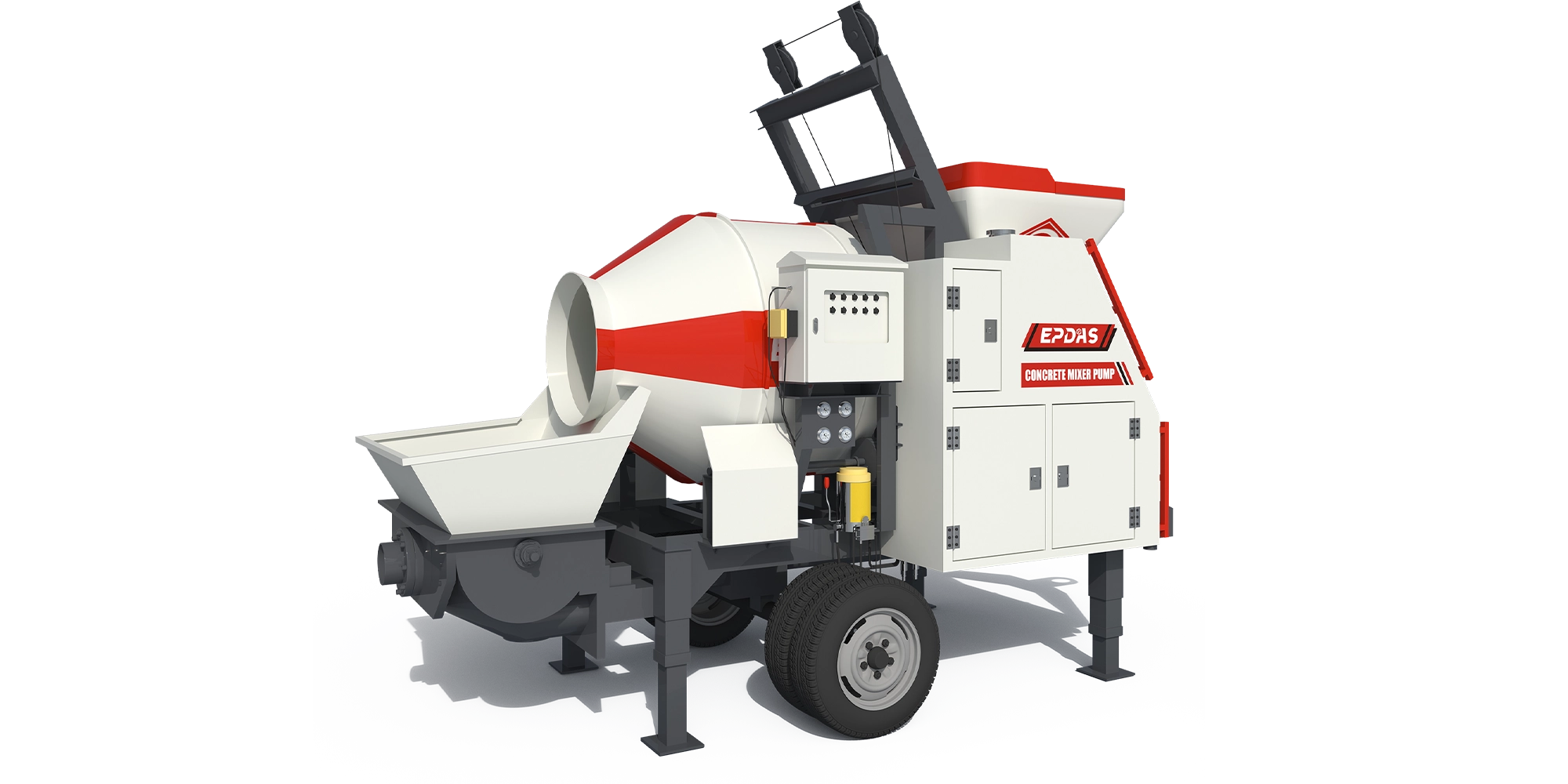
Concrete Mixer Pump
Concrete mixer pump integrates mixing and conveying functions into one unit. It is compact, flexible and suitable for small and medium construction sites. Diesel and electric versions are optional. Featuring stable hydraulic performance, easy operation and low failure rate, it efficiently delivers concrete to high and far positions, saving time and labor greatly.
- Concrete Mixing:22.5m³/h
- Concrete Pumping:30~50m³/h
What is a Concrete Mixer Pump
Many novice construction workers tend to confuse mixer pumps with ordinary concrete equipment. Simply put, the concrete mixer pump is an integrated construction equipment, which integrates the independent mixer and the concrete conveying pump into a whole machine, and does not need to cooperate with multiple pieces of equipment. This kind of equipment positioning is accurately adapted to small and medium-sized non-standard projects.
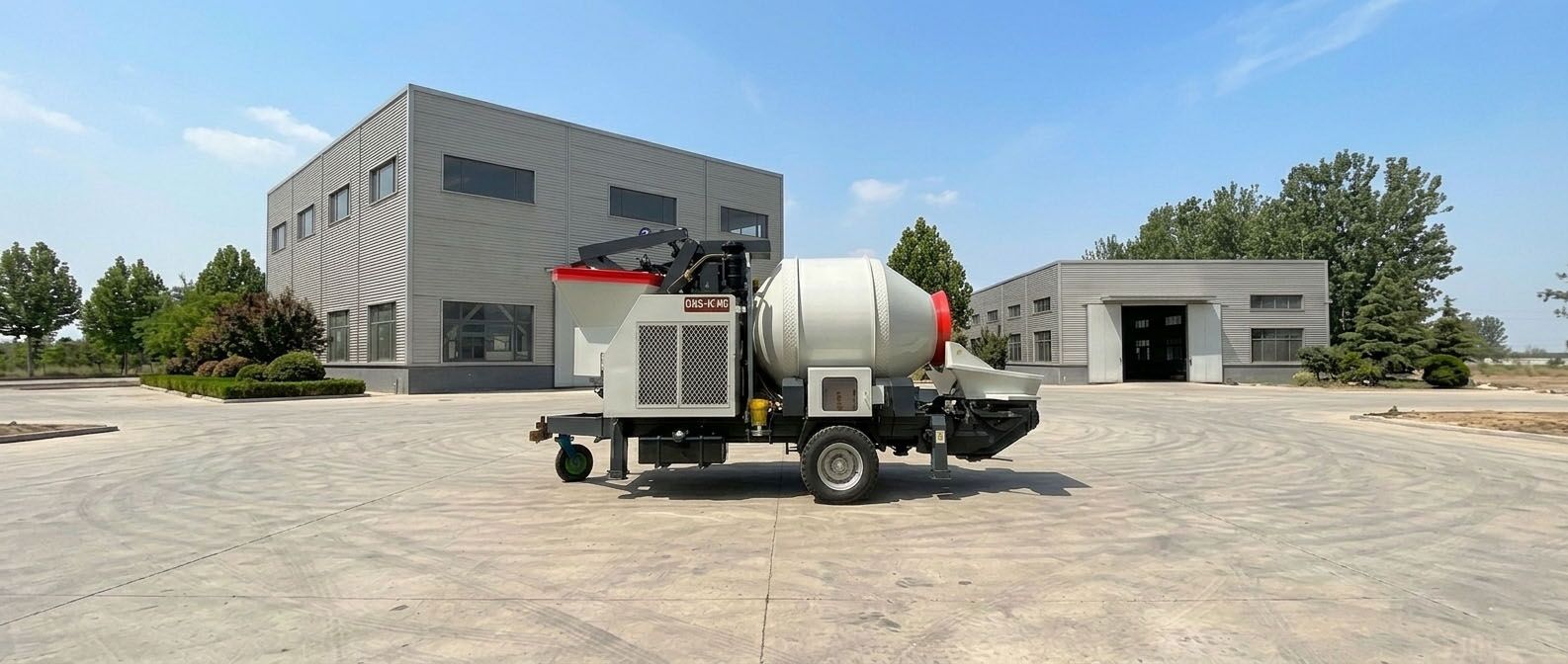
Many remote rural construction sites, narrow roadway construction, and small tunnel transformation projects do not have supporting mixing stations, and large-scale pumping equipment cannot enter the site. Mixer pumps can fill such construction gaps, and the adaptability far exceeds that of traditional split equipment.
- Concrete mixer pump
More compact and efficient to operate, combining mixing and pumping in one unit, making them ideal for small to medium construction sites, remote projects, and areas with limited equipment access.
| ITEM | DJBT50-10-85 | DJBT40-10-82 | DJBT30-08-76 | EJBT30-08-37 | |
| Theoretical concrete pumping | 48 m³/hr | 40 m³/hr | 32 m³/hr | 30 m³/hr | |
| Max. Concrete pumping pressure | 10 MP | 10 MP | 8 MP | 8 MP | |
| Main engine | Diesel engine: YUCHAI 85KW | Diesel engine: WEIFANG 82KW | Diesel engine: WEIFANG 76KW | Electric motor: 37KW | |
| Main oil pump | KAWASAKI 112 | KAWASAKI 112 | KAWASAKI 112 | JINDA | |
| Main oil cylinder diameter/stroke | Φ100/800 mm | Φ100/800 mm | Φ90/580 mm | Φ90/580 mm | |
| Concrete cylinder diameter/stroke | Φ180/800 | Φ180/800 | Φ180/580 mm | Φ180/580 mm | |
| Theoretical pump distance | Height: 70 m Length: 250 m | Height: 60 m Length: 250 m | Height: 50 m Length: 200 m | Height: 50 m Length: 200 m | |
| Hydraulic pump set | HUADE (CN) | HUADE (CN) | HUADE (CN) | HUADE (CN) | |
| Hydraulic valve set | TAIFENG (CN) | TAIFENG (CN) | TAIFENG (CN) | TAIFENG (CN) | |
| Lubricating system | Automatic hydraulic | Automatic hydraulic | Automatic hydraulic | Automatic hydraulic | |
| Concrete mixer volume | 450L per tank | 450L per tank | 450L per tank | 450L per tank | |
| Max. Aggregate size | 35 mm | 35 mm | 35 mm | 35 mm | |
| Aggregate lifting volume | 500L per hopper | 500L per hopper | 500L per hopper | 500L per hopper | |
| Concrete slump | 160-220 mm | 160-220 mm | 160-220 mm | 160-220 mm | |
| Controller | Wireless / Cabinet-buttons | Wireless / Cabinet-buttons | Wireless / Cabinet-buttons | Wireless / Cabinet-buttons | |
| Main electric components | CHINT (CN) | CHINT (CN) | CHINT (CN) | CHINT (CN) | |
| Machine weight | 5400 kg | 5300 kg | 5200 kg | 5000 kg | |
| Machine Dimension | Integrated (20GP pack) | 4500*2100*2300 | 4500*2100*2300 | 4500*2100*2300 | 4500*2200*2800mm |
| Split type (40HQ pack) | 5600*2100*2300 | 5600*2100*2300 | 5600*2100*2300 | / | |
| Diameter of concrete pipe | Φ125 mm | Φ125 mm | Φ125 mm | Φ125 mm | |
| Length of concrete pipe | 100 m | 100 m | 100 m | 100 m | |
Core Accessories and Hardware Configuration of High-performance Concrete Mixer Pump
The stability and service life of the equipment are basically determined by the core accessories. Most of the low-priced models on the market use ordinary general-purpose accessories. There is no obvious problem in short-term use. Long-term continuous construction is prone to oil leakage, stuttering, pipe blockage and other problems. Frequent downtime and maintenance will delay the construction period. High-quality concrete mixer pumps will be equipped with imported and industrial-grade accessories to ensure long-term stable operation.

- Main oil pump
Main oil pump uses imported accessories from Flutek Kawasaki and Rexroth from Germany. As the center of the hydraulic system, the high-quality oil pump can maintain stable pumping pressure, avoid uneven concrete output and pouring faults caused by pressure fluctuations, and adapt to long-term uninterrupted construction.
The whole machine is equipped with a special diesel engine for Weichai. This industrial-grade engine is suitable for outdoor high and low temperature, sand and dust and other harsh working conditions. The power output is stable, and there will be no shutdown and insufficient power due to environmental changes. It is suitable for field work at unprotected sites. - Open hydraulic system
Open hydraulic system is a mainstream prime configuration, which can reduce the energy loss in the hydraulic transmission process, make the process of equipment start-stop, pumping and return smoother, and reduce the wear speed of accessories. Equipped with a 100μm high-precision oil suction filter, it can filter the impurities in the hydraulic oil, protect the oil pump, hydraulic valve and other precision accessories, and effectively extend the service life of the equipment.
- Aviation-grade coolers
Aviation-grade coolers can continuously stabilize the temperature of hydraulic oil. During continuous construction, the hydraulic system will continue to heat up. If the temperature is too high, it will cause the equipment to slow down and stop. The special cooler can avoid such problems and ensure the stable operation of the equipment all day.
- Hydraulic pipelines and control components
Hydraulic pipelines and control components also affect the failure rate of equipment. The Italian Manuli oil pipe has excellent sealing, and there will be no oil leakage in long-term high-pressure operation. Taiwan Yu Yan Hydraulic Valve controls the accuracy of the system, so that the pumping start and stop and flow adjustment are more accurate, and the concrete discharge deviation is reduced. The supporting high-precision proximity switch can accurately sense the operating status of the equipment and reduce the probability of operating errors.
- Stirring drum
Stirring drum is made of 250 mm thickened integrated steel. Compared with ordinary thin steel plate drums, it has stronger wear resistance and deformation resistance. Long-term stirring of sand and stone raw materials will not cause cylinder wall wear, deformation and leakage, and the equipment structure stability is better.
Core Advantages of Concrete Mixer Pump in Construction
Small and medium-sized construction teams are most concerned about cost and practicality when purchasing equipment. The reason why the concrete mixer pump has become mainstream equipment for small-scale projects in recent years is that it meets the rigid needs of small and medium-sized construction sites and adapts to the construction mode of small-scale, multi-frequency and limited site space.

It can replace the traditional mixer + conveying pump with one machine, which directly reduces the cost of equipment procurement. At the same time, a single equipment only needs 1-2 workers to operate. Compared with the traditional multi-device multi-person collaboration model, labor costs are greatly reduced, and there is no need to occupy a large amount of site space to store equipment.
Stirring and pumping are seamlessly connected, and there is no waiting time for material transshipment. In traditional construction, concrete needs to be transported manually after the mixing is completed. The material is prone to solidification and separation problems during the material transfer process. The mixer pump can be used as you mix, which can continue to discharge the material, accelerate the overall construction progress, and reduce the risk of delaying the construction period.
The overall operation threshold of the equipment is low, and the operation process is fully automatic. There is no need for workers to have professional equipment operation qualifications. After simple learning, novices can complete daily construction operations and adapt to small and medium-sized construction teams with large worker mobility.
The equipment adapts to a wide range of scenarios. The power of the whole machine is lower than that of large-scale commercial equipment, and there will be no insufficient power distribution on the site. It can be used for rural self-built houses, urban indoor renovation, and outdoor infrastructure projects. With different mobile structures, it can also cope with mountainous, muddy, narrow and other complex working conditions.
The unified mixing process and precise fixed-point pumping can reduce the waste of concrete materials, while ensuring that the proportion of each batch of concrete is consistent, the stability of the building structure after pouring is better, and the workload of later rework and repair is reduced.
Standard Operation Process of Concrete Mixer Pump
Concrete mixer pump realizes the process-oriented operation of the construction site by integrating loading, mixing and pumping. The following are the main operating steps of the equipment in the actual project.

- Field deployment and pipeline connection
After the equipment enters the site, the operation point is selected according to the terrain of the site. Use hydraulic support feet to complete the leveling of the fuselage. The wheeled model is suitable for ordinary hardened ground, and the crawler model is suitable for soft or undulating fields. Connect the conveyor pipes according to the distance of the pouring point. When connecting, it is necessary to focus on checking the integrity of the clamp sealing ring to ensure that the interface is tight. Seal failure will lead to slurry loss, which is a common reason for the suspension of construction.
- Material ratio and mixing operation
Send sand, stone, cement and other raw materials into the hopper proportionally. The 2026 model generally optimizes the opening height of the hopper, which is convenient for small loaders or manual feeding. The stirring drum completes the material mixing within the preset time. The thickened drum wall can withstand the long-term friction of sand and gravel, ensuring that the degree of collapse of each batch of concrete is consistent, thus reducing the pressure load of the subsequent pumping system.
- Power pumping and working condition monitoring
After the concrete enters the pumping system, the main oil pump drives the piston for forward transportation. The machine monitors the value of the hydraulic meter through the control panel and adjusts the output according to the pumping height. When the material is too dry or the pipe resistance increases, the system can start the reverse pump function and pump the concrete in the pipeline back to the hopper for secondary stirring, which effectively avoids the risk of pipe blockage.
- Post-construction cleaning and daily maintenance
After the construction is completed, use the high-pressure cleaning system of the equipment to rinse the inside of the pipeline with the cleaning ball to prevent the residual hardening of the concrete. Focus on cleaning up the accumulated material around the stirring shaft end and the distribution valve. Keeping these key parts clean can significantly reduce the wear of the seals and extend the service life of the equipment.
Analysis of Concrete Mixer Pump Return on Investment (ROI)
Many small and medium-sized construction teams are confused about whether to purchase mixer pumps. The core is that the equipment is idle and the return cycle is too long. Judging from the first-line construction data, concrete mixer pump is a type of construction equipment with a high rate of return for small and medium-sized projects. The core is that it integrates equipment to maximize profits.
- 01
Cost reduction
Owning the equipment means that you have regained the profit initiative in the construction chain. There is no need to queue up for the mixing station or rent a large pump truck, and thousands of yuan can be saved for a single transfer and mixing station fee. The traditional model requires multiple collaborations of mixers, transshipment workers and pumpers.
- 02
Efficiency revolution
In the engineering circle, the construction period is the credibility. The operation speed of the mixer pump is more than 30% faster than that of traditional split-type equipment. It used to be 3 days of work, but now it is finished in 2 days. This means that your team can receive 10-15 more sporadic orders a year. The 2026 model generally strengthens the heat dissipation system and supports several-hour continuous operation, which is especially suitable for municipal or road and bridge projects that rush the construction period.
- 03
Measurement of return on investment
The return cycle is affected by the frequency of receiving orders and local labor costs, but for teams that take orders stably, the formula is as follows:
Return on cost = (lease fee savings + labor cost savings + new order profits brought about by efficiency improvement) - operating costs (oil/electricity, maintenance)
According to the average data in the southern and central and western regions, if the effective construction time of 15-20 days per month is maintained, most teams can recover the purchase cost of the whole machine in about 3-5 months. - 04
Long-term value
For teams that undertake civil construction and scattered road administration, the greatest value of own equipment is that it can be done at any time. It is no longer limited by the delivery volume of commercial mixing stations, and no longer stops work because of not being able to rent a pump truck. This flexibility is the core soft power to improve the market competitiveness of the team.
Core Considerations for Purchase of Concrete Mixer Pumps
- Match the production capacity demand of the project
The hourly output of conventional equipment is between 5-50m³. For small self-built houses and sporadic repair projects, you can choose the 5-20m³/h model. For bulk factory and road infrastructure projects, you can choose a high-capacity model of 30-50m³/h to avoid the equipment output speed not keeping up with the construction rhythm.
- Check the specifications of aggregate adaptation
The particle size of sand and stone used in different construction sites is different, and the maximum aggregate size that concrete mixer pump can handle is clearly limited. If the particle size of sand and gravel exceeds the equipment standard, it is very easy to cause pipe blockage and pump body wear.
- Choose the power model
For field and mountainous construction sites without stable municipal electricity, priority is given to diesel models; for urban fixed construction sites and indoor construction, priority is given to electric models to reduce daily operating costs.
- Pumping distance is the selection index
Statistics on the maximum vertical pouring height and horizontal conveying distance of the project before purchase. High-rise construction needs to be matched with the high-pressure pumping model, and long-distance flat-ground pouring focuses on the adaptability of the pipeline to avoid the equipment conveying range failing to cover the construction point.
- Degree of concrete collapse
Adapting concrete mixer pump with a collapse degree of 100mm or more can ensure the smooth flow of materials. If the construction requires low-slump concrete, you need to communicate with our manufacturer in advance to customize the adaptation model and avoid the problem of pipe blockage.
- The convenience of equipment maintenance
Priority is given to models with universal accessories and easy disassembly and installation. There is no need for professionals for daily cleaning and parts replacement. You can independently complete the basic maintenance and reduce the later maintenance expenses and downtime. Finally, in combination with the terrain of the construction site, choose a wheeled or crawler mobile structure to adapt to the construction conditions of the site.
Mainstream Application Scenarios of Concrete Mixer Pump

Civil and Commercial Buildings: solving the "last kilometer" pouring
In the reconstruction of self-built houses, multi-storey residences and shops in the countryside, commercial concrete mixes often cannot reach because of narrow roads and steep slopes.
Core advantages: Covers an area of only a dozen square meters, on-site feeding and on-site pumping, perfectly adapting to narrow lanes.
Scope of operation: It covers the main structure pouring, indoor floor leveling, beam and column reinforcement and other refined operations.

Industrial infrastructure and logistics warehouse
For the ground hardening or wall reinforcement of small and medium-sized factories and warehouses, the construction speed is the key.
Core advantages: The transfer of concrete mixer pump is extremely fast, and it can be evacuated after construction, minimizing the interference with the original logistics and production layout of the factory.
Scope of operation: foundation reinforcement, wear-resistant floor laying, secondary structural column grouting.
Road and municipal engineering
Rural highway expansion and community road surface repair projects are often numerous, small and scattered.
Core advantages: It has its own mobile wheels or tracks, which can quickly switch between multiple construction points. Even if the temporary power distribution at the construction site is insufficient, it can be turned on normally.
Scope of operation: rural "household communication" highways, factory road surface repair, municipal pipe network backfilling.
Equipment Details Display of Concrete Mixer Pumps
These photos highlight concrete mixer pump’s key job on site: steady material supply, powerful high-pressure transfer, and precise power management. It delivers continuous mixing, dependable pumping, and smooth concrete flow, keeping construction work moving efficiently and reliably.
Concrete Mixer Pump FAQs
- Are concrete mixers and cement mixers the same equipment?
Yes, they are different terms for the same piece of equipment. In daily construction, concrete mixers are often referred to as cement mixers. Their core function is to blend aggregates, cement and water into concrete mixture, with no essential difference between them.
- Can portable concrete mixers be used for large-scale commercial projects?
Not recommended. Portable mixers feature small mixing capacity and low efficiency, only meeting the demand for small-batch concrete. Using portable mixers will severely delay the construction progress. Continuous mixers or concrete batching plants should be adopted instead.
- What is the maximum holding time of concrete in a mixer drum?
It should not exceed 90 minutes at most, and the optimal pouring time is within 60 minutes after water is added for mixing. Concrete begins to initially set once water is added. If the time exceeds 90 minutes, its workability and strength will drop drastically, leading to potential quality issues after pouring.
- Do all concrete mixers come with a water tank?
Not all of them. Small portable mixers are generally not equipped with an independent water tank, and water needs to be measured and added manually in advance. Modern mobile concrete mixers are basically fitted with an independent water tank, which allows water addition during transportation to extend the initial setting time of concrete.
- What are the key tasks for the daily maintenance of concrete mixers?
Inspect and replace wear parts. Check mixing/screw blade wear and replace damaged ones timely. Lubricate transmission components regularly and clear drum residual concrete to avoid hardening/caking.
- What should I do if the pipeline gets clogged during concrete pumping?
Optimize the concrete mix: Adjust the water-cement ratio to improve workability and flowability before pumping. Match the pipe diameter: Always use the correct delivery pipe size that matches your specific concrete aggregate grading. Keep pipelines clean: Flush and wash the pipelines thoroughly after every session to prevent old residue buildup. Emergency troubleshooting: In case of an immediate blockage, try using the reverse pumping function to break the clog, or use a specialized pipeline clean-out tool to clear the pipe safely.
- Is it more cost-effective to buy or rent the equipment?
The best choice depends entirely on your project timeline, workload, and financial strategy: Buying: This is ideal for long-term, high-volume projects. Owning the equipment delivers a much higher long-term ROI and ensures 100% equipment availability whenever you need it. Renting: This is perfect for short-term projects, temporary jobs, or testing out a new machine. It significantly minimizes your upfront capital investment and gives you excellent cash flow flexibility.
- How safe is the Concrete Mixer Pump during operation?
Highly safe, provided operators follow these three baseline rules: Wear PPE: Ensure the team always wears standard safety gear. No overloading: Never pump beyond the rated capacity or height limits. Daily checks: Verify hydraulic pressure, pipe couplings, and outrigger stability before starting.
- What types of concrete can a twin-shaft concrete mixer handle?
It handles almost all concrete types and construction mixes on the market, including: Standard mixes: Commercial ready-mix concrete and precast concrete. Specialty concrete: Dry-hard concrete, roller-compacted concrete (RCC), high-strength concrete, and self-consolidating concrete (SCC). Other materials: Various types of mortar and construction powder blends.
- What is the standard mixing cycle time for twin-shaft concrete mixer?
The standard mixing cycle for regular materials takes only 30 to 60 seconds. You can slightly adjust this timing based on your specific concrete mix design, aggregate size, and hardness.
Customize Your Solutions
Contact us now via Email:info@epdas.com, or Whatsapp:+86 188 38115507 , or fill in the form below.
FEW TIPS:
- Please describe the output capacity per hour of the concrete mixer pump (e.g., 30m³/h-80m³/h).
- Please confirm the power type of the concrete mixer pump (e.g., diesel type / electric type).
- Please provide the maximum concrete delivery distance (e.g., horizontal 100m / vertical 50m).
- Please tell the applicable project and site conditions (e.g., rural building / urban construction site).
- If you are interested in becoming our distributor, please let us know.
Service Process:
- Business negotiation
- Solution development
- Manufacturing and commissioning
- Operational production