
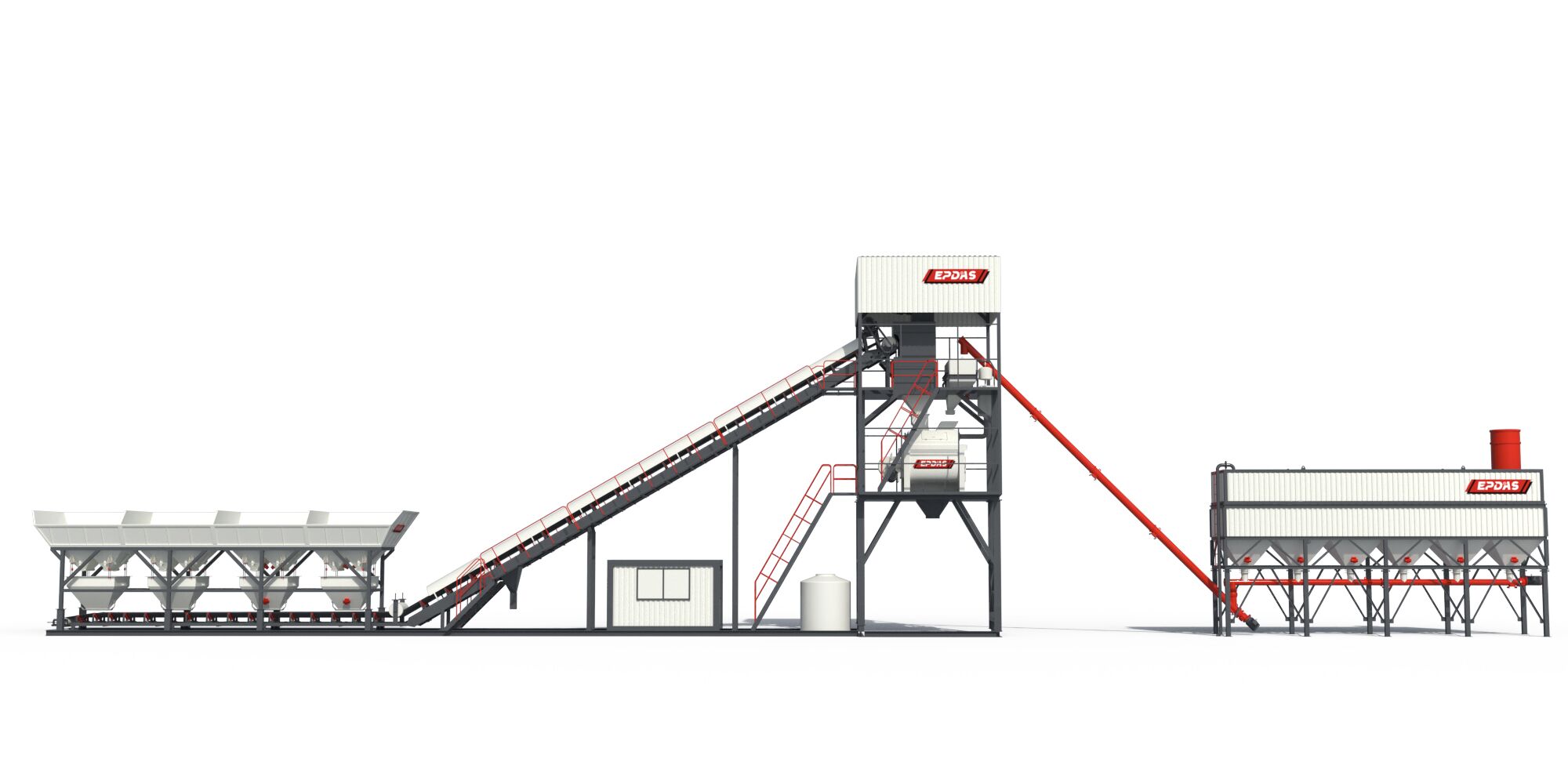
Foundation Free Concrete Plant
Foundation-free concrete batching plant is a high-efficiency concrete production equipment that adopts an integrated steel structure frame and modular design, eliminating the need for complex reinforced concrete foundation construction, enabling quick installation on hardened ground,
- Productivity:90-120 cubic meters /hour
- Model:MHZS90/120/180
What is a Foundation Free Concrete Batching Plant
A foundation free concrete batching plant fixes that once and for all. You won’t have to spend weeks digging, leveling, or pouring concrete just to support your mixing equipment. Instead, this system uses a heavy-duty custom steel chassis that holds all its key parts together: the mixing unit, batching system, material storage bins, and conveyor belts, all in one seamless setup. All you need to do is find a flat spot on your site, smooth it out a little, lock down the plant’s built-in support legs, and you’re ready to mix.

- Foundation-Free Concrete Batching Plant
| Model | MHZS90 | MHZS120 | MHZS180 |
| Central mixing console | JS1500 | JS2000 | MAO3000 |
| Productivity | 90 cubic meters /hour | 120 cubic meters /hour | 180 cubic meters /hour |
| Main structure | Mixing platform steel frame + free base steel frame | ||
| Aggregate Storage | 4 boxes * 8m3 | 4 boxes* 12m3 | 4 boxes* 20m3 |
| Aggregate feed type | Belt conveyor (B=800mm, 22kw) | Belt conveyor (B=1000mm, 37kw) | Belt conveyor (B=1000mm, 45kw) |
| Aggregate waiting box | No | Yes | Yes |
| Aggregate weighing system | 4 sets (independent) | 4 sets (independent) | 4 sets (independent) |
| Cement weighing system | 2 sets (+ physical dust collector) | 2 sets (+ Electrostatic precipitator) | 2 sets (+Pulse dust collector) |
| Water weighing system | 1 Set (+1.5m3 plastic water tank) | 1 Set (+10m3 steel plate water tank) | 1 Set (+10m3 steel plate water tank) |
| Liquid Additive Weighing System | 1 Set (+2m3 plastic liquid tank) | 1 Set (+4m3 plastic liquid tank) | 2 sets (+8m3 plastic liquid tank) |
| Stirring power | 2*30kW | 2*37 kW | 2*55kW |
| Total Power | 113 kW | 136 kW | 200 kW |
| Dimensions | 30m*4m*10m | 36m*4.2m*12m | 46.5m*4.3m*13m |
| Gross weight | 28 tons | 35 tons | 42 tons |
| Overall shape | The entire factory is lined up in a row, with free basic design. | ||

Cost Details of Foundation Free Concrete Batching Plants
Investing in a foundation free concrete batching plant is a smart choice for cutting construction timelines and site preparation costs, but understanding its full cost breakdown, from base price to hidden fees and long-term value, is key to making a cost-effective purchase. Whether you’re planning small-scale projects or large infrastructure builds, clarifying these cost factors ensures you get the right plant without overspending on unnecessary features or unexpected expenses.
- Base Price: What Determines How Much You’ll Pay
Figuring out how much a foundation-free plant costs is simple. It comes down to three things: how much concrete it can make per hour, the brand, and any extra features you add. Bigger plants that make more concrete cost more, obviously. Well-known brands cost a bit more, but they use better parts that last longer,so you won’t have to fix or replace things as often. Extra features like remote control or cold-weather heaters add to the price, too. Stick to what you actually need and no point paying for things that won’t help your project.
- Hidden Costs: Don’t Let These Sneak Up on You
A lot of people forget about hidden costs when they buy a foundation free concrete batching plant and those costs can add up fast.
First transportation: these plants are heavy, so you’ll need a special truck to move them, especially if you’re shipping across the country or to a remote site.
Then installation: medium or large plants need a crane and a small crew to set up, which usually costs 5% to 10% of the plant’s base price.
Last maintenance: mixing blades and liners wear out over time, and you need to pay for regular checks to keep the control system running. - ROI Comparison: Foundation-Free VS Traditional Batching Plants
At first glance, foundation-free plants might seem just as expensive as traditional ones or maybe even a little more. That's not the case. A traditional 90 cubic meter per hour plant might cost 200,000 yuan just for the foundation alone. With a foundation-free model, you skip that cost entirely. And since you can reuse the plant for multiple projects, you don’t have to buy a new one every time you move sites.
- Money-Saving Tips: Get the Best Deal Without Wasting Cash
When you’re shopping for a plant, don’t just pick the first supplier you find. Get quotes from a few different companies, and make sure you’re comparing apples to apples from capacity to features. Avoiding extra parts or services into the price, so ask for a breakdown of what you’re paying for. If you don’t need remote control, don’t pay for it. And if your project only needs a small amount of concrete, don’t buy a big one. Buying exactly what you’ll use is the best way to save money in the long run.
How Does a Foundation Free Concrete Plant Work
This video provides a detailed static inspection of our foundationless concrete batching plant, paused mid-operation. Explore the robust engineering, integrated steel ground frames, and core component layouts that deliver high stability without traditional concrete foundations.
Suitable Scenarios for Foundation Free Concrete Batching Plants
Foundation free concrete batching plants stand out for their quick setup, easy relocation and strong adaptability to diverse terrains, making them the ideal concrete production solution for projects with mobile construction needs, remote work sites or tight timelines and budgets.
- Highway, Bridge, and Expressway Projects
They are spread out, with multiple work sites, and almost always on tight schedules. Foundation free plants are perfect for this, which you can move it from one section of the project to another, without having to build a new foundation every time. If a storm washes out a road, you can get the plant to the site quickly, mix concrete, and fix the damage fast.
- Infrastructure and Public Engineering Projects
Projects like rural water supply systems, small reservoirs, and rural road paving usually have tight budgets and remote sites. Foundation free plants are cheap to set up and easy to move so that you don’t have to spend money prepping the site for a foundation. Meanwhile, they work well on rough terrain, too. It’s simple, affordable, and perfect for small to medium-sized projects.
- Precast and Ready-Mix Concrete Operations
If you make precast parts like slabs or piles, you might need extra mixing capacity for a short time, or you might need to move production to a different factory. A foundation free plant is satisfied with your needs. For small ready-mix suppliers, these plants are a game-changer too. You can drive the plant right to your customer’s site, mix concrete on the spot, and save money on transportation costs.
- Mining and Quarry Sites
Mines and quarries are usually in remote areas, with bad roads. Getting concrete delivered there is expensive and slow. A foundation free plant solves that: you can drive it right to the site, mix concrete where you need it, and avoid the hassle of hauling concrete long distances. Whether you’re building a mine road, a machine room, or a retaining wall, the plant can handle it.
How to Choose the Right Foundation Free Concrete Batching Plant for Your Needs
Selecting the ideal foundation free concrete batching plant boils down to aligning the equipment’s capacity, design, and quality with your project’s unique requirements from daily concrete output and site conditions to long-term reliability and after-sales support.
- 01
Figure Out What Your Project Actually Needs
Ask yourself: How much concrete do I use every day? If you’re building a small house, 10 to 25 cubic meters per hour is enough. If you’re working on a highway, you might need 50 cubic meters per hour or more. And check your site: if it’s small, get a compact plant. If it’s remote, pick one that’s easy to transport. If the soil is soft, make sure the plant has strong support legs to stay secure.
- 02
Check the Key Technical Details
The concrete you make is only as good as the plant mixing it. Look for a plant with a twin-shaft forced mixer, which blends cement, aggregates, and water evenly, so every batch is strong and consistent. If the measurements are off, your concrete won’t be strong enough, which can ruin your project and cost you more money later. Don’t forget safety: make sure the plant has emergency stop buttons and overload protection to keep your crew safe.
- 03
Make Sure the Supplier Is Reliable
Not all suppliers are the same. Check if they have certifications like ISO9001 or CE, which shows they follow strict quality standards. Ask to see their past projects and have they worked on jobs like yours? What do their customers say about them?
- 04
Test the Plant Before You Buy
Don’t just take the supplier’s word for it and ask them to show you the plant in action. Whether they show you how it runs, how easy it is to operate, and how well it mixes concrete. Ask for a trial run: have them mix concrete using your project’s ratio, so you can check the quality and speed for yourself. Compare a few different plants and choose one that fits your budget.
Core Advantages of Foundation Free Concrete Batching Plants
- Cost Optimization: Cut Expenses by Over 30%
The biggest way these plants save you money is simple: no more foundation costs. Think about it, hiring excavators, road rollers, and a crew to pour and finish a traditional foundation takes weeks and costs a fortune, while you skip all that with a foundation-free plant. A quick check to make sure the ground is flat is all it takes to get the plant installed.
- Rapid Deployment: Start Mixing in Days, Not Weeks
Every part is pre-assembled and tested at the factory, no more piecing together components on-site, which always takes longer than you think. When the plant arrives at your site, you just need a crane to lift the modules into place, secure the support legs, and run a quick check to make sure everything’s working. Most standard models are up and running in 7 to 10 days, and smaller units can start mixing in just a couple of days.
- Unbeatable Flexibility: Works Anywhere You Need It
Traditional batching plants that need solid soil, a ton of space, and hours of prep work just to get set up. Foundation-free plants don’t have any of those demands. Whether you’re working in a remote mountain area, a rural community, or even a tight urban spot, all you need is a flat patch of ground. When your project wraps up, just take the plant apart, load it onto a truck, and move it to your next job.
- Strong Versatility: Fits Every Project Type
These plants are compact, so they don’t take up much space, even in tight urban sites where you’re working near homes or other buildings. And they’re not limited to just one type of concrete, either. Whether you need ready-mix for a house, stiff concrete for a road base, or lightweight concrete for a bridge, this plant can handle it. It works for roads, houses, utility projects. Whatever your job calls for, it’s up to the task.
- Green and Eco-Friendly: Meets Modern Construction Standards
Nowadays, every construction project has to think about the environment and these plants make it easy. Because it doesn’t need to dig up huge chunks of soil to build a foundation, so you cut down on construction waste and keep the site’s natural terrain intact. That means lower carbon emissions, too. Most models have enclosed operations, so dust and noise stay low without complaints from nearby residents.
- Easy to Operate: No Specialized Training Needed
Don’t need to hire experts to run these plants, because they’re designed to be simple to use. The control panel has big, clear icons, and all the important buttons are in one place. Switching between batching, mixing, and discharging is just a push of a button, no complicated dials or endless parameters to check. Your existing crew can learn to operate it in just a few days of quick training.
EPDAS Foundation Free Concrete Plant Projects
Equipment Details Display of Foundation Free Concrete Batching Plants
Foundation free concrete batching plant adopts an integrated modular steel frame, needing no reinforced concrete foundation but only hardened level ground for use. It enables fast deployment, low cost and flexible transportation, with stable performance, ideal for temporary construction, road & bridge engineering and mobile concrete supply.
Foundation Free Concrete Plant FAQs
- How do I choose the right concrete batching plant for my project?
To choose the right concrete batching plant, consider factors such as required output capacity, project duration, site size, and budget. Mobile concrete batching plants are suitable for temporary or remote projects, while stationary batching plants are ideal for long-term, high-capacity concrete production. We are a Professional supplier and can help you select the most efficient solution.
- What types of mixers are used in concrete batching plants?
Concrete batching plants can be equipped with twin-shaft mixers, planetary mixers, pan mixers, or single-shaft mixers. Twin-shaft mixers are widely used in stationary concrete batching plants due to their high output and strong mixing performance, while planetary mixers are ideal for precast concrete and high-quality concrete production. Choosing the right mixer depends on concrete grade, production capacity, and project requirements.
- Can a concrete batching plant control system be customized?
Yes. The batching plant control system can be fully customized, including PLC brand, interface language, automation level, and data management functions. Advanced options include remote monitoring, automatic reporting, and production data storage, making the concrete mixing plant easier to operate and manage.
- What power supply standards can concrete batching plants support?
Concrete batching plants can be designed to match different international electrical standards, such as 380V 50Hz, 415V 50Hz, or 440V 60Hz. Electrical components are selected according to local power conditions to ensure safe and stable operation.
- Can concrete batching plants operate in extreme climates?
Yes. Customized concrete batching plants can be designed for hot, cold, dusty, or humid environments. Options include thermal insulation, heating systems, dust collectors, and corrosion-resistant materials to ensure reliable performance in harsh working conditions.
- What is the delivery time for a concrete batching plant?
The production time for a concrete batching plant usually ranges from 15 to 45 days, depending on capacity and customization requirements. Shipping time varies by destination. EPDAS can provide clear delivery schedules and export support.
- What should I do if the weighing is inaccurate and the concrete mix ratio has a large error?
If you notice weighing errors, stop production immediately and do not force the machine to run. Check these common issues first: Calibrate the sensors regularly: Weighing sensors can drift slightly over time. Calibrating them once a month will ensure continuous accuracy. Check for moisture and loose wiring: Inspect the sensors to see if they are damp or if the cables are loose. Fix any wiring issues right away. Prevent material buildup: Avoid overloading the aggregate bins. Leftover material can press against the weighing hopper and ruin the measurement. Clean out the bins daily.
- What are the wearable parts of the equipment and how often should they be replaced?
The core wearable parts are mainly located in the mixing and conveying systems. These include mixer blades, liners, conveyor belts, seals, and screw conveyor flights. Under normal use and proper daily maintenance, the estimated replacement intervals are as follows: Mixer blades and liners: 6 to 12 months Conveying belts: 1 to 2 years Seals and lubrication components: Inspect and replace every 3 to 6 months The exact lifespan depends on your production frequency and the abrasiveness of your materials. We highly recommend keeping a small stock of these wear parts in advance to prevent unexpected downtime and project delays.
- How is the mobile concrete batching plant transported?
Transportation is highly convenient and generally split into two types based on the equipment design: Towed (Trailer-mounted) models: These units are built on a heavy-duty chassis with wheels and can be easily towed directly to the job site by a standard truck head. Self-propelled models: These units are equipped with their own driving power system and can move independently around the site or short distances without requiring extra towing vehicles. Both options are engineered for rapid relocation and can be quickly prepared for transport to keep your project moving efficiently.
- Is a foundation-free concrete batching plant more cost-effective than a traditional one?
Yes, it is definitely more cost-effective for temporary projects or jobs that require frequent relocation. While the initial equipment purchase prices are similar, the foundation-free model eliminates the expensive civil engineering costs of pouring a permanent concrete foundation. The entire setup can be reused at next job sites, which saves a significant amount of money over the long term. On the other hand, if you are running a long-term, fixed-location factory, a traditional batching plant might offer slightly better long-term stability.
- Can cement silos be used to store materials other than cement?
Yes. You can store any dry, powder-like materials such as fly ash, lime, and slag powder without major modifications. Just make sure to avoid cross-contamination by keeping different materials in separate silos. Note: If storing highly corrosive materials, a specialized anti-corrosion coating is required.
- Can screw conveyors handle vertical transport?
Yes, but only for short distances. Vertical transport requires short-pitch screw flights and strict feed rate control to prevent material backflow. Because vertical transport consumes much more power, we recommend using an inclined conveyor instead if space permits to reduce energy costs and mechanical wear.
- What should I do if the screw shaft makes unusual noises?
Stop the machine and check these three main causes to troubleshoot the issue: Blade-to-trough friction: Check the alignment of the screw shaft. Adjust its level and straightness to stop the blades from scraping the trough wall. If blades are unevenly worn, grind or replace them. Damaged bearings: Turn off the power and check the bearings for wear. Replace any damaged bearings immediately and apply fresh lubricant. Material jamming: Clear out any blocked material inside the trough. Control the feeding speed to prevent overloading, and inspect the screw flights for any deformation.
- What causes the screw conveyor motor to overheat and how do I fix it?
Motor overheating is usually caused by four common issues. Follow these steps to fix them: Overloading: Reduce the feeding speed and clear any jammed material inside the trough. If the conveyor regularly operates under heavy loads, consider upgrading to a motor with higher power. Poor heat dissipation: Clean off any dust and debris from the motor surface to ensure the cooling vents are clear. Avoid running the motor in high-temperature environments for too long. Jammed bearings: Inspect the bearings for wear and tear. Apply fresh grease, and replace them immediately if they are damaged. Wiring faults: Check the electrical connections for loose wiring or aging cables. Repair or replace the damaged wiring right away.
- What should I do if the screw conveyor leaks material during operation?
Material leakage is usually caused by seal failures or structural wear. Check these three areas to fix it: Damaged seals: Inspect the trough seals and O-rings. Replace any aging or broken sealing components immediately to restore a tight seal. Trough or blade wear: Check for holes or thinned areas on the trough walls and screw flights. Repair or replace the worn sections right away, and set up a regular inspection schedule. Inlet/Outlet leaks: Adjust the sealing mechanisms at both the feeding inlet and discharge outlet. Install extra gaskets or sealing pads to stop materials from escaping.

Customize Your Solutions
Contact us now via Email:info@epdas.com, or Whatsapp:+86 188 38115507 , or fill in the form below.
FEW TIPS:
- Please describe the capacity per hour of the batching plant (e.g., 25m³/h-240m³/h).
- Please tell us the project location (please specific the city).
- Please tell us your project start-up date.
- Please detail your specific requirements or expectations (e.g., batching plant type, voltage,automation, climate, etc.).
- If you are interested in becoming our distributor, please let us know.
Service Process:
- Business negotiation
- Solution development
- Manufacturing and commissioning
- Operational production