
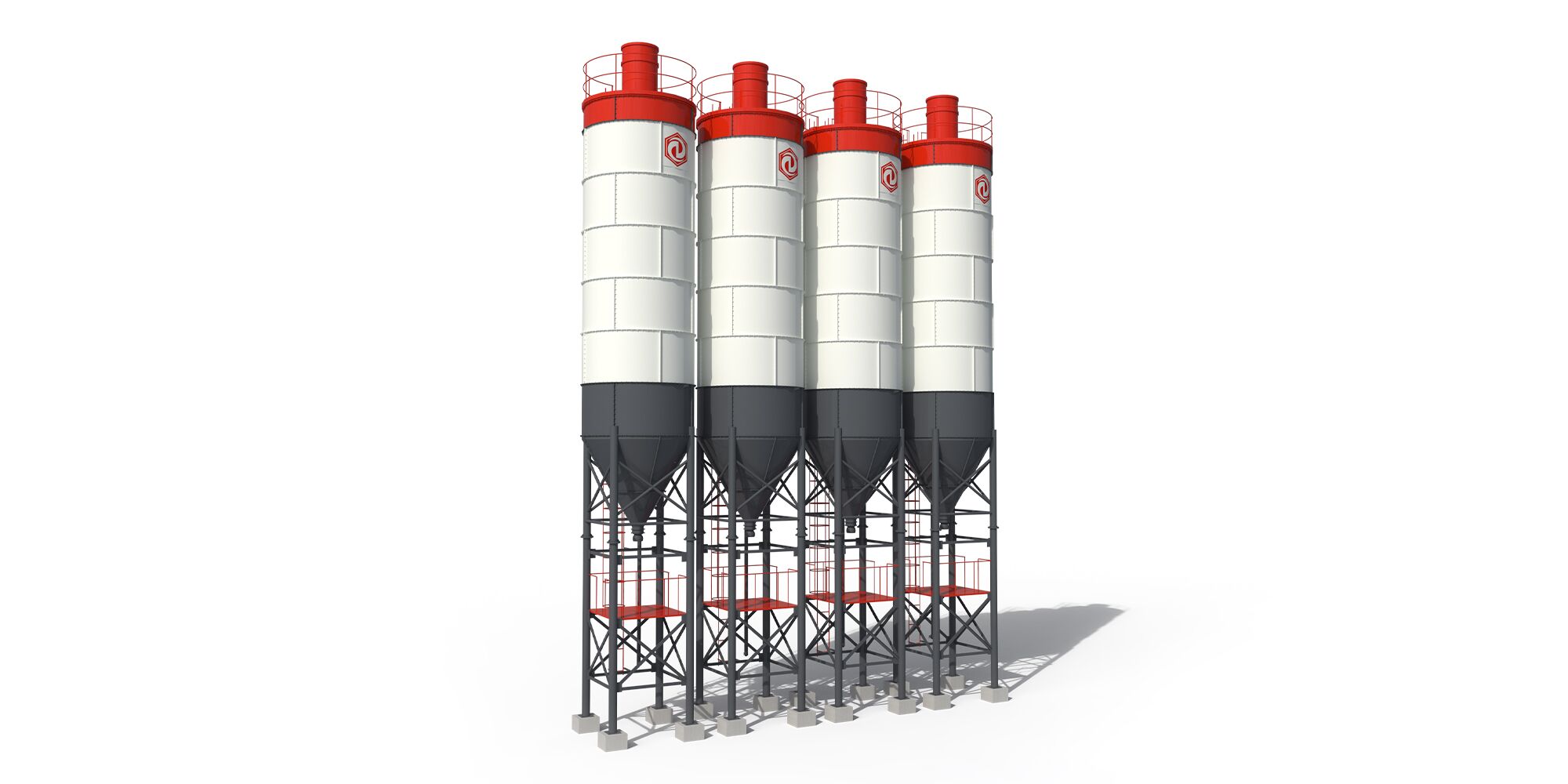
Cement Silo
A cement silo is a sealed storage tank for bulk cement, featuring good airtightness to prevent moisture. It has automated unloading, suits construction sites, and cuts material waste and labor costs effectively.
- Height:4.8-22.2m
- Main types:Horizontal/Vertical
What is a Cement Silo
Cement silo isn’t just a metal tank. It’s the only way to keep cement, fly ash, lime and all dry powdery materials which is usable on construction sites. Cement storage silo units are sealed for a reason: moisture ruins everything fast. One small leak, a little rain seepage, and your cement cakes hard, useless, wasted money and wasted time. That’s why a sealed silo isn’t an add-on. It’s the first thing you need for any job that mixes concrete.

- Vertical Cement Silo
- Horizontal Cement Silo
- Mobile Cement Silo VS Stationary Cement Silo
Vertical cement silos are probably the most common choice you’ll see on concrete batching sites. The structure is usually a simple upright cylinder, mainly because it saves a lot of ground space. On busy construction sites, that matters more than people think. Since the silo works with vertical height, storage can go anywhere from around 50 tons to as high as 1,000 tons, depending on the setup.
| Capacity | Diameter of silo | Height of silo | Total Height | Assort with mixer | Assort with screw conveyor |
| 30T | Φ3m | 4.8m | 11.4m | JD350 | Φ140/Φ168 |
| 50T | Φ3m | 5.4m | 12m | JS500/JS750 | Φ168/Φ219 |
| 80T | Φ3m | 9m | 15.6m | JS750/JS1000 | Φ219 |
| 100T | Φ3m | 11.4m | 18m | JS1000-JS2000 | Φ219/Φ273 |
| 150T | Φ3.3m | 23.5m | 29m | JS1000-JS3000 | Φ273 |
| 200T | Φ4.5m | 18.6m | 25.2m | JS1500-JS3500 | Φ273/Φ323 |
| 300T | Φ4.5m | 24.6m | 29.5m | JS2000-JS4000 | Φ323/Φ407 |
| 500T | Φ6M | 22.2m | 28.8m | JS3000-JS6000 | Φ407 |
Horizontal cement silos feel quite different in practice. They sit flat on the ground and have a long, low shape, which makes them easier to transport and reposition when needed. That’s also the reason they’re often used on temporary sites or projects that don’t stay in one place for too long.
| Capacity | Diameter of silo | Height of silo | Total Height | Assort with mixer | Assort with screw conveyor |
| 30T | Φ3m | 4.8m | 11.4m | JD350 | Φ140/Φ168 |
| 50T | Φ3m | 5.4m | 12m | JS500/JS750 | Φ168/Φ219 |
| 80T | Φ3m | 9m | 15.6m | JS750/JS1000 | Φ219 |
| 100T | Φ3m | 11.4m | 18m | JS1000-JS2000 | Φ219/Φ273 |
| 150T | Φ3.3m | 23.5m | 29m | JS1000-JS3000 | Φ273 |
| 200T | Φ4.5m | 18.6m | 25.2m | JS1500-JS3500 | Φ273/Φ323 |
| 300T | Φ4.5m | 24.6m | 29.5m | JS2000-JS4000 | Φ323/Φ407 |
| 500T | Φ6M | 22.2m | 28.8m | JS3000-JS6000 | Φ407 |
Mobile cement silos are used in projects that require flexibility and fast setup. They are usually mounted on a trailer or skid base, so no concrete foundation is needed. Once delivered, they can often be put into operation in about 15 minutes without cranes or heavy equipment, improving on-site efficiency.
Stationary cement silos are designed for permanent batching plants and large projects. They offer higher capacity and stable continuous feeding, making them suitable for long-term, high-volume production.
Benefits of a High-quality Cement Silo
Many people think a cement silo is just a tank for storing cement, but it actually does much more than that. A good-quality silo helps prevent common site problems and can reduce long-term operating costs.
- Cut Cost Waste, Boost Cost Efficiency
Saves Your Budget Sealing is everything for a cement silo. In real construction conditions, even a tiny crack lets moisture in. Cement cakes in 3 days, sometimes less. We’ve seen 10% of a batch scrapped just because of a bad seal. Automated unloading helps too. One worker, no manual shoveling, no teams carrying cement bags, saving labor, saving time and saving cash.
- Keeps the Site Safe
Loading and unloading bulk powder is a messy business. Dust clouds are more than just a nuisance. They are a serious breathing hazard for your workers and a quick way to get environmental complaints. This is why a high-spec cement silo is essential. These units feature built-in filtration systems to trap dust right at the source. This keeps your site air clear and your entire operation cleaner.
Reliable sealing is also a major safety factor. A tight seal prevents material leaks that can lead to slips and messy site conditions. - Eliminates Unplanned Downtime
What construction sites fear most is running out of material and having to stop work. A cement silo solves this problem by storing a large amount of cement, ensuring a steady supply for concrete mixing and ongoing construction work. The level indicator shows the remaining material inside the silo in real time, so workers can plan refilling in advance and avoid sudden material shortages.
- Lasts for Years
Cement silos made from high-quality materials like galvanized steel are more resistant to corrosion and weather, so they can hold up well even after years of outdoor use. With regular basic maintenance, it’s common for them to last more than 10 years.
- Stabilizes Material Quality
Cement is very sensitive to moisture and impurities. Even a small amount of dampness or contamination can reduce concrete strength and affect project acceptance. A high-quality cement silo uses a fully sealed structure, with both feeding and discharging carried out in a closed system, effectively keeping out rain, moisture, and external impurities.
Inside the silo, level monitoring and aeration systems also help keep the cement loose and uniform, preventing issues like layering or hardening. With this kind of silo, each batch of concrete mixing becomes more stable, reducing problems such as rework, weak strength, or failed quality tests.
How to Choose a Cement Silo
Choosing a cement silo is not simply about getting the largest capacity or the lowest price. The key is whether it actually fits your real project needs. Below are a few key points that can help you avoid common mistakes.
Cement Silo Capacity Calculation:
First, you need to estimate how much cement your site uses per day or per week, and then match it with the project duration to decide the required storage capacity. For example, on a small job site where cement consumption is around 1–2 tons per day, a 50–100 ton cement silo is usually enough.
A simple and practical way to estimate it is as follows:
V = D × T
V: Recommended cement silo capacity (tons)
D: Daily cement consumption (tons/day)
T: Storage duration (usually 3–7 days is recommended)
For example, if a job site uses 10 tons of cement per day and plans to store a 5-day supply, then a cement silo with around 50 tons capacity is recommended.
If you are not sure about the exact parameters, it is better to contact us and get professional selection advice based on your project conditions.
Pick Structure & Mobility Based on Your Site Space tight
If the job site is limited in space, a vertical cement silo is usually preferred because it saves ground area. If there are height restrictions, such as in urban construction sites, a horizontal cement silo is a better option.
For short-term projects that require frequent relocation, a mobile cement silo is the best choice since it does not require a foundation and can be deployed quickly. While long-term stationary batching plants or precast facilities, a stationary cement silo is more suitable.
Focus on Material & Build Quality
In terms of material, galvanized steel silos are usually the preferred choice. They offer good corrosion resistance, are relatively easy to maintain, and work well for most job sites. When purchasing, pay attention to the thickness of the steel plates. In addition, take a close look at the sealing performance of the silo and how smoothly the discharge system operates. These details can have a direct impact on day-to-day use and overall reliability.
Add Practical Features
Some extra features aren’t strictly necessary, but they can make day-to-day operation easier and save time over the long run. Things like level indicators, dust collection systems, or automatic unloading can be added based on your budget and how you actually plan to use the silo.
Types of Cement Silos
On most job sites, you only need one type. It just depends on your space, how long you’re there, and if you need to move it. Stop Picking the Wrong One Cement silo types and just match the silo to the job.
- Material: Steel Cement Silo VS Concrete Cement Silo
90% of on-site teams use steel carbon or galvanized, because it’s tough, easy to move, and doesn’t rust. Cement silo steel units last 10+ years with basic care. While, concrete cement silo only for permanent mixing plants. They’re expensive, take forever to build, and can’t be moved.
- Structure: Vertical Cement Silo VS Horizontal Cement Silo
Vertical cement silos are probably the most common choice you’ll see on concrete batching sites. The structure is usually a simple upright cylinder, mainly because it saves a lot of ground space. On busy construction sites, that matters more than people think. Since the silo works with vertical height, storage can go anywhere from around 50 tons to as high as 1,000 tons, depending on the setup.
Horizontal cement silos feel quite different in practice. They sit flat on the ground and have a long, low shape, which makes them easier to transport and reposition when needed. That’s also the reason they’re often used on temporary sites or projects that don’t stay in one place for too long.
Because the height is low, loading and unloading are more straightforward, especially in urban construction areas where space and safety rules are tighter. Horizontal silos are generally better suited for small to medium projects rather than large continuous production. - Mobility: Mobile Cement Silo VS Stationary Cement Silo
Mobile cement silos are used in projects that require flexibility and fast setup. They are usually mounted on a trailer or skid base, so no concrete foundation is needed. Once delivered, they can often be put into operation in about 15 minutes without cranes or heavy equipment, improving on-site efficiency.
Stationary cement silos are designed for permanent batching plants and large projects. They offer higher capacity and stable continuous feeding, making them suitable for long-term, high-volume production.
What Determines Cement Silo Prices
Many buyers often ask about prices such as a 50-ton cement silo or a 300-ton cement silo. In fact, there is no fixed standard price for cement silos. The cost mainly depends on several key factors. Once these are clearly understood, it becomes much easier to see why prices can vary so much.
- 01
Capacity (50 tons vs 500 tons)
The larger the silo, the more steel material and fabrication work are required, which directly increases the cost. The price difference can be quite significant. In most cases, a 500-ton vertical cement silo can cost around 3–5 times more than a 50-ton mobile cement silo. A 200-ton silo usually falls somewhere in between.
- 02
Material (Carbon steel vs galvanized steel)
Standard carbon steel is more affordable, but it has weaker resistance to corrosion and weather exposure. Galvanized steel, on the other hand, comes at a higher cost but offers a much longer service life. In the long run, it is often more cost-effective. For example, a 100-ton galvanized cement silo is typically slightly more expensive than a regular carbon steel model of the same capacity.
- 03
Type (Mobile vs fixed silo)
Mobile cement silos are generally more expensive than fixed ones of the same capacity because they come with a trailer frame and are designed for fast deployment. This makes manufacturing more complex. They are commonly used in short-term projects or sites that require frequent relocation.
- 04
Configuration (dust collector, level sensors, automation system)
Basic models only include standard storage and discharge functions. If you add features such as automatic unloading, smart level monitoring, or high-efficiency dust collection systems, the price will increase accordingly. For instance, a 200-ton silo with upgraded automation features can be around 20% more expensive than a basic version.
- 05
Transportation and installation costs
Shipping and installation can also significantly affect the final price, especially for remote job sites or large-capacity silos that require heavy lifting equipment. Costs vary depending on distance and installation difficulty. For example, installing a 300-ton vertical silo usually costs much more than a 100-ton unit due to crane and labor requirements.
Cement Silo Maintenance Guide & Common Problem Solving
- Daily Maintenance 01:
Before daily operation, check the dust collection system and clean out any accumulated powder inside the dust collector to ensure proper performance. If the system becomes blocked, dust may spread during feeding, and it can also affect the internal pressure of the silo.
- Daily Maintenance 02:
Inspect the discharge system to make sure the screw conveyor is running smoothly, without jamming or abnormal noise.
- Daily Maintenance 03:
Check the level indicator to confirm the remaining material in the silo and plan refilling accordingly. At the same time, inspect the silo body for sealing conditions, looking for any signs of leakage or cracks, and address any issues as soon as they are found.
- Regular Overhauls 01:
Every month, carry out a full inspection of the cement silo, with a focus on corrosion of the silo body. Pay special attention to the bottom section and connection points, where rust is more likely to appear.
- Regular Overhauls 02:
On a quarterly basis, check the vibration devices and aeration system to make sure they are operating normally and not showing signs of damage. Replace any worn or aging parts in time to avoid unexpected failures.
- Regular Overhauls 03:
Once a year, a more comprehensive inspection should be carried out to assess the overall structural integrity of the silo and ensure it remains safe and reliable for continued use.
- Common Cement Silo Problems & Solutions 01:
One of the most common issues is material lumping, usually caused by moisture inside the silo. The fix is fairly simple. Keep the silo properly sealed in daily use to prevent water from entering. If lumps have already formed, the vibration system can be activated to break them up.
- Common Cement Silo Problems & Solutions 02:
Another frequent problem is discharge blockage. This is often related to poor material flow or debris at the outlet. In such cases, the aeration system can be turned on to improve material flow, while any blockage at the discharge opening should be cleared to restore smooth unloading.
- Common Cement Silo Problems & Solutions 03:
If dust leakage occurs, it is usually caused by a blocked dust collector or aging seals. Cleaning the dust collection system and replacing worn sealing parts will typically resolve the issue.
EPDAS Cement Silo Projects
Equipment Details Display of Cement Silo
Cement silo comprises heavy-duty steel structural frames, high-efficiency top dust collectors, automatic pressure safety valves, reliable fluidization arch-breaking devices and anti-corrosive level indicators, all made of premium materials with rigorous quality control for durable, reliable structural and component performance.
Cement Silo FAQs
- How do I choose the right concrete batching plant for my project?
To choose the right concrete batching plant, consider factors such as required output capacity, project duration, site size, and budget. Mobile concrete batching plants are suitable for temporary or remote projects, while stationary batching plants are ideal for long-term, high-capacity concrete production. We are a Professional supplier and can help you select the most efficient solution.
- What types of mixers are used in concrete batching plants?
Concrete batching plants can be equipped with twin-shaft mixers, planetary mixers, pan mixers, or single-shaft mixers. Twin-shaft mixers are widely used in stationary concrete batching plants due to their high output and strong mixing performance, while planetary mixers are ideal for precast concrete and high-quality concrete production. Choosing the right mixer depends on concrete grade, production capacity, and project requirements.
- Can a concrete batching plant control system be customized?
Yes. The batching plant control system can be fully customized, including PLC brand, interface language, automation level, and data management functions. Advanced options include remote monitoring, automatic reporting, and production data storage, making the concrete mixing plant easier to operate and manage.
- What power supply standards can concrete batching plants support?
Concrete batching plants can be designed to match different international electrical standards, such as 380V 50Hz, 415V 50Hz, or 440V 60Hz. Electrical components are selected according to local power conditions to ensure safe and stable operation.
- Can concrete batching plants operate in extreme climates?
Yes. Customized concrete batching plants can be designed for hot, cold, dusty, or humid environments. Options include thermal insulation, heating systems, dust collectors, and corrosion-resistant materials to ensure reliable performance in harsh working conditions.
- What is the delivery time for a concrete batching plant?
The production time for a concrete batching plant usually ranges from 15 to 45 days, depending on capacity and customization requirements. Shipping time varies by destination. EPDAS can provide clear delivery schedules and export support.
- What should I do if the weighing is inaccurate and the concrete mix ratio has a large error?
If you notice weighing errors, stop production immediately and do not force the machine to run. Check these common issues first: Calibrate the sensors regularly: Weighing sensors can drift slightly over time. Calibrating them once a month will ensure continuous accuracy. Check for moisture and loose wiring: Inspect the sensors to see if they are damp or if the cables are loose. Fix any wiring issues right away. Prevent material buildup: Avoid overloading the aggregate bins. Leftover material can press against the weighing hopper and ruin the measurement. Clean out the bins daily.
- What are the wearable parts of the equipment and how often should they be replaced?
The core wearable parts are mainly located in the mixing and conveying systems. These include mixer blades, liners, conveyor belts, seals, and screw conveyor flights. Under normal use and proper daily maintenance, the estimated replacement intervals are as follows: Mixer blades and liners: 6 to 12 months Conveying belts: 1 to 2 years Seals and lubrication components: Inspect and replace every 3 to 6 months The exact lifespan depends on your production frequency and the abrasiveness of your materials. We highly recommend keeping a small stock of these wear parts in advance to prevent unexpected downtime and project delays.
- How is the mobile concrete batching plant transported?
Transportation is highly convenient and generally split into two types based on the equipment design: Towed (Trailer-mounted) models: These units are built on a heavy-duty chassis with wheels and can be easily towed directly to the job site by a standard truck head. Self-propelled models: These units are equipped with their own driving power system and can move independently around the site or short distances without requiring extra towing vehicles. Both options are engineered for rapid relocation and can be quickly prepared for transport to keep your project moving efficiently.
- Is a foundation-free concrete batching plant more cost-effective than a traditional one?
Yes, it is definitely more cost-effective for temporary projects or jobs that require frequent relocation. While the initial equipment purchase prices are similar, the foundation-free model eliminates the expensive civil engineering costs of pouring a permanent concrete foundation. The entire setup can be reused at next job sites, which saves a significant amount of money over the long term. On the other hand, if you are running a long-term, fixed-location factory, a traditional batching plant might offer slightly better long-term stability.
- Can cement silos be used to store materials other than cement?
Yes. You can store any dry, powder-like materials such as fly ash, lime, and slag powder without major modifications. Just make sure to avoid cross-contamination by keeping different materials in separate silos. Note: If storing highly corrosive materials, a specialized anti-corrosion coating is required.
- Can screw conveyors handle vertical transport?
Yes, but only for short distances. Vertical transport requires short-pitch screw flights and strict feed rate control to prevent material backflow. Because vertical transport consumes much more power, we recommend using an inclined conveyor instead if space permits to reduce energy costs and mechanical wear.
- What should I do if the screw shaft makes unusual noises?
Stop the machine and check these three main causes to troubleshoot the issue: Blade-to-trough friction: Check the alignment of the screw shaft. Adjust its level and straightness to stop the blades from scraping the trough wall. If blades are unevenly worn, grind or replace them. Damaged bearings: Turn off the power and check the bearings for wear. Replace any damaged bearings immediately and apply fresh lubricant. Material jamming: Clear out any blocked material inside the trough. Control the feeding speed to prevent overloading, and inspect the screw flights for any deformation.
- What causes the screw conveyor motor to overheat and how do I fix it?
Motor overheating is usually caused by four common issues. Follow these steps to fix them: Overloading: Reduce the feeding speed and clear any jammed material inside the trough. If the conveyor regularly operates under heavy loads, consider upgrading to a motor with higher power. Poor heat dissipation: Clean off any dust and debris from the motor surface to ensure the cooling vents are clear. Avoid running the motor in high-temperature environments for too long. Jammed bearings: Inspect the bearings for wear and tear. Apply fresh grease, and replace them immediately if they are damaged. Wiring faults: Check the electrical connections for loose wiring or aging cables. Repair or replace the damaged wiring right away.
- What should I do if the screw conveyor leaks material during operation?
Material leakage is usually caused by seal failures or structural wear. Check these three areas to fix it: Damaged seals: Inspect the trough seals and O-rings. Replace any aging or broken sealing components immediately to restore a tight seal. Trough or blade wear: Check for holes or thinned areas on the trough walls and screw flights. Repair or replace the worn sections right away, and set up a regular inspection schedule. Inlet/Outlet leaks: Adjust the sealing mechanisms at both the feeding inlet and discharge outlet. Install extra gaskets or sealing pads to stop materials from escaping.

Customize Your Solutions
Contact us now via Email:info@epdas.com, or Whatsapp:+86 188 38115507 , or fill in the form below.
FEW TIPS:
- Please specify the storage capacity of the cement silo (e.g., 30T-2000T)
- Please indicate the discharge rate of the cement silo (e.g., 5T/h-50T/h)
- Please confirm the applicable material type of the cement silo
- Please state the overall height of the cement silo (e.g., 8m-20m)
- If you are interested in becoming our distributor, please let us know.
Service Process:
- Business negotiation
- Solution development
- Manufacturing and commissioning
- Operational production