
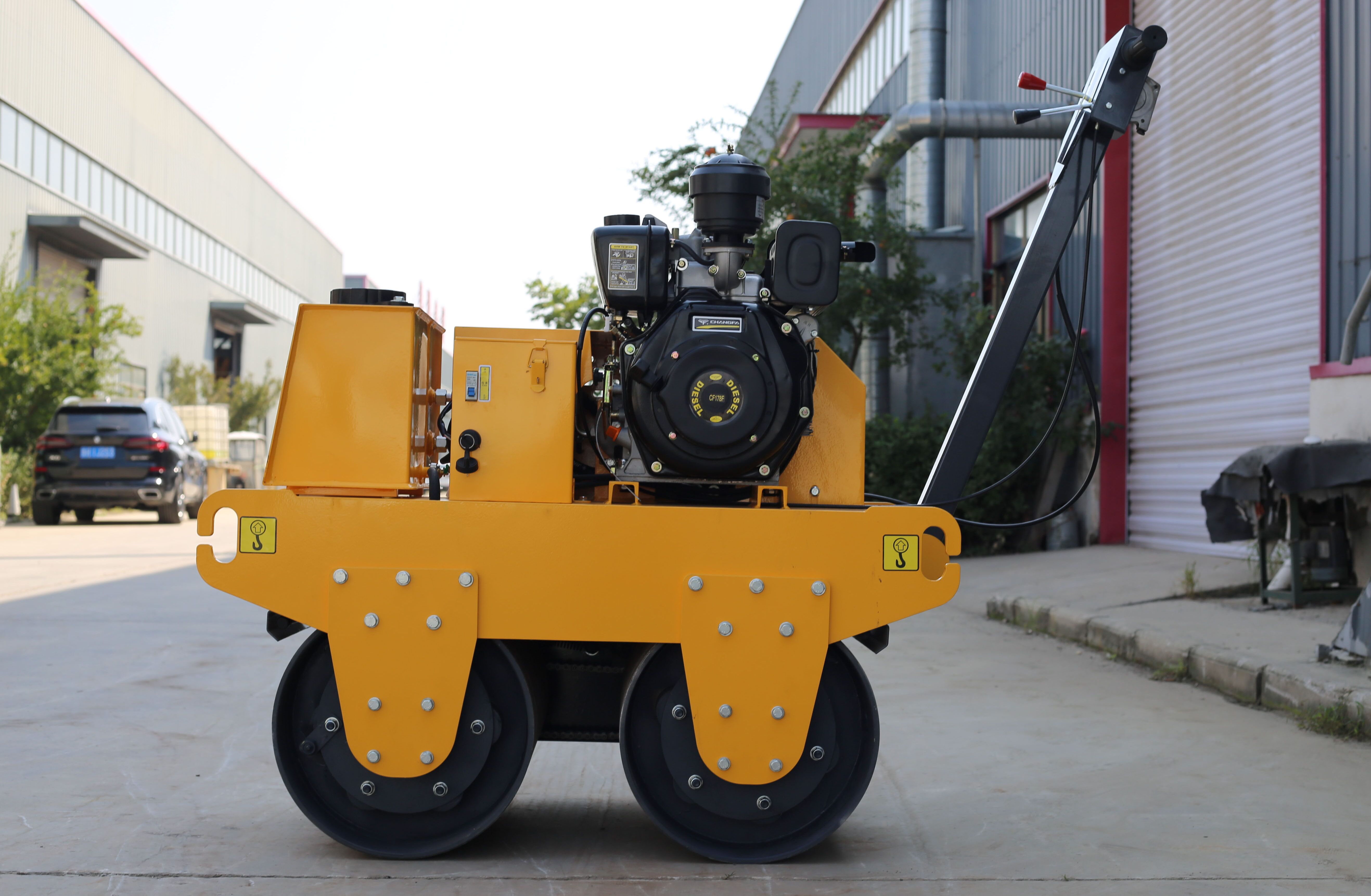
Mini Road Roller
The mini road roller is designed to deliver reliable surface finishing and soil stabilization for various construction applications. Equipped with efficient vibration and rolling systems, it provides consistent compaction results on asphalt, gravel, and soil layers. Its practical design helps contractors improve work quality, reduce labor requirements, and achieve better control during daily construction operations.
- Steel Drum Qty.:1~2
- Drum Width:450~1100mm
What is a Mini Road Roller?
The mini road roller is a lightweight and compact road compaction machine, which is specially designed for narrow construction scenarios where large road rollers cannot operate. Unlike traditional heavy-duty compaction equipment, its machine size is small, steering is flexible, and transportation is convenient. It can adapt to various small projects, road surface repair, and fine compaction operations.
Compared with simple compaction methods such as manual compaction and plate compaction, mini road rollers have higher operation efficiency and more uniform compaction performance. They are the core compaction equipment for small and medium-sized construction projects and municipal maintenance projects.
- Mini Road Roller
| Models | YL450 | YL600A | YL600C | YLS450 | YLS600A | YLS600B |
| Engine | Gasoline | Gasoline | Diesel | Diesel | Gasoline | Diesel |
| Starting Method | Recoil Start | Recoil Start | Electric Start | Electric Start | Recoil Start | Electric Start |
| Steel Drum Size | 450*φ426mm | 600*φ426mm | 600*φ426mm | Front Drum 450*φ426mm,Rear Drum 450*φ426mm | Front Drum 600*φ426mm,Rear Drum 600*φ426mm | Front Drum 600*φ426mm,Rear Drum600*φ426mm |
| Machine Weight | 260kg | 305kg | 342kg | 450kg | 480kg | 516kg |
| Overall Dimensions (Handle Folded) | 1050*590*1100mm | 1650*760*1100mm | 1650*760*1100mm | 1650*590*1100mm | 2450*780*1150mm | 2450*780*1150mm |
| Models | YLS600C | JSY700 | JS800 | JS1000 | JS3500 | JS6000 |
| Engine | Water-Cooled Diesel | Diesel | ||||
| Starting Method | Electric Start | |||||
| Steel Drum Size | Front Drum 600*φ426mm, Rear Drum 600*φ426mm | Front Drum 700*φ530mm, Rear Drum 700*φ530mm | Front Drum 800*φ530mm, Rear Drum 800*φ530mm | Front Drum 1000*φ610mm, Rear Drum 1000*φ610mm | Front Drum 1200*φ920mm | Front Drum 1450*φ1060mm |
| Machine Weight | 550kg | 970kg | 1070kg | 1580kg | 2750kg | 5200kg |
| Overall Dimensions (Handle Folded) | 2450*780*1150mm | 2100*860*2070mm | 2200*920*2070mm | 2300*1120*2150mm | 3600*1350*2300mm | 4560*1650*2600mm |
Core Application Scenarios of Mini Road Rollers
The core advantage of mini road rollers is their ability to adapt to various restricted construction scenarios and solve common industry problems, such as large equipment being unable to access the site and poor compaction quality caused by manual construction. The specific application scenarios cover many fields, including municipal construction, infrastructure, landscaping, and municipal maintenance.

- Repair and construction of asphalt pavement
In urban roads, community roads, pothole repairs, and partial repaving operations, it is difficult for large road rollers to approach roadsides, manhole covers, green belts, and other edge areas.
The mini road roller can operate close to the construction edges, complete uniform compaction of the asphalt surface layer, and ensure that the repaired road surface maintains consistent flatness with the original pavement. - Construction of sidewalks and slow-moving systems
The construction space of sidewalks, pedestrian streets, and community walkways is narrow, and paving materials are relatively fine. Heavy equipment may easily damage surrounding facilities.
The mini road roller has a compact body and controllable compaction force. It can accurately complete the compaction operation of the road foundation and paving layer, meeting the requirements of refined municipal construction. - Parking lot and small site paving
The construction scope of outdoor parking lots, community parking spaces, and small sports venues is scattered, and the working areas are often narrow.
The mini road roller offers convenient transportation and flexible operation. It can complete sectional compaction operations, ensure the overall flatness of the site, and meet the load-bearing requirements of daily vehicle traffic and site use. - Construction of garden landscape engineering
Outdoor construction scenarios such as garden paths, landscape platforms, and courtyard floors have high requirements for equipment flexibility and construction accuracy.
The mini road roller will not damage surrounding green plants and landscape facilities. It can complete the compaction of roadbeds and sand-gravel cushion layers, and adapt to various landscape supporting projects. - Municipal pipeline backfill compaction
The backfill compaction operation after the installation of underground pipelines, cables, and utility lines is a high-frequency application scenario for mini road rollers.
Manual backfill compaction is prone to problems such as loose soil layers and later settlement. Mini road rollers can complete layered compaction around trenches to ensure the density and stability of the backfill soil layer and avoid later pavement settlement.
Mini Road Rollers Selection Guide
Different construction scenarios and materials require different equipment models and configuration requirements. Selecting the right equipment according to the actual project conditions can not only meet construction standards but also avoid excessive equipment performance and unnecessary cost waste.
- Select according to equipment weight
For small repair projects, landscape walkways, and sidewalk construction, priority can be given to lightweight models weighing 300-600kg. The compact body provides flexible operation and convenient transportation, which is sufficient to meet the requirements of shallow compaction.
For conventional projects such as asphalt pavement, parking lots, and daily road maintenance, medium-sized models weighing 700-1200kg are recommended. They provide moderate compaction performance and offering the best balance between performance and versatility, making them the mainstream choice for commercial construction applications.
For high-intensity operations such as road foundation reinforcement, earth backfill, and deep soil compaction, heavy-duty models above 1200kg can be selected. They provide better deep compaction performance and can meet the requirements of high-standard road foundation construction.
- Select according to construction materials
Asphalt pavement construction focuses on surface flatness and smoothness, making double steel wheel models a suitable choice. The front and rear steel wheels perform synchronous compaction, providing uniform compaction results and reducing surface marks.
Soil, sand, and backfill layer construction require higher compaction depth. Models with greater excitation force can be selected, relying on high-frequency vibration to consolidate deeper soil layers and improve the density and stability of the road foundation.
- Select according to power type
For outdoor construction projects without strict emission restrictions, gasoline and diesel-powered models can be selected. They provide strong power output and long operating endurance, making them suitable for various outdoor construction scenarios.
For indoor construction, confined working areas, and urban projects with strict environmental protection requirements, electric models are preferred. They provide zero emissions and low noise operation, meeting the requirements of environmentally friendly construction without producing exhaust pollution.
- Select according to steel wheel type
Single steel wheel models mainly adopt a structure of “front steel wheel + rear rubber wheel”. They provide strong traction and good compaction depth, making them more suitable for foundation compaction operations involving soil, earthwork, sand, and gravel.
Double steel wheel models provide more uniform overall compaction with fewer compaction blind spots and better surface flatness. They are especially suitable for asphalt pavement paving, road surface finishing, and fine repair operations.
Common Construction Problems and Equipment Solutions
Many small and medium-sized construction teams and municipal maintenance units encounter various compaction challenges in daily operations. Most of these problems are not caused by construction technology, but by a mismatch between equipment selection and actual working conditions. Mini road rollers can solve different construction pain points in a targeted manner.

- Large equipment cannot enter narrow construction sites
The construction space of old urban communities, streets, and municipal corner areas is limited. Traditional heavy-duty road rollers have a wide body and a large turning radius, making them unable to enter these areas for operation. Even if they can barely enter the site, they may easily collide with walls, roadsides, and landscaping facilities, causing secondary damage.
The mini road roller has a compact body with a small turning radius. It can flexibly turn in narrow spaces and adjust the operating angle on site. It is fully suitable for various restricted construction sites and fills the equipment gap for compaction operations in narrow areas. - Manual compaction is inefficient and has unstable quality
For many small-scale repair projects and scattered construction projects, contractors often use manual compaction and simple ramming methods. This method not only requires a large amount of labor and is time-consuming, but also easily causes uneven compaction and local looseness. In the later stage, it may lead to pavement problems such as surface loosening, settlement, and cracking.
The mini road roller can be operated by one person, and uniform-speed operation ensures consistent compaction quality across the entire pavement. The density achieved by mechanical compaction is much higher than manual operation, which can effectively improve construction quality, shorten the construction period, and reduce labor costs. - High transportation cost and low utilization rate of large equipment
The procurement cost of heavy road rollers is high, the equipment size is large, and special trailers are required for transportation, resulting in high relocation costs. For scattered repair projects and small construction sites, the utilization rate of large equipment is extremely low. Long-term idle equipment not only wastes resources but also significantly increases overall construction costs.
The procurement threshold of mini road rollers is lower, and the equipment is lightweight and compact. Ordinary transport vehicles can complete equipment relocation without high transportation costs. The equipment has wide application scenarios, low failure rates, and simple daily maintenance requirements.
Strength and Service Advantages of EPDAS

As a professional manufacturer of mini road rollers, we focus on the research and development, production, and export of various small compaction equipment. We have been engaged in the construction machinery industry for many years and have established a mature production system and quality control process. The quality of our equipment meets international construction machinery standards.
The factory is equipped with complete automated production lines and professional testing equipment. Before leaving the factory, each machine undergoes multiple quality inspection procedures, including compaction performance testing, hydraulic system inspection, and power system debugging, to prevent defective equipment from being delivered and ensure the operating stability of every machine.
We support diversified customization services and can adjust equipment color, body logos, and configuration parameters according to customer requirements to meet the personalized needs of different dealers and construction companies. At the same time, we provide complete export documents and international logistics support to meet the procurement and customs clearance requirements of overseas customers.
Our products are exported to Europe, America, and many other markets, and have been recognized by overseas customers and partners.
A complete after-sales service and spare parts supply system is our core advantage. The key spare parts of the equipment are stocked throughout the year, allowing us to quickly respond to customers’ replacement requirements and reduce long-term equipment downtime.
At the same time, we provide one-on-one technical guidance and equipment maintenance training services to help customers quickly master equipment operation, maintenance, and basic troubleshooting methods. This helps reduce long-term operating costs and improve equipment usage efficiency.
Core Performance Advantages of Mini Road Roller
- Compact body, mobility and flexibility
The weight of the whole machine is moderate, and it is easy to move and transport. Whether it is internal relocation on the construction site or transportation between different project sites, it is very convenient. It perfectly adapts to decentralized and small-scale construction projects.
- Stable and strong compaction performance
The equipment has a maximum gradeability of 30% and can also drive stably on slopes and uneven construction sites. It maintains a uniform compaction performance and adapts to complex terrain construction scenarios.
- Reliable power, low consumption, and durability
It adopts an air-cooled four-stroke design, with stable operation and a low failure rate, making it suitable for outdoor and complex construction environments. The air-cooled structure does not require a complex water-cooling system. The structure is simple, and daily maintenance is convenient.
- Hydraulic control, simple operation
The whole machine adopts an all-hydraulic drive system with front and rear two-wheel drive, providing stable driving traction and providing stable driving traction and ensuring smooth operation. The hydraulic steering control is light, with high steering accuracy, allowing beginners to operate the equipment skillfully in a short time.
- Comfortable and safe working environment
There is no obvious vibration on the operating platform of the whole machine. The surrounding protection design is complete, and the operation safety is high. The front and rear visibility is unobstructed, allowing the operator to clearly observe the condition of the steel wheels and sprinkler system during operation.
- Wear-resistant structure, extending equipment service life
The key components are manufactured with high-strength wear-resistant materials. The design is optimized for long-term working conditions involving impact and friction, improving the overall durability of the equipment.
EPDAS Mini Road Roller Projects
Mini Road Roller FAQs
- What is a mini lifting dumper used for?
A mini lifting dumper is designed to transport and unload materials in confined construction sites, landscaping projects, agricultural work, and other areas with limited access. Its lifting function allows materials to be discharged at a higher level or into containers and trucks.
- How much can a mini lifting dumper carry?
The payload depends on the specific model. Mini lifting dumpers are generally designed for small to medium material-handling tasks, with capacity selected according to the project requirements, site conditions, and required lifting height.
- How high can a mini lifting dumper lift and dump materials?
The maximum lifting and dumping height depends on the model and lifting system. Before choosing a machine, check the required discharge height to make sure it can reach the target truck, container, or working area.
- Can a mini lifting dumper work on uneven terrain?
Yes. Many mini lifting dumpers are designed for outdoor work and can operate on uneven terrain. However, the actual working capability depends on the machine's ground clearance, drivetrain, tires, load, and site conditions.
- Is a mini lifting dumper suitable for narrow or confined job sites?
Yes. Its compact dimensions make a mini lifting dumper suitable for narrow construction sites, landscaping areas, renovation projects, and other locations where larger dumpers have limited access.
- What is a mini road roller used for?
A mini road roller is mainly used to compact soil, asphalt, gravel, and other construction materials. It is commonly used for roads, sidewalks, driveways, parking areas, landscaping, and small construction projects.
- Can a mini road roller compact asphalt?
Yes. A mini road roller can be used to compact asphalt on small roads, driveways, parking areas, and other paving projects. The suitable roller type and operating parameters depend on the asphalt mix and project requirements.
- Can a mini road roller be used for soil compaction?
Yes. Mini road rollers are commonly used for compacting soil, gravel, sand, and other granular materials. They are particularly useful for small construction areas where a larger roller may be difficult to operate.
- What is the compaction width of a mini road roller?
The compaction width depends on the drum size and model. A wider drum covers more area per pass, while a narrower drum provides better access in confined spaces. Choose the width according to the site size and working area.
- What is the difference between a single drum and double drum road roller?
A single-drum roller has one vibrating drum and is commonly used for soil and granular material compaction. A double-drum roller has two drums and provides more uniform compaction, making it particularly suitable for asphalt and other paved surfaces.
- What is a skid steer loader used for?
A skid steer loader is a compact, versatile machine used for material loading, excavation, grading, site preparation, landscaping, and debris removal. With different attachments, it can perform a wide range of tasks.
- How much can a skid steer loader lift?
The lifting capacity depends on the model's rated operating capacity (ROC), tipping load, hydraulic system, and attachment. Choose a machine based on the weight and type of materials you need to handle.
- What is rated operating capacity (ROC) on a skid steer loader?
Rated operating capacity (ROC) is the maximum recommended operating load for a skid steer loader under specified conditions. It is an important reference when choosing a loader for safe and stable material handling.
- What attachments can be used with a skid steer loader?
Common skid steer attachments include buckets, pallet forks, augers, grapples, breakers, trenchers, and brush cutters. The available attachments depend on the loader's hydraulic flow, attachment interface, and intended application.
- What is the difference between standard-flow and high-flow hydraulics?
Standard-flow hydraulics provide enough hydraulic power for common attachments such as buckets and forks. High-flow hydraulics provide greater hydraulic flow for demanding attachments such as breakers, brush cutters, and cold planers.
Related Products
Customize Your Solutions
Contact us now via Email:info@epdas.com, or Whatsapp:+86 188 38115507 , or fill in the form below.
FEW TIPS:
- Please provide your required working weight and compaction width for the mini road roller.
- Please specify your main application scenarios and construction conditions.
- Please share your preferred power type and engine requirements.
- Please indicate your target quantity and delivery destination for quotation.
- If you are interested in becoming our distributor, please let us know.
Service Process:
- Business negotiation
- Solution development
- Manufacturing and commissioning
- Operational production