
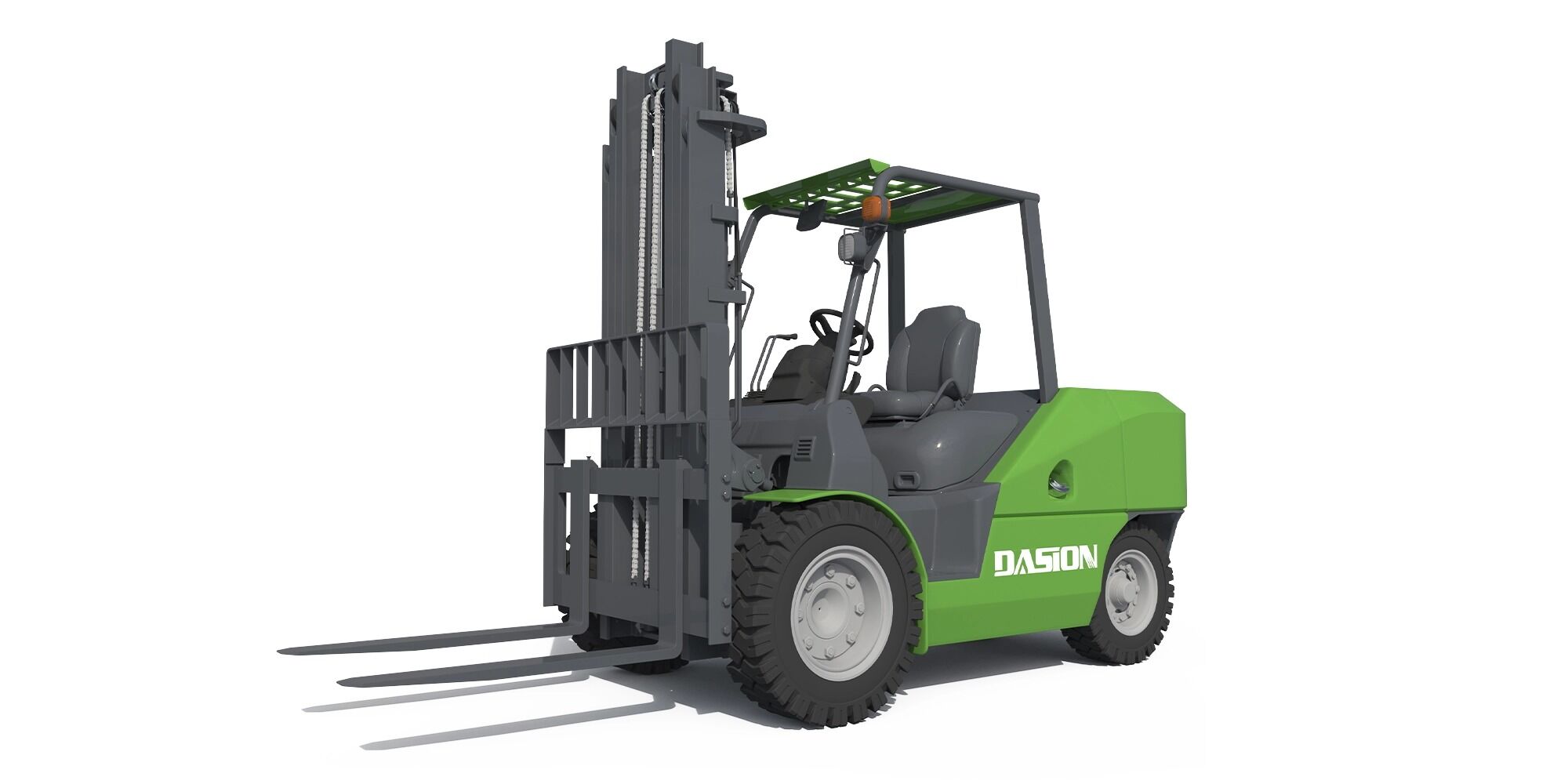
Forklift
There are 2 power options available for DASION forklifts: Diesel version and Electric version (Lead-acid batteries or Lithium batteries).
Both of them can boasts stable load-bearing capacity and flexible maneuverability. Equipped with reliable hydraulic drive system, it lifts and transports goods efficiently. Durable wear-resistant parts extend service life. It is widely applied in industries such as logistics, warehousing, and factory manufacturing.
- Lifting Capacity:2.0~10t
- Lifting Height:3m~10m
What is a Forklift
DASION forklifts, also known as lift trucks or fork trucks, are industrial vehicle specifically designed for loading, unloading, stacking, and short-distance transportation of palletized goods. It is different from a telehandler. Their core feature is a front-mounted mast and tines (forks) that can flexibly adjust in height to meet various operational needs. Beyond standard pallet handling, a forklift can be adapted to handle specialized cargo like cartons, drums, and steel by swapping out different attachments.
- Diesel Version Forklift
- Electric Version Forklift
More powerful and rugged to run, making them ideal for heavy-load and tough construction projects that require fast, continuous, and high-capacity material handling.
| Model | Unit | K20 | K25 | K30 | K35 | K40 | H45 | HX50 | H100 | ||
| Rated capacity | kg | 2000 | 2500 | 3000 | 3500 | 4000 | 4500 | 5000 | 10000 | ||
| load Centre | mm | 500 | 500 | 500 | 500 | 500 | 500 | 500 | 600 | ||
| Lift height | mm | 3000 | 3000 | 3000 | 3000 | 3000 | 3000 | 3000 | 3000 | ||
| Free lift height | mm | 130 | 130 | 140 | 145 | 150 | 150 | 150 | 200 | ||
| Fork size | L×W×T | mm | 1070×100×40 | 1070×122×40 | 1070×122×45 | 1070×122×50 | 1070×122×50 | 1070×150×50 | 1070×150×50 | 1800×175×80 | |
| Mast tilt angle | F/R | Deg. | 6°/12° | 6°/12° | 6°/12° | 6°/12° | 6°/12° | 6°/12° | 6°/12° | 6°/12° | |
| Front overhang | mm | 441 | 441 | 460 | 465 | 485 | 560 | 560 | 700 | ||
| Rear overhang | mm | 520 | 520 | 550 | 550 | 590 | 580 | 580 | 748 | ||
| Min. ground clearance(Bottom of mast) | mm | 115 | 115 | 135 | 135 | 135 | 175 | 175 | 235 | ||
Overall dimensions | Length to face of fork (without fork) | mm | 2595 | 2595 | 2750 | 2750 | 2820 | 3240 | 3100 | 4298 | |
| Overall width | mm | 1160 | 1160 | 1240 | 1240 | 1240 | 1480 | 1480 | 2250 | ||
| Mast lowered height | mm | 1980 | 1980 | 2070 | 2070 | 2070 | 2275 | 2275 | 2830 | ||
| Mast extended height (with backrest) | mm | 4050 | 4050 | 4065 | 4065 | 4065 | 4310 | 4310 | 4380 | ||
| Overhead guard height | mm | 2220 | 2220 | 2220 | 2220 | 2220 | 2350 | 2350 | 2540 | ||
| Turning radius(outside) | mm | 2480 | 2480 | 2600 | 2600 | 2650 | 3050 | 2990 | 3930 | ||
| Speed | Travel(Unladen) | km/h | 19 | 19 | 19 | 19 | 19 | 19 | 19 | 28 | |
| Lifting(Laden) | mm/sec | 540 | 540 | 430 | 400 | 400 | 420 | 380 | 220 | ||
| Lowering(Laden) | mm/sec | 450 | 450 | 450 | 450 | 450 | 450 | 450 | 360 | ||
| Max. Drawbar pull(Laden/unladen) | KN | 17 (14.5) | 17 (14.5) | 18 (15.7) | 18 (18) | 18(18) | 24 (20) | 15 | 69 | ||
| Max. Gradeability(Laden) | % | 20 | 20 | 20 | 18 | 16 | 20 | 12 | 20 | ||
Tyre | Front | mm | 7.00-12-12PR | 7.00-12-12PR | 28×9-15-12PR | 28×9-15-12PR | 28×9-15-12PR | 8.25-15-14PR | 300-15-18PR | 9.00-20 | |
| Rear | mm | 6.00-9-10PR | 6.00-9-10PR | 6.50-10-10PR | 6.50-10-10PR | 6.50-10-10PR | 700-12-14PR | 700-12-14PR | 9.00-20 | ||
| Tread | Front | mm | 970 | 970 | 1000 | 1000 | 1000 | 1180 | 1190 | 1585 | |
| Rear | mm | 980 | 980 | 980 | 980 | 980 | 1190 | 1110 | 1715 | ||
| Wheelbase | mm | 1650 | 1650 | 1750 | 1750 | 1750 | 2100 | 1950 | 2850 | ||
| Operating weight | kg | 3260 | 3510 | 4100 | 4390 | 4550 | 6490 | 6010 | 12710 | ||
| Weight Distribution | Laden | Front Axle | kg | 4890 | 5410 | 6300 | 7080 | 7520 | 9600 | ||
| Rear Axle | kg | 570 | 610 | 800 | 810 | 830 | 1390 | ||||
| Unladen | Front Axle | kg | 1510 | 1280 | 1536 | 1590 | 1600 | 2830 | 5890 | ||
| Rear Axle | kg | 1750 | 2230 | 2546 | 2810 | 2950 | 3600 | 6820 | |||
| Battery | Voltage/Capacity | v/Ah | 12/80 | 12/80 | 12/80 | 12/80 | 12/80 | 24/80 | 12/80 | 24/80 | |
| Engine | model | QC490BPG | QC490BPG | QC490BPG | QC490BPG | QC490BPG | 4D35G | A498 | CA6110 | ||
| Manufacture | (xinchai) | (xinchai) | (xinchai) | (xinchai) | (xinchai) | (xinchai) | (xinchai) | (Xichai) | |||
| Rated output/r.p.m. | kW | 39/2650 | 39/2650 | 39/2650 | 39/2650 | 40/2650 | 48/2300 | 45/2500 | 83/2000 | ||
| Rated torque/r.p.m. | N-m | 160/1980 | 160/1980 | 160/1980 | 160/1980 | 160/1800-2000 | 230/1600 | 193/1800 | 450/1400-1500 | ||
| No.of Cylinder | 4 | 4 | 4 | 4 | 4 | 4 | 4 | 6 | |||
| Bore×Stroke | mm | 90×100 | 90×100 | 90×100 | 90×100 | 90×100 | 98×105 | 98×105 | 110×125 | ||
| Displacement | cc | 2540 | 2540 | 2540 | 2540 | 2600 | 2540 | 3168 | 7127 | ||
| Fuel Tank Capacity | L | 60 | 60 | 60 | 60 | 60 | 90 | 90 | 170±10 | ||
| Transmission | Manufacture | CHINA | CHINA | CHINA | CHINA | CHINA | CHINA | CHINA | Zhe Jiang zhongchai | ||
| Type | Mechanical manual transmission | Mechanical manual transmission | Mechanical manual transmission | Mechanical manual transmission | Mechanical manual transmission | Mechanical manual transmission | Hydraulic Auto | Hydraulic Auto | |||
| Stage | F/R | 1/1 (2/2) | 1/1(2/2) | 1/1(2/2) | 1/1(2/2) | 1/1(2/2) | 1/1(2/2) | 1/1(2/2) | 2 / 2 | ||
| Operating pressure(For attachments) | Mpa | 17.5 | 17.5 | 17.5 | 17.5 | 17.5 | 17.5 | 19 | 20 | ||
More quiet and agile to turn, making them ideal for indoor and urban construction projects that require clean, emission-free, and precise component positioning.
| Model | Unit | CPD10 | CPD20 | CPD35 | CPD40 | CPD45 | CPD50 | |
| Driving mode | Seated | Seated | Seated | Seated | Seated | Seated | ||
| Rated capacity | Q | kg | 1000 | 2000 | 3500 | 4000 | 4500 | 5000 |
| Load center distance | C | mm | 500 | 500 | 500 | 500 | 500 | 500 |
| Power mode | Lead-acid Battery | Lead-acid Battery | Lead-acid Battery | Lead-acid Battery | Lead-acid Battery | Lead-acid Battery | ||
| Wheelbase | L1 | mm | 1330 | 1550 | 1850 | 2040 | 2040 | 2040 |
| Tyre | ||||||||
| Tyre type | Solid Tires | Solid Tires | Pneumatic Tire | Solid Tires | Solid Tires | Solid Tires | ||
| Wheels number(front/rear) | 2/2 | 2/2 | 2/2 | 2/2 | 2/2 | 2/2 | ||
| Front track | W3 | mm | 910 | 945 | 1002 | 1310 | 1310 | 1310 |
| Rear track | W2 | mm | 865 | 880 | 994 | 1110 | 1110 | 1110 |
| Tyre(front) | 15X4 1/2-8 | 18×7-10 | 28×9-15 | 250-15 | 250-15 | 250-15 | ||
| Tyre(rear) | 15X4 1/2-8 | 15X4 1/2-8 | 18×7-8 | 21X8-9 | 21X8-9 | 21X8-9 | ||
| Size | ||||||||
| Front overhang | L2 | mm | 308 | 325 | 467 | 573 | 573 | 573 |
| Tilt of the mast,front/rear | α/β | ° | 5/10 | 5/10 | 5/10 | 6/12 | 6/12 | 6/12 |
| Height,mast retraction | H1 | mm | 2017 | 2030 | 2057 | 2340 | 2340 | 2340 |
| Free lift height | H3 | mm | / | / | 120 | 120 | 120 | 120 |
| Overall maximum lift height | H | mm | 3000 | 3000 | 3000 | 3000 | 3000 | 3000 |
| Height,mast extended | H2 | mm | 3957 | 4055 | 4200 | 4220(fork excluded)3790 | 4220(fork excluded)3790 | 4220(fork excluded) 3790 |
| Overhead guard height | H4 | mm | 1847 | 2110 | 2200 | 2350 | 2350 | 2350 |
| Lateral Fork Adjustment(Outside of Forks) Max/Min | W5 | mm | 970/200 | 1040/100 | 1100/244 | 1240/300 | 1240/300 | 1240/300 |
| Fork size (LxWxT) | T*W*L4 | mm | 30*100*1070 | 40*100*1070 | 45*122*1070 | 50*145*1070 | 50*150*1070 | 55*150*1070 |
| Truck body length(fork excluded) | L' | mm | 1980 | 2230 | 2600 | 2990 | 2990 | 2990 |
| Truck body width | W1 | mm | 1020 | 1096 | 1225 | 1585 | 1585 | 1585 |
| Turning radius | R | mm | 2050 | 2280 | 2300 | 2700 | 2700 | 2700 |
| Groubd clearance under mast | H5 | mm | 77 | 88 | 82 | 160 | 160 | 160 |
| Ground clearance at center of wheelbase(laden) | H6 | mm | 100 | 110 | 145 | 160 | 160 | 160 |
| Width of aisle right-angle stacking(pallet1000x1000mm clearance 200mm) | Ast | mm | 3400 | 3750 | 4300 | 4543 | 4543 | 4543 |
| Width of aisle right-angle stacking(pallet1200x1200mm clearance 200mm) | Ast | mm | 3650 | 3950 | 4500 | 4673 | 4673 | 4673 |
| Performance | ||||||||
| Travel speed,laden/unladen | km/h | 10/11 | 7.5/8.5 | 10/10 | 12/13 | 12/13 | 12/13 | |
| Lifting speed,laden/unladen | mm/s | 220/230 | 180/200 | 200/300 | 280/300 | 270/280 | 250/280 | |
| Lowering speed,laden/unladen | mm/s | 550 | 550 | 450 | 450 | 450 | 450 | |
| Maximum negoniable gradient,laden/unladen | % | 15/20 | 15/20 | 12/20 | 15/20 | 15/20 | 12/20 | |
| Weight | ||||||||
| Service mass(with battery) | kg | 1570 | 2550 | 4400 | 6660 | 6850 | 7100 | |
| Axle load:unloaded,front/rear | kg | 3230/3430 | 3220/3630 | 3200/3900 | ||||
| Axle load:loaded,front/rear | kg | 9380/1270 | 10160/1190 | 10850/1250 | ||||
| Battery voltage /nominal capacity | V/Ah | 60V/120Ah | 60V/210Ah | 72V/260Ah | 80V/300Ah | 80V/400Ah | 80V/500Ah | |
| Battery weight | kg | 150 | 300 | 430 | 860 | 860 | 1100 | |
| Electrical configuration | ||||||||
| Drive motor power-60 minutes | kW | 5(PMSM) | 5(PMSM) | 9(PMSM) | 18AC | 18AC | 18AC | |
| Lift motor power-15 minutes | kW | 4.5(PMSM) | 4.5(PMSM) | 9(PMSM) | 16.5AC | 25AC | 25AC | |
| Drive motor controlling mode | MOSFET/PMSM | MOSFET/AC | MOSFET/AC | MOSFET/AC | MOSFET/AC | MOSFET/AC | ||
| Lifting motor controlling mode | MOSFET/PMSM | MOSFET/AC | MOSFET/AC | MOSFET/AC | MOSFET/AC | MOSFET/AC | ||
| Service brake/parking brake | Hydraulic/Mechanial | Hydraulic/Mechanial | Hydraulic/Mechanial | Hydraulic/Mechanial | Hydraulic/Mechanial | Hydraulic/Mechanial | ||
Core Components of a Forklift
DASION forklifts operate stably and efficiently through the precise coordination of its core systems. Understanding its basic anatomy will help you select the right equipment and properly maintain it.

- The Power System
The "heart" of the forklift, providing energy to the entire vehicle. It is primarily divided into electric (driven by battery packs and electric motors) and internal combustion (IC) models (powered by engines and fuel tanks). The power system dictates the vehicle's runtime and torque performance.
- The Hydraulic System
Comprising a hydraulic pump, cylinders, and high-pressure fluid lines, it achieves precise fork movements through hydraulic pressure transmission. All height adjustments are driven by this system.
- The Work Equipment (Mast Assembly)
Including the forks, the mast, and the lift chains. The forks directly bear the load. The mast extends vertically to adjust height, and the chains transmit hydraulic power to ensure smooth lifting and lowering.
- The Drivetrain and Suspension (Chassis System)
It consists of the wheels, frame, and steering mechanism. The frame supports the vehicle's entire weight, while the rear-wheel steering mechanism allows the forklift to maneuver flexibly in tight spaces. Wheel types are split into pneumatic and solid tires, chosen based on the operating terrain.
- The Control System
The operator's command hub, including the steering wheel, hydraulic control levers, pedals, and dashboard displays. Modern forklifts also integrate backup cameras, strobe lights, and other operator-assist safety devices.
The 5 Most Common Forklift Applications
While forklifts span almost every industrial sector, over 90% of global demand is concentrated in these five core scenarios. Each has its own operational dynamics and pain points, requiring tailored forklift configurations.
Warehousing and Logistics
This is the single largest market for forklifts, with over 40% of units operating in various distribution hubs.
Operational Dynamics:
Focused on loading/unloading, stacking, and short-haul transit of palletized goods. Shifts are long, and space optimization is critical. Traditional flat warehouses feature 3–5 meter shelving, whereas modern high-bay facilities reach 8–12 meters, with aisle widths tightened from 3 meters down to 1.8 meters.
Common Pain Points:
- Traditional lead-acid batteries run out of juice too quickly and require tedious battery swapping.
- Wide aisles waste expensive warehouse real estate
- Poor visibility at high lift heights increases the risk of dropped loads
Recommended Solutions:
- Standard Flat Warehouses: 3-ton electric counterbalance forklifts (zero emissions for indoor use).
- High-Bay Warehouses: Reach trucks with lift heights of 8–12 meters and tight 1.6-meter turning radiuses.
- E-Commerce Micro-Fulfillment: 1–2 ton compact electric forklifts with agile frames and fast-charging capabilities.
Manufacturing and Processing
Factories represent the second-largest user segment, relying on forklifts to move raw materials to assembly lines and transfer finished products.
Operational Dynamics: Continuous 8–12 hour daily cycles require rugged reliability. Work environments vary wildly, ranging from pristine clean rooms to heavy machining shops filled with oil mist and dust.
Common Pain Points:
- Diesel exhaust pollutes indoor air quality
- High equipment breakdown rates stall production lines
- Heavy loads cause mast deflection or hydraulic fluid leaks over time
Recommended Solutions:
- General Manufacturing: 3–5 ton dieselor LPG (liquid propane gas) forklifts for sustained power and easy maintenance.
- Electronics/Precision Manufacturing: 3ton electric forklifts equipped with hydraulic dampening systems for ultra-stable transport.
- Heavy Machinery Production: 6–10 tonheavy-duty diesel forklifts configured with a 1.2x safety load margin.
Ports and Inland Freight Terminals
Ports and freight hubs experience the highest operational intensity, demanding near continuous 24-hour runtimes.
Operational Dynamics:
Heavy handling of shipping containers, break bulk, and less-than-truckload (LTL) cargo, with constant cycling between container vessels, rail cars, and warehouses. Operations are mostly outdoors on uneven, wet, or weathered ground.
Common Pain Points:
- Soaring fuel consumption driving up operating overhead
- Rapid equipment aging and short lifespans
- Long lead times and high costs for imported spare parts
Recommended Solutions:
- Container Terminals: 10–16 tonheavy-duty diesel forklifts paired with high-efficiency, low-consumption engines.
- Inland Freight Stations: 3–5 tondiesel forklifts for rapid refueling and relentless, multi-shift durability.
- Bonded Logistics Parks: Versatile utility forklifts equipped with quick-change attachmentsystems to maximize fleet utility.
Construction and Building Materials
These sites represent the harshest operating environments, demanding extreme off-road capability and structural durability.
Operational Dynamics:
Terrains are deeply rutted, muddy, and littered with rebar, gravel, and debris. Cargo includes rebar, bulk cement, concrete formwork, lumber, and ceramic tiles, all varying drastically in weight, shape, and dimensions.
Common Pain Points:
- Standard forklifts have low ground clearance and easily high-center (get stuck)
- Pneumatic tires suffer frequent punctures
- Dust and muddy water infiltrate components, causing premature mechanical failures
Recommended Solutions:
- Construction Sites: Rough-terrain forklifts featuring 4WDand a high ground clearance of over 30
- Building Materials Wholesalers: 3-tondiesel or LPG forklifts with hydraulically adjustable fork positioners.
- Precast Concrete Plants: Counterbalance forklifts equipped with side-shifters and optional extended fork sleeves.
Food and Pharmaceuticals
These sectors impose the strictest regulatory compliance, demanding pristine hygiene and environmental standards.
Operational Dynamics:
Absolutely zero exhaust emissions or particulate contamination allowed; vehicle bodies must withstand aggressive washdowns and sanitization. Cold-storage variants must operate reliably in sub-zero environments.
Common Pain Points:
- Air quality citations and fines from environmental agencies due to internal combustion emissions
- Hard-to-clean crevices on the chassis that compromise food safety audits
- Severe battery drainage and capacity loss in sub-zero temperatures
Recommended Solutions:
- Food Processing Facilities: 3-ton electric forklifts with smooth, streamlined chassis profiles and optional stainless-steel components.
- Pharma Warehousing: Explosion-proof electric forklifts fully compliant with GMP (Good Manufacturing Practice) standards.
- Cold-Chain Logistics: Specialized low-temperature lithium-ion electric forklifts engineered so that battery degradation does not exceed 10% even at -30℃.
Quick Selection Guide Based on Demand
When choosing DASION forklifts, you don’t need to get bogged down by endless specifications. You can quickly narrow down your options using these three core dimension.
- By Power Source
Electric Forklifts:
They are a relatively new energy-efficient option that has gained popularity over the past five years. They are suitable for indoor applicaitons such as warehousing, where low noise and zero exhaust emissions are required. For customers from Europe and America, we recommend electric forklifts, with the C or D series as preferred options.
Diesel Forklifts:
As traditional equipment is more suitable for outdoor and long hours of operation. They are practical in regions with reliable and affordable fuel supplies, such as Central Asia, the Middle East, and Southeast Asia. For these markets, we recommend diesel forklifts. The K series offers a more attractive design for distributors, while the KII series is more economical and easy to maintain for end users. - By Load Capacity
1–2 Tons:
Designed for light-duty handling, such as small parcels, office archives, and small parts in e-commerce fulfillment centers. The compact chassis allows for nimble turning in narrow aisles.
3–5 Tons:
The most widely used tonnage tier, capable of meeting the needs of most manufacturing plants and warehouses. It handles standard pallets, bulk crates, and medium-sized machinery, offering excellent versatility.
Over 6 Tons (Heavy-Duty):
Heavy-duty forklifts specifically engineered for moving large machinery, structural steel, shipping containers, and other massive loads. They feature reinforced chassis frames and high-torque power systems built for prolonged, heavy-cycle operations. - By Mast Type
Standard Mast:
Standard mast is the most common mast type in the industry, designed for most ordinary handling and stacking applications. It has a simple structure and is economical, making it suitable for common warehousing, factory, and logistics operations.
Free-Lift Mast:
A free-lift mast can lift the forks before the entire mast rises, making it more suitable for low-clearance applications such as container loading and low-ceiling warehouses. When working height is limited, we generally recommend a free-lift mast as the preferred choice.
Forklift Selection Guide: Pitfalls to Avoid
Many first-time buyers fall into predictable traps, resulting in overspending or purchasing a model poorly suited to their operational environment. Based on our experience working with hundreds of clients, we have outlined the most critical pitfalls to avoid.
- 01
Confusing Nominal Capacity with Actual Residual Capacity
The "3-ton" rating advertised by manufacturers is typically the maximum limit calculated at a specific standard load center (usually 500 mm) up to a lift height of only 3 meters. The moment you lift higher than 3 meters or handle awkwardly shaped cargo that pushes the center of gravity forward, the forklift's residual capacity drops significantly. We always recommend purchasing a model with a rated capacity slightly higher than your heaviest load.
- 02
Focusing solely on the Purchase Price instead of Total Cost of Ownership (TCO)
While internal combustion forklifts are cheaper upfront, their long-term fuel and maintenance overhead is massive. A typical 3-ton diesel forklift can easily burn through 30,000 to 40,000 RMB in fuel annually. Furthermore, IC engines require frequent maintenance schedules such as oil changes, filter replacements, and spark plug swaps. Over a 5-year operating life cycle, the cumulative cost of ownership for a diesel unit is often 20% higher than that of an electric alternative.
- 03
Blindly Chasing High-End Specifications
More features do not necessarily mean better utility. Some buyers only need a 3-meter lift but pay extra for a 6-meter mast. Others operate exclusively on smooth indoor concrete floors but spec out expensive rough-terrain tires. These redundant features drive up procurement costs while reducing the vehicle's agility and battery life. For example, an oversized mast unnecessarily restricts the operator’s forward visibility, and rough-terrain tires wear down quickly and create excessive noise on smooth cement. Our engineers focus on tailoring configurations strictly to your actual working conditions.
- 04
Getting Overwhelmed by Technical Spec Sheets
Many clients find terms like load center distance, turning radius, and duty cycles confusing, leaving them vulnerable to aggressive sales pitches. For example, a manufacturer might claim their electric forklift features an "8-hour battery life," but that figure is often clocked under unladen, low-speed test conditions. In a real-world, full-load work environment, that same battery might only last 4 to 5 hours. Our engineers cut through the jargon, explaining each metric in plain language and providing on-site demonstrations so you can evaluate real-world performance firsthand.
Core Advantages of Forklifts
- Significantly Boost Material Handling Efficiency
A standard 3-ton forklift can carry 3 tons of cargo at a time at speeds of around 10 km/h. In just one hour, it can complete the daily workload of 5 to 8 skilled manual laborers. For warehouses and factories handling large volumes of goods, this efficiency boost drastically shortens order turnaround times and easily eases shipping bottlenecks during peak seasons.
- Drastically Reduce Labor Costs
A forklift requires only one trained operator to replace a whole team of laborers. In the long run, the procurement and maintenance costs of a forklift are far lower than the cumulative annual salaries of multiple workers. Additionally, it eliminates the headaches of peak-season hiring shortages or production disruptions caused by sudden employee turnover.
- Maximize Storage Space Utilization
Manual stacking is generally capped at around 2 meters due to safety and collapse risks. In contrast, a forklift’s lifting height can reach 12 meters or more, fully utilizing a warehouse's vertical space. By deploying narrow-aisle forklifts, warehouse aisle widths can be reduced from over 3 meters down to 1.8 meters, increasing overall storage capacity by more than 50%.
- Minimize Workplace Accidents and Compliance Risks
Manual handling frequently leads to back injuries, crush injuries, and other workplace accidents due to physical fatigue or human error. Forklifts mechanicalize heavy lifting, fundamentally reducing manual contact with heavy loads. Furthermore, our forklifts have passed international safety certifications like CE and ISO, aligning with local occupational safety regulations to help enterprises avoid costly compliance risks.
- Enhance Operational Stability and Safety
Engineered with a stable chassis and robust hydraulic systems, forklifts lift and transport goods smoothly without the swaying or dropping risks associated with manual lifting. Modern forklifts are also equipped with safety features such as backup cameras, warning lights, seat-belts, and automatic speed-reduction systems.
- Versatile, All-Scenario Adaptation
By utilizing different attachments, forklifts can handle far more than just standard pallets. They can easily manage cartons, drums, steel, and containers. For example, installing a carton clamp allows the safe handling of boxed beverages and appliances, while a rotator attachment enables the tipping and pouring of chemical raw materials from drums.
EPDAS Forklift Projects
Equipment Details Display of Forklifts
These images showcase DASION forklift’s essential role on demanding job sites: handling heavy-duty payloads, positioning materials with pinpoint precision, and maintaining absolute stability under rigorous working conditions. Its rigid, high-visibility mast allows for accurate stacking in high-density storage structures, ensuring continuous logistics throughput, reliable operation, and efficient project progress.

Forklift FAQs
- What is the difference between a telescopic handler and a forklift?
Unlike a standard forklift, a telescopic handler provides extended reach and greater lifting height. Telehandler forklifts are better suited for construction sites where materials need to be placed at height or over obstacles, while forklifts are mainly used for warehouse operations.
- How do I choose the right telescopic handler for my project?
Choosing the right telescopic handler depends on lifting capacity, maximum height, terrain conditions, and attachment requirements. Compact telehandlers suit tight spaces, while heavy-duty models are ideal for large construction and industrial projects.
- What drive and steering systems are used in telescopic handlers?
Most telescopic handlers are equipped with four-wheel drive and multiple steering modes, including front-wheel steering, four-wheel steering, and crab steering. These features improve maneuverability on tight or uneven construction sites and enhance overall operational efficiency.
- What lifting height and reach can a telescopic handler achieve?
Lifting height and forward reach depend on the model. Standard telescopic handlers offer lifting heights from 6 to over 18 meters, with forward reach capabilities of up to 10 meters. Selecting the right telehandler forklift ensures safe load placement at the required working height.
- What attachments can be used with a telescopic handler?
Telescopic handlers support a wide range of attachments, including forks, buckets, lifting hooks, work platforms, and bale clamps. Quick-attach systems allow operators to switch tools easily, increasing machine versatility across construction, agriculture, and industrial tasks.
- What safety systems are built into modern telescopic handlers?
Modern telescopic handlers include load moment indicators, overload protection, emergency braking systems, and stability control. These safety features help prevent tipping and ensure safe operation during lifting and material handling tasks.
- What is the difference between a telescopic wheel loader and a telehandler?
Telescopic Loader: This machine focuses on scooping, loading, and ground-level material handling. It offers a moderate lift height and excellent agility. Telehandler: This machine is engineered specifically for high-altitude material placement and equipment installation.
Related Products
Customize Your Solutions
Contact us now via Email:info@epdas.com, or Whatsapp:+86 188 38115507 , or fill in the form below.
FEW TIPS:
- Please provide the core performance parameters (e.g., maximum lifting height, maximum lifting capacity, mast type, etc.)
- Please clarify the application conditions and supporting configuration (e.g., indoor warehouse, rough terrain site, solid tire, non-marking tire)
- Please confirm the power type of the forklift (e.g., diesel, electric, LPG/gasoline dual fuel, etc.)
- Please state the attachment requirements (e.g., standard fork, side shifter, fork positioner, bale clamp, etc.)
- If you are interested in becoming our distributor, please let us know.
Service Process:
- Business negotiation
- Solution development
- Manufacturing and commissioning
- Operational production