
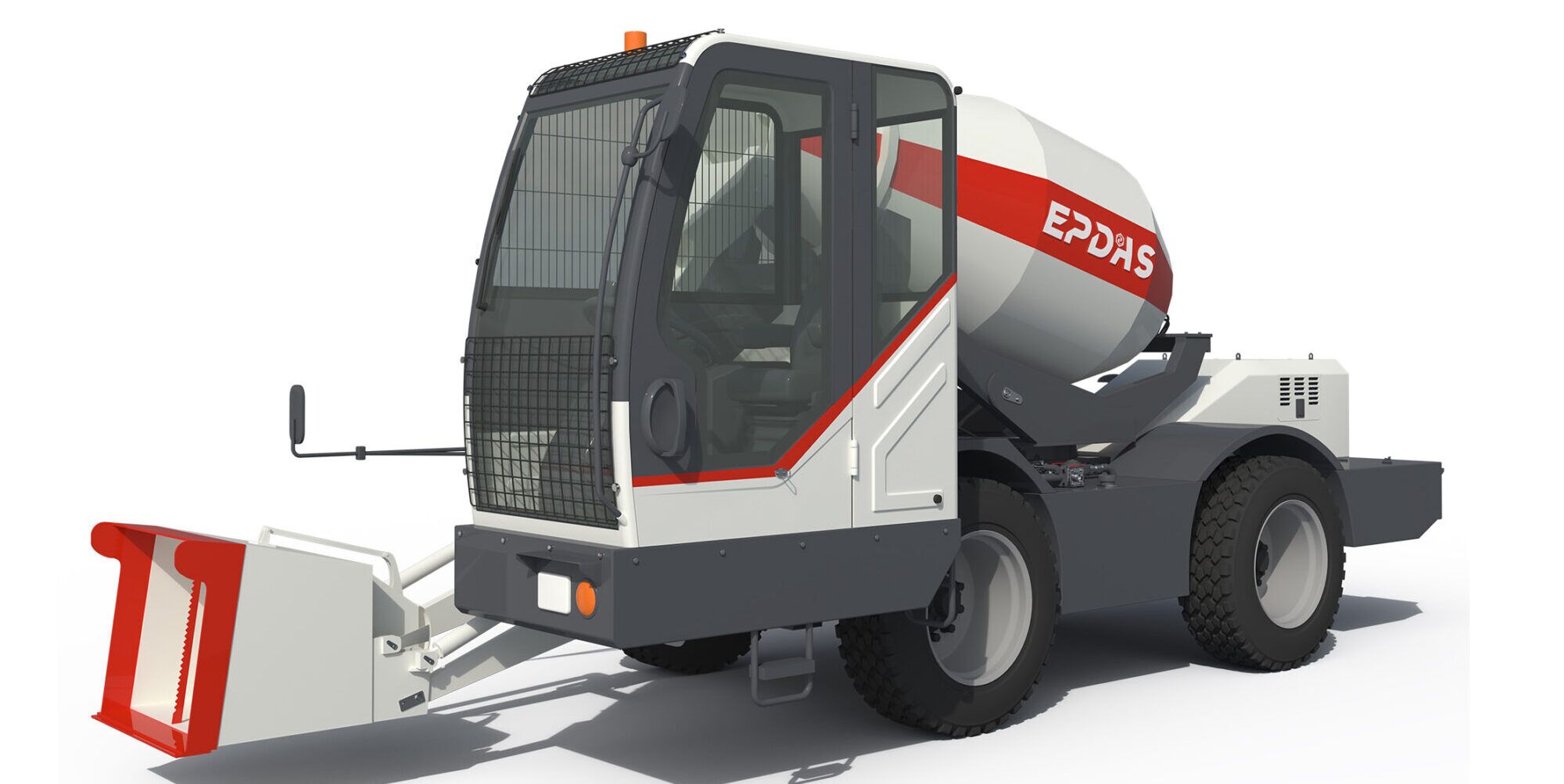
Self-loading Concrete Mixer
Integrated self-loading concrete mixer integrates loading, mixing and discharging in one, PLC-controlled for easy operation, compact and efficient, ideal for on-site concrete production in construction, road and rural engineering projects.
- Output capacity:2.5~5.5m³
- Mixer Drum Rotation:270°
What is Self-loading Concrete Mixer
When many people hear this name for the first time, they will think that it is just an upgrade of an ordinary mixer, but in fact it is not. Its core advantage is “integration”, integrating the functions of loader, mixer, transport truck and unloading device into one device. Driven by powerful engine and torque converter, it can independently complete the whole process of concrete production without any external auxiliary equipment.
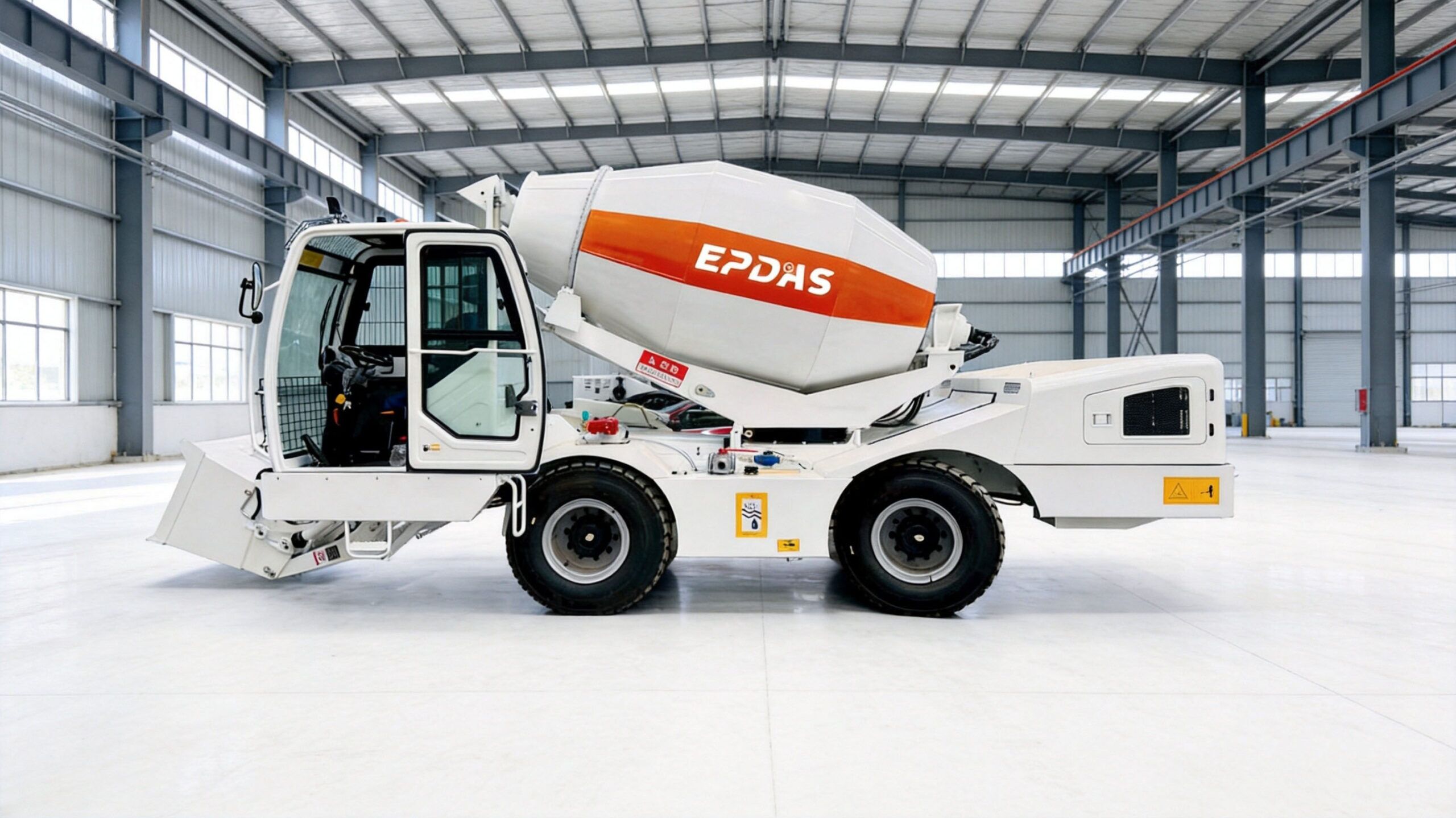
Simply put, its workflow is very clear: first, it automatically shovels up sand, gravel, cement and other raw materials through the self-convelled hydraulic control bucket (forward and back-out design). At the same time as shoveling, the pressure sensor of the main cylinder will complete the real-time dynamic weighing of each shovel. After the raw material enters the mixing cylinder, it will be mixed evenly and after the mixing is completed, the equipment relies on the hydraulic steering drive bridge to drive concrete directly transport the concrete to the pouring site. Finally, through the stirring that can be rotated 270°and has the function of swinging cylinder completes multi-angle unloading.
- Integrated Self-loading Concrete Mixer Mixing Capacity
| Model | EP5.5H | EP4.0H | EP3.0H | EP2.5H | |
| Mixing System | Output capacity | 5.5m³ per batch | 4.0m³ per batch | 3.0m³ per batch | 2.5m³ per batch |
| Rotation angle | 270° | ||||
| Mixer Drum Angle | 16 ° | ||||
| Loader control | Hydraulic 4 way stick | ||||
| Swing Reducer | Customized by EPDAS | ||||
| Water Tank Volume | 620 L | 550 L | 500 L | 370 L | |
| Engine | Brand | YUCHAI | YUNNEI | YUNNEI | YUNNEI |
| Rated Power/RPM | 110KW/2200RPM | 92KW/2200RPM | 76KW/2200RPM | 76KW/2200RPM | |
| Chassis | Total Weight | 9200 KG | 8500 KG | 8000kg | 6600 KG |
| Driver Type | Front 2+ Rear 2 | ||||
| Chassis | Off-road-Integral frame | ||||
| Wheel Base | 2420 mm | 2350 mm | 2350 mm | 1960 mm | |
| Tyre | 16/70-24 | 16/70-20 | 16/70-20 | 23.5-16 | |
| Transmission | Full Hydraulic | ||||
| Speed | High:20-50 KM/H | ||||
| Low:0-20 KM/H | |||||
| Grade-ability | 30° – 40° | ||||
| Overall Size | L7820*W2850*H3400mm | L7600*W2800*H3380mm | L7500*W2700*H3380mm | L7040*W2530*H3200mm | |
Core Components: Each Design Meets the Construction Needs
The core component system and key components of this equipment are based on the actual operation scenarios and working conditions of the construction site for targeted research and development design, and it deeply meets the core demands of various actual use scenarios of various construction sites such as open-air construction, site operation and continuous operation.

- High-efficiency mixing system
The mixing cylinder has a geometric volume of 5.0m³. It adopts advanced double-heral line stirring logic inside, and cooperates with the flow guide screw to force the flow of the material to change. This design follows the mechanical principle of "left-handed feeding and right-handed feeding", so that the material forms a strong convection in the cylinder and the stirring is more uniform.
- Accurate weighing and water feed
Rely on the oil pressure sensor of the main cylinder of the bucket to realize electronic weighing. The operator monitors weight of each shovel through the industrial-grade touch screen in the cab. With ordinary water pumps and zero-clearing digital water meters, the ratio is more accurate than that of ordinary equipment on the market.
- Flexible unloading system
Mixing cylinder can not only rotate 270 degrees, but also has a unique tank swing and "backwarping" function. The operator can operate through the hydraulic control single handle in the cab, which not only saves time but also ensures safety.
- Chassis system
Adopts profile seamless steel pipe integrated frame, which is extremely resistant to torsion. With 16/70-20 steel wire tires, it gives the equipment the stability of driving on muddy construction sites.
ROI Analysis: The Deep Game of Leasing and Owning
In actual engineering, there is no absolute right or wrong to choose “leased equipment” or “own equipment”. The key is which model is more suitable for your current business scale and capital efficiency. We will disassemble the costs and benefits for your reference:
Mode A: Rental equipment (with emphasis on flexibility)
Applicable scenarios: short-term temporary reinforcement, extremely small single usage, or funds are more inclined to flow to other high-turnal links.
Advantages: The initial cash flow pressure is low, there is no need to be responsible for long-term maintenance and storage, and the project will be settled at the end.
Cost: The long-term operating cost is relatively high. External procurement of ready-mixed concrete (commercial mix) usually requires a freight premium of about 15-40 yuan per square (depending on the transportation distance). At the same time, you need to coordinate additional loader workers and auxiliary workers, and the management radius is large.
Model B: Own EP4.0 equipment (with long-term profit)
Applicable scenarios: the project cycle is more than 1 year, there is a continuous project start, or the remote location makes it difficult for commercial transportation.
Economic account reference:
Cost hedging: The investment in the purchase of a piece of equipment can be hedged in about 1-2 years through freight difference and labor savings (depending on the construction intensity and frequency of use).
Take the 5000-square-meter concrete project as an example, according to the estimated transportation cost of about 20-30 yuan per square, on-site production can save about 100,000-150,000 yuan in freight compared with foreign buyers (depending on the transportation distance and raw material supply mode)
In terms of labor, one-person operation mode can be used in most working conditions. By reducing 2 fixed-post operators, the monthly salary per person is 6,000-8,000 yuan, which can save about 200,000-300,000 yuan in management expenses in 1.5 years.
[Note: The above calculation is mainly based on freight difference and labor optimization, and does not fully include equipment energy consumption, consumable parts replacement and daily maintenance costs. The actual income needs to be comprehensively evaluated in combination with specific construction conditions.]
Asset residual value: After the end of the project, the self-owned equipment usually retains about 40%-60% of the residual value (depending on the use and maintenance situation). The specific realization capacity also depends on the market demand for second-hand equipment and the universality of equipment. This part belongs to the precipitation of fixed assets, which can continue to dilute unilateral costs in subsequent projects.
Advantages: The construction rhythm is completely autonomous, rejects “stoppage and waiting for materials”, and the concrete marking is more stable under the monitoring of the digital system.
Maintenance Tips: Make Self-loading Concrete Mixer Last Longer
After many construction teams buy equipment, due to inadequate maintenance, equipment failures occur frequently, which affects the construction progress and increases maintenance costs. In fact, the maintenance of this device is not difficult. As long as you develop good habits, you can effectively extend the service life.

- Clean it regularly
After each use, be sure to clean up the concrete residue in the mixing cylinder. It is difficult to clean up concrete after solidification, which not only affects the uniformity of the next stirring, but also wears out the mixing blades and cylinder walls, increasing maintenance costs. When cleaning, you can add an appropriate amount of water to the cylinder, turn the mixing cylinder, and rinse the residue.
- Regular lubrication
The moving parts of the equipment, such as hydraulic rods, tug wheels, gears, etc., should be regularly checked for engine oil and hydraulic oil to reduce the wear between the parts and avoid problems such as jamming and abnormal noise. It is recommended to check the hydraulic filter element once every 500 hours of operation to prevent impurities from damaging the precision pump valve and ensure the smoothness of walking and stirring.
- Do a good daily inspection
Before each start, check whether the loading bucket is deformed or worn, whether the mixing cylinder is loose, whether the hydraulic system is leaking oil, and the tire pressure is normal. If you find a problem, deal with it in time. Don't wait until a small failure becomes a big problem, causing the equipment to be unable to use it normally and delay the construction period.
- Monthly Inspection
The sensor of the symmetrical heavy system conducts a static review every month to ensure the accuracy of the weight data displayed on the screen, which is the first line of defense to ensure the quality of construction. Follow the manufacturer's operation and maintenance guidelines, and do not operate illegally because it will not only damage the equipment, but also may cause safety accidents.
Why Choose EPDAS Self-loading Concrete Mixer
Among many brands, the core competitiveness of EPDAS is to change from simply selling machinery to customized construction solutions. The following are the characteristics of EPDAS that stand out in extreme conditions around the world, especially in the Philippines and Africa
- 01
Targeted optimization
For the rainy and muddy conditions in Southeast Asia or the high temperature in Africa, we will enhance the engine heat dissipation system and transmission bearings to ensure that the equipment can keep production quality in extreme environments.
- 02
Simplify configuration
Abandon flashy design, focus on mixing efficiency and chassis stability, and ensure that every penny is spent on core output.
- 03
Efficient loading and mixing
Integrated automatic loading system, independent throughput of sand, gravel and cement can be realized without additional loader. With the mechanical logic of left-handed feeding and right-handed unloading, the cycle speed of a single batch has been greatly improved.
- 04
Full-angle dynamic unloading
The mixing cylinder supports multi-dimensional rotation and swing, and cooperates with the four-way pilot handle of the electric control button integrated in the cab. Even novices can accurately control the unloading flow in a short time and deal with narrow roadbed or side ditch pouring.
- 05
Zero downtime test standard
Each device is simulated before leaving the factory. We directly use aggregates and cement to measure their mixing uniformity and unloading fluency, and block downtime caused by system defects from the source.
Six Core Advantages: Solve the Pain Points of Construction, Save Costs and Improve Efficiency
- Ultimate cost control ability
The most obvious saving is labor. In the past, loading, stirring and transportation required at least 3 people to cooperate, but now one person can almost complete all the operations.
- Excellent all-terrain passability
EP4.0 relies on the 20T drive bridge and heavy-duty chassis, and the equipment has a 30°-40° climbing ability. Whether it is a mountain road or a muddy foundation pit after rain, it can enter and exit autonomously with strong traction.
- Digital quality assurance
"Double helix + diversion" technology cooperates with digital weighing to ensure that the output concrete marks are consistent, which can reduce the rework caused by quality problems from the source.
- Efficient turnover rhythm
Loading, stirring, transportation and unloading are integrated. The actual cycle of a single batch is ≤15 minutes, and the output per hour can reach 16 square meters. With the driving speed of 20-50 km/h, the single operation cycles is greatly shortened.
- Strong scene adaptability
Adopting the rear wheel steering design, the body is compact, and it can also turn flexibly in a 3-meter-wide alley. With the high and low speed stirring logic, it can effectively prevent concrete separation during driving.
- Perfect safety and durability
The whole vehicle adopts the whole vehicle waterproof harness. The cab is equipped with air conditioning, broken window hammer, fire extinguisher, seat belt and reversing image as standard. It not only ensures the comfort of the operator (adjustable seat), but also meets strict safety standards.
EPDAS Self-loading Concrete Mixer Projects
Self-loading Concrete Mixer FAQs
- What are the advantages of a self-loading concrete mixer compared to traditional mixers?
A self-loading concrete mixer eliminates the need for separate loaders, batching plants, and transport vehicles. This reduces labor costs, saves time, and improves flexibility, making it an ideal solution for small to medium construction projects and remote job sites.
- How do I choose the right self-loading concrete mixer for my project?
When choosing a self-loading concrete mixer, consider mixing capacity, engine power, terrain conditions, and daily concrete output. Smaller models suit residential projects, while larger models are better for infrastructure and commercial construction. EPDAS can help you select the best model.
- What engine and hydraulic systems are used in self-loading concrete mixers?
Self-loading concrete mixer trucks are powered by diesel engines with hydraulic systems that control loading, mixing, steering, and discharging. High-quality hydraulic pumps and valves ensure stable operation, precise control, and long service life even in harsh construction environments.
- Can self-loading concrete mixers work on rough or uneven terrain?
Yes. Most self-loading concrete mixers are equipped with four-wheel drive, high ground clearance, and articulated steering, allowing them to operate efficiently on rough, muddy, or uneven terrain commonly found at construction sites, rural areas, and mining projects.
- What maintenance is required for a self-loading concrete mixer?
Routine maintenance includes checking hydraulic oil, cleaning the mixing drum, inspecting wear parts, lubricating joints, and monitoring engine performance. Proper maintenance ensures stable operation, extends equipment lifespan, and minimizes downtime.
- What is the mixing capacity of a self-loading concrete mixer?
Mixing capacity varies by model, typically ranging from 1.2 m³ to 6.5 m³ per batch. The choice of capacity depends on project size, daily concrete demand, and transportation distance. Larger-capacity self-loading concrete mixers are ideal for medium-scale infrastructure and remote projects.
Related Products
Customize Your Solutions
Contact us now via Email:info@epdas.com, or Whatsapp:+86 188 38115507 , or fill in the form below.
FEW TIPS:
- Please describe the mixing capacity of the integrated self-loading concrete mixer (e.g., 1.5m³-5m³).
- Please describe the chassis configuration of the integrated self-loading concrete mixer.
- Please describe the power type of the integrated self-loading concrete mixer.
- Please describe the custom requirements of the integrated self-loading concrete mixer (e.g., hopper expansion/color customization).
- If you are interested in becoming our distributor, please let us know.
Service Process:
- Business negotiation
- Solution development
- Manufacturing and commissioning
- Operational production