
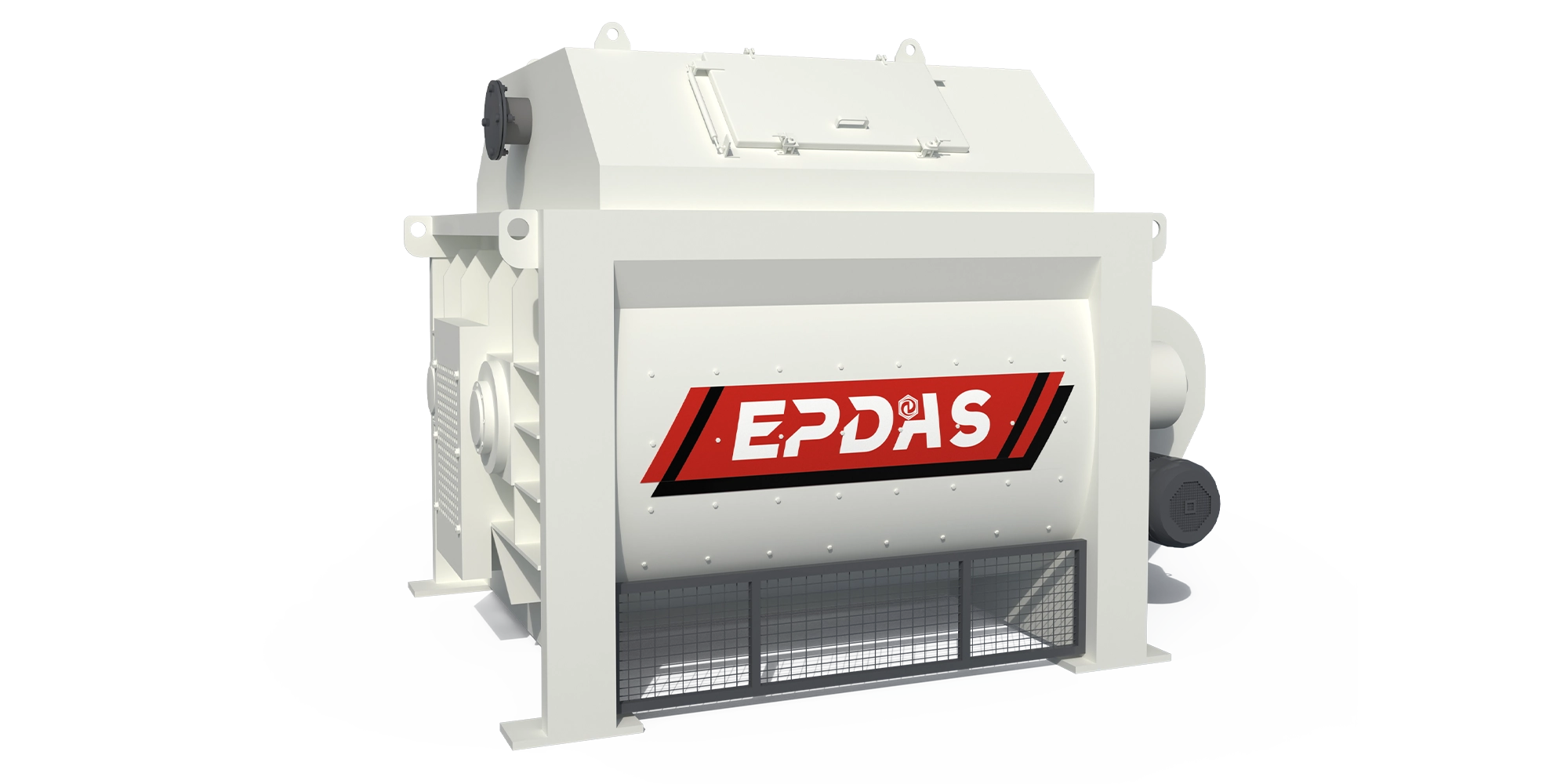
Twin Shafts Concrete Mixer
Twin-shaft concrete mixer is a high-efficiency compulsory mixing machine featuring two horizontal shafts with counter-rotating paddles. Widely used in concrete batching plants, it delivers rapid, homogeneous mixing for various concrete types, including dry-hard and heavy-fluid mixtures. Known for its rugged durability and powerful shearing action, it is the industry standard for high-volume construction projects.
- :
- :
What is Twin Shafts Concrete Mixer
The twin shafts concrete mixer is a type of forced mixing equipment. Its core structure consists of two horizontal mixing shafts arranged in parallel, which rotate synchronously in opposite directions during operation. This is the defining feature that distinguishes it from drum-type self-falling mixers and vertical planetary mixers.
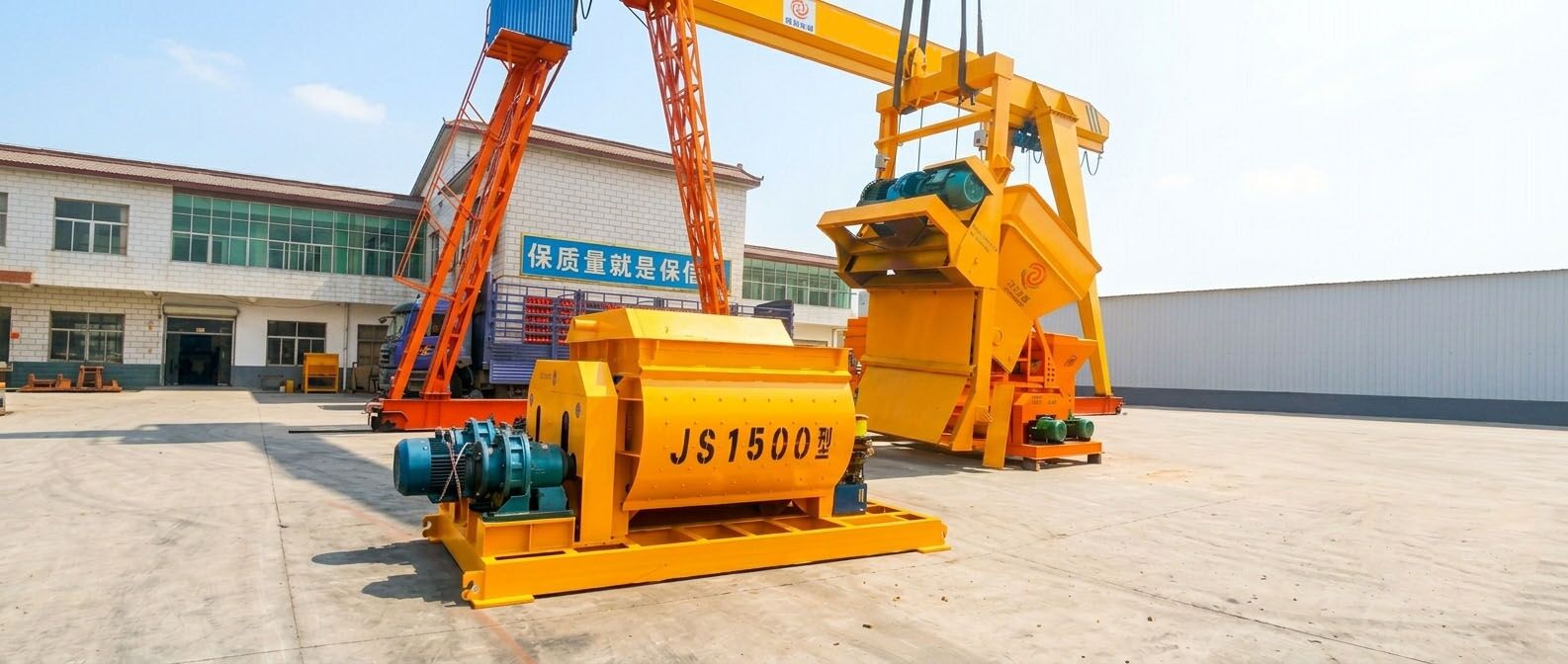
The overall structure of the equipment is robust. The interior of the mixing chamber is equipped with replaceable wear-resistant liners, while the exterior features an integrated steel frame. The entire system relies on a motor, reducer, and torque distribution system to drive the mixing mechanism, forcing the materials to undergo shearing, turning, and mixing through external mechanical forces, rather than relying on the gravity-driven rolling of the material itself.
Working Principle and Operational Logic of Core Components of Twin Shafts Concrete Mixer
The high efficiency of the twin shafts concrete mixer mainly relies on the coordinated performance of its four core systems, from power transmission to finished product discharging. Every structural and material design directly determines the quality of the concrete and the service life of the equipment.

- Power and Transmission System
Core configuration: Heavy-duty motor, pulley, high-precision reducer, and a torque distributor
Working Principle: The motor outputs power, which adjusts torque via the reducer until the speed is stabilized. Finally, it drives the two horizontal mixing shafts to rotate at a uniform speed in opposite directions via a torque distributor.
Application Value: Even when facing the mixing of heavy concrete or low-slump dry-hard concrete, it still provides a stable drive without power insufficiency or shaft jamming. - Mixing system
Core configuration: High-strength steel mixing shafts with heat-treatment, thickened Ni-Hard wear-resistant cast iron blades, and staggered mixing arms (supporting 60° and 90° installation angles).
Working Principle:Along with the synchronous twin-shaft rotation, the bottom and middle materials are thrown upward, while translated axially back and forth, shearing and squeezing against each other.
Application Value: It forms an overlapping turbulent zone, which achieves deep intermixing of cement, aggregates, water, and admixtures in a short time, and thoroughly eliminates mixing dead zones to avoid dry materials, agglomeration, and non-uniform slurry. The structure easily handles large aggregates up to 150mm. - Protection and lubrication system
Core configuration: Six-layer shaft-end sealing technology, external bearings, automatic centralized lubrication system, and monitoring sensors.
Working Principle: External bearings and six-layer shaft-end sealing are used for blocking the penetration of cement slurry and dust, while the rest of the system continuously pumps grease to maintain a stable protective pressure layer.
Application Value: Monitoring sensors track operational status in real-time and provide early warning of potential failures. - Hydraulic discharge system
Core configuration: large hydraulic discharge door.
Working Principle: The hydraulic system drives the discharge door through a three-stage logic sequence.
Application Value: It can freely adjust the discharging speed and quantity to avoid material accumulation. There is minimal residual material left in the chamber, which not only ensures the quality of each batch of concrete but also shortens production intervals.
Comparison of Twin-shaft Concrete Mixer with Other Mixing Equipment
The twin shafts concrete mixer is a forced mixing equipment. Its core structure consists of two horizontal mixing shafts arranged in parallel. When working, they rotate synchronously in opposite directions. This is also a distinct feature that distinguishes it from drum-type self-falling mixers and vertical planetary mixers.
| Comparison Items | Twin Shafts Concrete Mixer | Drum Mixer | Planetary Mixer | Single Shaft Mixer |
| Mixing Quality | suitable for all types of concrete | prone to localized uneven mixing | highly suitable for fine materials | poor uniformity |
| Mixing Speed | Fast | Slow | Medium | Slow |
| Max Aggregate Adaptation | Supports up to 150mm large aggregates | Only suitable for small and medium aggregates | Not suitable for large aggregates | Large aggregates easily jam and cause uneven mixing |
| Mass Production Capacity | High ideal for large-scale production lines | Low only suitable for small-scale, sporadic construction | Medium mostly used for small-batch precast production | Medium unable to adapt to large-scale mass production projects |
| Operation & Maintenance Cost | Medium wear-resistant components offer long service life | Low but equipment performance limits are obvious | High complex structure, difficult to repair | Medium faster wear and tear of consumable parts |
The entire equipment features a robust structure. The interior wear-resistant liners are designed to be disassembled, and the exterior is an integrated steel frame. Driven by a motor, a reducer, and a torque distribution system, the entire system operates the mixing mechanism. Completing the shearing, turning, and mixing of materials does not rely on the gravity-driven rolling of the material itself, but is achieved through external mechanical forces.
Mainstream Application Scenarios of Twin Shafts Concrete Mixer
The application scenarios of the twin shafts concrete mixer span multiple fields, including civil production, industrial manufacturing, and large-scale infrastructure. It is a highly versatile concrete mixing equipment.

- Commercial concrete batching plants
This is the primary application scenario for the equipment. It can continuously and stably produce various grades of commercial concrete, meeting the standardized material demands of urban construction and municipal engineering. Its high output and high stability perfectly match the large-scale, uninterrupted production models of concrete batching plants.
- Precast concrete component factories
It produces specialized concrete for precast components such as precast slabs, beams, columns, roof tiles, permeable bricks, and concrete pipes. Relying on its extraordinary mixing homogeneity, it ensures consistent structural density and standard compressive strength of precast elements and reduces the rejection rate.
- Brick, ceramic, and mortar production
Beyond standard concrete, the equipment can also blend clay bricks, glass-ceramic raw materials, construction mortar, self-leveling mortar, and other materials. With zero mixing dead zones and precise material proportioning, it meets the diversified production needs of small and medium-sized building material processing plants.
- Large-scale infrastructure projects
It is widely utilized in national large-scale projects such as highways, bridges, airports, tunnels, hydroelectric power stations, and dams. It effectively handles large-aggregate concrete and low-slump crushed stone concrete, satisfying continuous construction demands under complex outdoor working conditions.
Common Mistakes in the Procurement of Twin Shafts Concrete Mixers
Many procurement customers easily fall into the trap of one-sided selection when choosing a twin shafts concrete mixer. Focusing solely on surface parameters while ignoring core configurations and application adaptability eventually leads to high equipment failure rates, soaring maintenance costs, and production lines with mismatched capacities. To select equipment that is project-appropriate and durable, buyers must avoid the most common procurement errors in the industry.
- 01
Only comparing equipment prices while ignoring comprehensive cost-effectiveness
Some buyers are prone to choose low-priced models. However, most low-cost equipment cuts corners on core accessories and material technology. This will lead to frequent breakage of wear-resistant parts, higher failure rates, and increased downtime for maintenance.
- 02
Ignoring the material and quality of wear-resistant components
Mixing blades and liner plates are the fastest-wearing parts of the equipment. Low-priced equipment often uses ordinary wear-resistant steel, which lacks sufficient hardness and wears down rapidly. The service life of Ni-Hard alloy is three times longer than these options.
- 03
Overlooking the configuration of the shaft-end sealing structure
Shaft-end leakage is the primary fault pain point for twin-shaft concrete mixers. If the equipment only uses single-layer seals and lacks automated lubrication, it will lead to slurry leakage, dust intrusion, and ultimately jam the mixing shaft.
- 04
Neglecting the manufacturer’s after-sales and supporting services
A concrete mixer is heavy industrial equipment and has a high demand for a timely supply of parts. If the equipment fails and cannot be repaired promptly, it will shut down the entire production line, causing massive project losses.
- 05
Blindly purchasing oversized specifications and models
Some customers blindly select large-tonnage and large-capacity mixers that do not match the actual specifications and output requirements of their batching plants. This not only increases the purchasing and consumption costs, but also keeps the equipment operating in a low-load state.
- 06
Ignoring the power configuration of motors and reducers
To cut costs, some manufacturers pair mixers with under-powered drive components. When mixing large aggregates, dry-hard concrete, or high-strength concrete, such equipment suffers from insufficient power, weak mixing action, and shaft jamming.
Core Advantages of the Twin Shafts Concrete Mixer
- Uniform mixing
Materials can be coated perfectly and evenly through powerful convective shearing. With this high-standard concrete quality, it can basically avoid concrete segregation, clumping, and dry material residues.
- Excellent production efficiency
The mixing cycle of the equipment is only 30 to 60 seconds, and its mixing speed is far superior to traditional drum mixers. Models cover a single-batch output from 0.5m³ to 4.5m³, adapting to the diverse capacity requirements.
- Extended wear life
The machine frame is thicker and more rigid to maintain stability during continuous high-load operations. It not only extends the equipment’s service life, but also saves expensive later-stage fixed asset depreciation and renewal costs.
- Reducing equipment failure
This equipment utilizes a six-layer shaft-end sealing technology with a labyrinth grease-storage sealing structure. It effectively blocks cement slurry and dust from intruding into core transmission components, thereby minimizing mechanical failure rates.
- Simple operation and maintenance
It eliminates frequent and complex manual maintenance and grease supply. Operators can directly inspect the mixing status inside the chamber, making daily cleaning and routine inspections highly convenient.
- Wide material adaptability
The equipment is compatible with mixing various types of concrete, including dry-hard, plastic, fluid, and lightweight aggregate concrete, while also adapting to specialty mixes like high-strength concrete and self-consolidating concrete.
EPDAS Twin Shafts Concrete Mixer Projects
Equipment Details Display of Twin Shafts Concrete Mixer
These images showcase the twin shafts concrete mixer’s essential role on challenging production lines: delivering rapid mixing cycles, processing diverse aggregate blends with pinpoint uniformity, and maintaining absolute stability under rigorous working conditions. Its heavy-duty synchronized shafts and wear-resistant paddle design allow for accurate composition control in complex concrete mix designs, ensuring continuous high-quality output, reliable operation, and efficient project progress.
Twin Shafts Concrete Mixer FAQs
- Are concrete mixers and cement mixers the same equipment?
Yes, they are different terms for the same piece of equipment. In daily construction, concrete mixers are often referred to as cement mixers. Their core function is to blend aggregates, cement and water into concrete mixture, with no essential difference between them.
- Can portable concrete mixers be used for large-scale commercial projects?
Not recommended. Portable mixers feature small mixing capacity and low efficiency, only meeting the demand for small-batch concrete. Using portable mixers will severely delay the construction progress. Continuous mixers or concrete batching plants should be adopted instead.
- What is the maximum holding time of concrete in a mixer drum?
It should not exceed 90 minutes at most, and the optimal pouring time is within 60 minutes after water is added for mixing. Concrete begins to initially set once water is added. If the time exceeds 90 minutes, its workability and strength will drop drastically, leading to potential quality issues after pouring.
- Do all concrete mixers come with a water tank?
Not all of them. Small portable mixers are generally not equipped with an independent water tank, and water needs to be measured and added manually in advance. Modern mobile concrete mixers are basically fitted with an independent water tank, which allows water addition during transportation to extend the initial setting time of concrete.
- What are the key tasks for the daily maintenance of concrete mixers?
Inspect and replace wear parts. Check mixing/screw blade wear and replace damaged ones timely. Lubricate transmission components regularly and clear drum residual concrete to avoid hardening/caking.
- What should I do if the pipeline gets clogged during concrete pumping?
Optimize the concrete mix: Adjust the water-cement ratio to improve workability and flowability before pumping. Match the pipe diameter: Always use the correct delivery pipe size that matches your specific concrete aggregate grading. Keep pipelines clean: Flush and wash the pipelines thoroughly after every session to prevent old residue buildup. Emergency troubleshooting: In case of an immediate blockage, try using the reverse pumping function to break the clog, or use a specialized pipeline clean-out tool to clear the pipe safely.
- Is it more cost-effective to buy or rent the equipment?
The best choice depends entirely on your project timeline, workload, and financial strategy: Buying: This is ideal for long-term, high-volume projects. Owning the equipment delivers a much higher long-term ROI and ensures 100% equipment availability whenever you need it. Renting: This is perfect for short-term projects, temporary jobs, or testing out a new machine. It significantly minimizes your upfront capital investment and gives you excellent cash flow flexibility.
- How safe is the Concrete Mixer Pump during operation?
Highly safe, provided operators follow these three baseline rules: Wear PPE: Ensure the team always wears standard safety gear. No overloading: Never pump beyond the rated capacity or height limits. Daily checks: Verify hydraulic pressure, pipe couplings, and outrigger stability before starting.
- What types of concrete can a twin-shaft concrete mixer handle?
It handles almost all concrete types and construction mixes on the market, including: Standard mixes: Commercial ready-mix concrete and precast concrete. Specialty concrete: Dry-hard concrete, roller-compacted concrete (RCC), high-strength concrete, and self-consolidating concrete (SCC). Other materials: Various types of mortar and construction powder blends.
- What is the standard mixing cycle time for twin-shaft concrete mixer?
The standard mixing cycle for regular materials takes only 30 to 60 seconds. You can slightly adjust this timing based on your specific concrete mix design, aggregate size, and hardness.
Customize Your Solutions
Contact us now via Email:info@epdas.com, or Whatsapp:+86 188 38115507 , or fill in the form below.
FEW TIPS:
- Please specify preferred mixing capacity and drive system configuration.
- Please select your required power source (e.g., electric motor / diesel ).
- Please verify preferred liner plate material and wear resistance level.
- Please indicate preferred discharge gate mechanism and control type.
- If you are interested in becoming our distributor, please let us know.
Service Process:
- Business negotiation
- Solution development
- Manufacturing and commissioning
- Operational production