
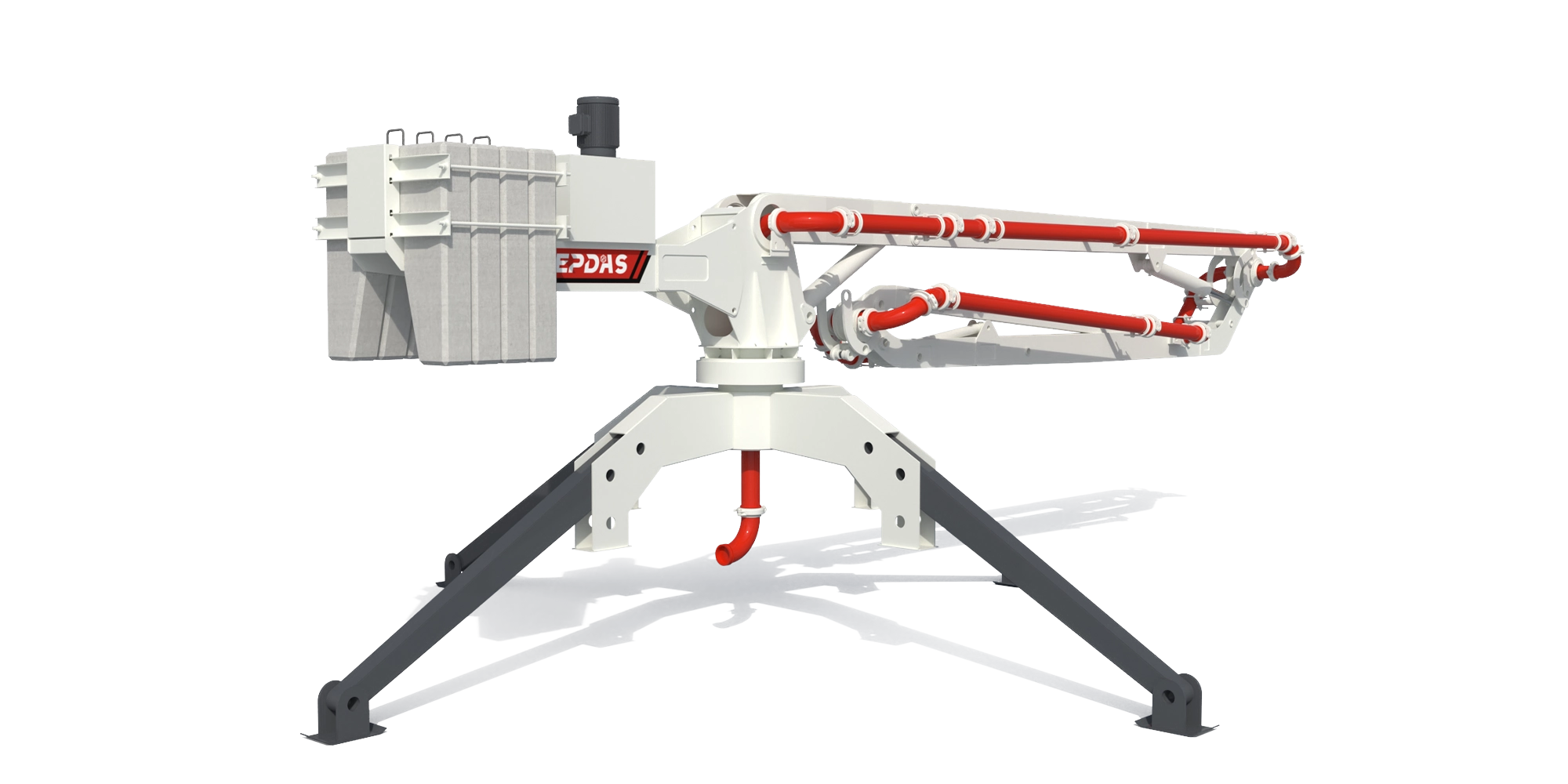
Spider Boom
A Spider Boom is a versatile aerial work platform featuring multi-section articulated booms and stabilizing outriggers. Its track chassis ensures low ground pressure, protecting fragile indoor floors, while its narrow, stowed footprint easily clears standard doorways.
- Boom Placing Radius:14~21m
- Boom Rotation Speed:0.3~0.8r/min
What is a Spider Boom
A Spider Boom is a compact aerial work platform, equipped with multi-section articulated booms and independent stabilizing outriggers. It called spider boom from its stowed configuration. Four outriggers unfold and plant on the ground like a spider.
- Spider Boom
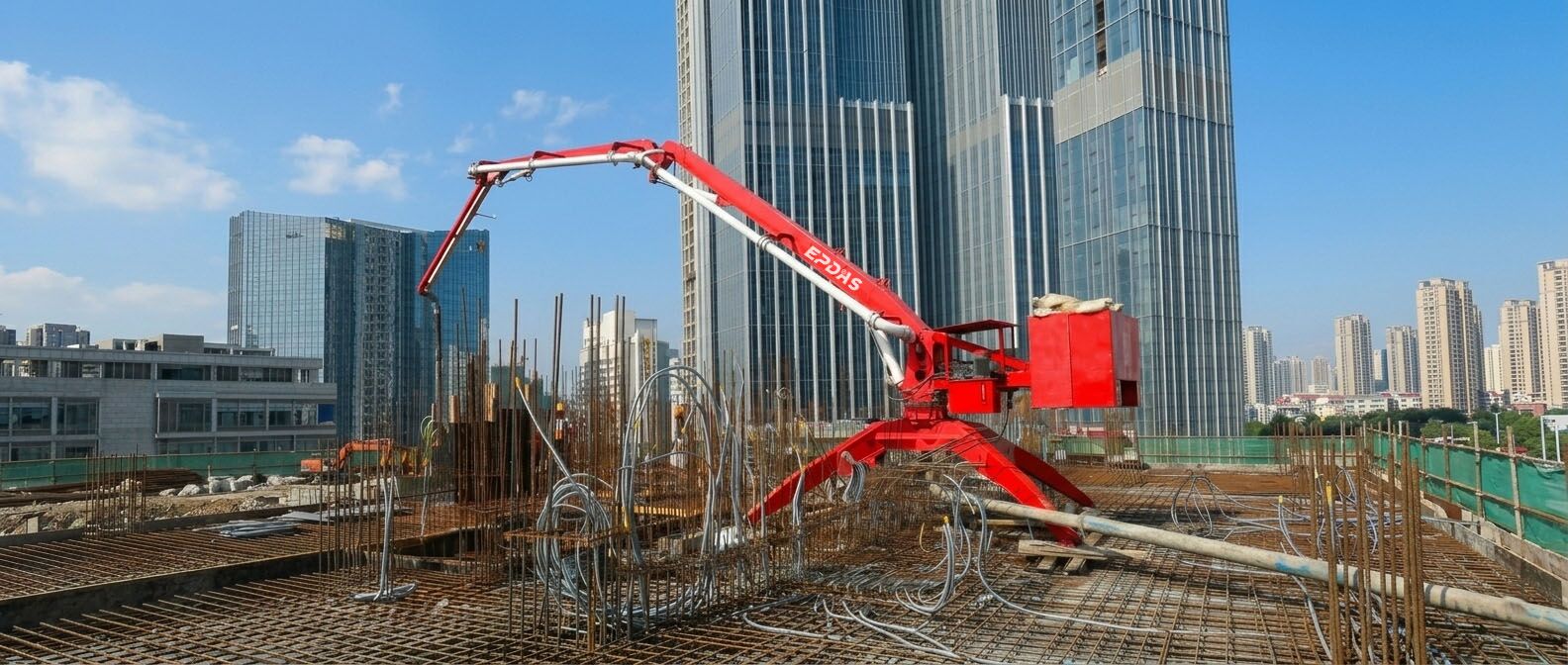
More efficient and flexible to operate, making them ideal for high-rise and urban construction projects that require fast, continuous, and precise overhead placement.
| Model | HGY14 | HGY15 | HGY17 | HGY21 | |
| Item | Unit | parameter | |||
| Max. placing radius | m | 14 | 15 | 17 | 21 |
| Big arm length | m | 5.7 | 6 | 6.66 | 8.66 |
| Big arm elevation | ° | -2~84.4 | 0~70 | 0~65 | 0~65 |
| Medium arm length | m | 4.52 | 5 | 5.73 | 6.73 |
| Medium arm elevation | ° | 0~180 | 0~180 | 0~180 | 0~180 |
| Small arm length | m | 3.78 | 4 | 4.61 | 5.61 |
| Small arm elevation | ° | 0~180 | 0~180 | 0~180 | 0~180 |
| Hose length | m | 3 | 3 | 3 | 3 |
| Concrete delivery pipe | mm | ø125×6 | ø 125×6 | ø 125×6 | ø 125×6 |
| Tail rotary radius | m | 2.72 | 2.81 | 3.51 | 3.93 |
| Total power | Kw | 4 | 4 | 5.5/7.5 | 5.5/7.5 |
| System pressure | Mpa | 24 | 24 | 24 | 24 |
| Rotary speed | r/min | 0.3—0.8 | 0.3—0.8 | 0.3—0.8 | 0.3—0.8 |
| Rotary range | ° | 0~360 | 0~360 | 0~360 | 0~360 |
| Supporting legs span | m | 3.15×3.15 | 4×4 | 4.6×4.6 | 5×5 |
| Overall height | m | 2.9 | 2.6 | 3.2 | 3.75 |
| Bare machine weight | kg | 2700 | 3230 | 5000 | 6700 |
| Balance weight | kg | 2×900 | 2×1100 | 2200 | 2×1100 |
| Control mode | kg | Panel/ Wireless remote control | Panel/ Wireless remote control | Panel/ Wireless remote control | Panel/ Wireless remote control |
What does the Specification of Spider Boom Mean
When buying or renting a spider boom, misinterpreting the technical specification may lead to selecting unsuitable equipment that cannot be used in construction and postpone the construction schedule. In order to avoid such issues, we have translated complex mechanical technical terms into simple and easy-to-understand explanations.

- Working height
This is different from platform height. Working height always includes the operator’s upward reach. Selecting equipment based solely on platform height may result in choosing a model that is too small for standard operations.
- Horizontal boom reach and obstacle clearance
These metrics define how far the boom can extend horizontally and its capacity to clear obstacles. This is critical for projects such as pruning branches across greenbelts or maintaining curtain walls over walls and pipelines.
- Stowed dimensions
Pay close attention to the minimum transport width and overall height. If you plan to use a spider boom in historic stadiums or enclosed indoor spaces, always measure doorways, aisles, or freight elevators on-site with a tape measure prior to acquisition.
- Ground bearing pressure and gradeability
For high-grade marble tiles or delicate lawns, a track chassis with low ground bearing pressure is recommended to avoid floor damage. For mountainous gardens or rugged construction projects, check the gradeability to ensure the machine can handle the required slope angles.
- Rated platform capacity
This determines the maximum load the platform can carry. Ensure you calculate the combined weight of the operator, carry-on tools, and construction materials. Additionally, consider the equipment's load chart: heavier loads typically restrict the boom's outreach radius.
- Power parameters
Different power sources cater to distinct operational requirements. Electric power is eco-friendly but runtime is limited. Diesel power provides high torque and continuous operation, but it is restricted in certain environments due to emissions and fuel consumption.
Comparison Between Spider Booms and Mainstream Aerial Work Equipment
Lots of people find it challenging to choose between a spider boom, scissor lift, telescopic boom lift, and truck-mounted boom lift. Comparing them based on practical job-site conditions and project requirements makes it easy to determine the ideal solution.
Spider boom vs Scissor Lift
Core difference and performance comparison:
Scissor lift only supports single vertical lifting but its platform is wide and stable. It is totally suitable for vertical transportation for multi-person cooperation and bulk materials.
Spider boom has multi-angle obstacle-crossing outreach capacity. It is easy to bypass obstacles such as pipes and eaves to perform precise side outreach operations.
How to choose:
Flat construction sites, open-ground and have a large demand of load—–scissor lift
Limited access passage, obstacles directly below the working point and fragile ground—— spider boom
Spider boom vs Telescopic Boom Lift
Core difference and performance comparison:
Telescopic boom lift is mainly for aerial platform, especially for super high-rise building and large steel structures, 30-50m. Its body is large so it needs wide operating radius and spatial outrigger support.
Compared with it, spider boom’s body is medium and is compact when folding, so it can be transported by standard containers or light commercial vehicles. Its working height is amid 30m to cover most medium and small aerial work projects.
How to choose:
High-rise facade construction or large open-air heavy industrial projects——–telescopic boom lift
Max working height <30m, confined site space and frequent relocation between scattered job sites——spider boom
Spider boom vs Truck-Mounted Aerial Platform
Core difference and performance comparison:
Trucked-mounted aerial platform has excellent performance on long-distance relocation and is suitable for mobile operations along urban roadways, because it is directly mounted on truck chassis.
Spider boom belongs to non-road mobile machinery and exempt from urban truck restriction regulations. When facing short-distance relocation, we can transport it by small trailer.
How to choose:
Municipal streetlamp maintenance, roadside billboard inspection along highways, or multi-point patrol operations across different regions——–truck-mounted aerial platform
Off-road conditions, landscaping projects, muddy terrain, or scattered mixed indoor and outdoor aerial operations——-spider boom
Main Applications of Spider Boom
To help you maximize efficiency on-site, we have tailored the multi-functional capabilities of the spider boom into specific application solutions. Whatever dealing with overhead obstacles, fragile floors, or narrow access routes, this equipment excels across the five core business segments below.

- Building exterior wall maintenance
Ideal for municipal facade cleaning, coating refurbishment, and window maintenance. Its flexible articulated boom precisely navigates uneven facades and protruding obstructions without damaging delicate ground paving.
- Curtain wall glazing installation
The four outriggers provide exceptional stability, while non-marking rubber tracks allow the machine to travel over marble or indoor flooring without leaving scuffs. This makes it perfect for glass installation and maintenance in commercial buildings and lobbies.
- Landscape tree maintenance
For tall tree pruning and pest control on complex terrain, the boom can reach deep into tree canopies. Meanwhile, its tracked chassis maintains stability on uneven lawns, muddy ground, or soft, sloped terrain.
- Industrial plant maintenance
Designed for narrow, equipment-dense factory environments. With its compact body and superior maneuverability, it navigates within tight gaps of machinery with ease. Electric models guarantee zero exhaust emissions and low noise.
- Warehousing and logistics operations
Perfect for warehouse rack installation, high-level inventory handling, and lighting maintenance. Its ultra-tight turning radius allows it to maneuver freely without disrupting regular warehouse outbound operations.
Why Choose EPDAS
Investing in our machinery means securing long-term safety and operational assurance. Backed by our advanced manufacturing facility and professional team, EPDAS provides full-process service from production to delivery.
- 01
Direct factory supply and original technology source
We offer competitive quotation while maintaining stringent control over the equipment’s quality from the very first step of production. Without middlemen, we ensure that every spider boom delivered complies fully with international industry standards.
- 02
In-depth customization and full-scope OEM
We are dedicated to delivering the most suitable solutions tailored specifically to your on-site requirements. Beyond custom colors and branding, we offer comprehensive engineering modifications, including modifying platform dimensions, upgrading power systems, and integrating specialized tool interfaces.
- 03
Global shipping service
We utilize customized container loading and structural reinforcement techniques tailored to your order volume, ensuring your machinery arrives in pristine condition. Even amidst geopolitical uncertainties, we adhere strictly to a customer-first philosophy to provide you with the most seamless logistics options.
- 04
Professional technical training
Don’t worry about operation and maintenance. EPDAS offers complimentary training covering everything from basic operation to critical safety protocols. Should an emergency arise, our technical hotline is available during your working hours to provide prompt, expert troubleshooting.
Advantages of Spider Booms
- Compact design
Most spider booms have a stowed width is below 1 meter, allowing them to pass through standard doorways and narrow passages effortlessly. This enables them to access indoor areas like shopping malls, stadiums, and factory workshops.
- Low ground pressure
The tracked chassis and four outriggers evenly distribute the machine's weight on a larger surface area, reducing ground pressure to only 0.5-1.5 bar. This ensures safe operation on fragile surfaces like turf, marble, and hardwood floors without causing damage.
- Automatic outrigger system
Every model features an automatic outrigger system. A single button press completes outrigger deployment and leveling, significantly reducing setup time and enhancing operational safety.
- Versatile power options
Electric models are ideal for indoor applications requiring zero emissions and low-noise operation, while diesel models offer high power and extended runtimes, making them the premier choice for heavy-duty outdoor projects.
- 360°C continuous rotation
Both the platform and the turret can achieve full 360° rotation , allowing operators to cover surrounding areas without repositioning the chassis. This feature is exceptionally valuable in confined spaces.
- Radio remote control
A wireless remote control allows operators to manage travel, outrigger deployment, and boom movements from either the ground or the platform , maximizing operational flexibility and safety.
EPDAS Spider Boom Projects

HGY15 in Peru
In South American mountainous terrains, roads are narrow and steep, preventing heavy concrete pumps from turning or parking near bridgeheads. EPDAS provides a proven solution combining a spider boom with a remote trailer concrete pump.
Model: HGY15
Serves to:Mountain highway
Equipment Details Display of Spider Boom
These images showcase the spider boom’s essential role on challenging job sites: reaching demanding heights, positioning operators with pinpoint precision, and maintaining absolute stability under rigorous working conditions. Its multi-jointed, flexible boom allows for accurate access in complex architectural structures, ensuring continuous overhead installation, reliable operation, and efficient project progress.
Spider Boom FAQs
- What are the main types of concrete pumps available for sale?
The main types of concrete pumps include trailer concrete pumps, stationary concrete pumps, and truck-mounted concrete pump trucks. Trailer concrete pumps are cost-effective and flexible, while pump trucks are ideal for large-scale, high-rise construction. Stationary concrete pumps are commonly used for fixed or long-term projects.
- How do I choose the right concrete pump for my project?
Choosing the right concrete pump depends on project size, required pumping distance, concrete output, and site conditions. Small to medium projects often use trailer concrete pumps, while large infrastructure projects may require high-capacity concrete pump trucks. EPDAS can help match the right model to your needs.
- What is the maximum pumping distance of a concrete pump?
The pumping distance depends on the concrete pump model, hydraulic pressure, and pipeline configuration. Trailer concrete pumps can reach horizontal distances of 300–500 meters, while concrete pump trucks may achieve vertical heights of over 150 meters. Proper pipeline diameter and concrete mix design are critical for long-distance pumping performance.
- What concrete pump capacity do I need?
Concrete pump capacity is measured in cubic meters per hour (m³/h). Small projects may need 30–60 m³/h, while large commercial or infrastructure projects often require 80–120 m³/h or more. Selecting the correct capacity improves efficiency and reduces operating costs.
- What wear parts require regular replacement in concrete pumps?
Common wear parts in concrete pumps include delivery cylinders, cutting rings, wear plates, S-valves, and rubber hoses. Regular inspection and timely replacement of these components help maintain stable concrete pumping performance and extend the equipment's service life.
- What hydraulic systems are used in modern concrete pumps?
Modern concrete pumps typically use closed-loop or open-loop hydraulic systems with high-pressure piston pumps. These systems provide stable pumping pressure, precise flow control, and improved energy efficiency. High-quality hydraulic components significantly reduce wear and enhance the durability of concrete pumping machines in demanding job sites.
- How high can a concrete boom pump truck reach for building construction?
The vertical pumping height depends entirely on the equipment model and boom length: Small models (30-38m): These trucks have a vertical reach within 36 meters. They are perfect for rural self-built houses and low-rise infrastructure projects. Medium models (39-48m): These trucks can cover heights up to around 46 meters. They are the standard choice for regular urban commercial and residential buildings. Large models (50-62m and above): These heavy-duty trucks can exceed a vertical height of 60 meters. They are specifically engineered for high-rise buildings and massive bridge pier concrete pouring.
- Are your hydraulic and pipeline fittings easy to purchase overseas like in South America or Southeast Asia?
Yes. All hydraulic pipe fittings, seal rings, pipeline clamps, and basic valves on our equipment are strictly built to international DIN and ISO standards.
- Is the equipment prone to pipeline clogging when handling large aggregate sizes or high-grade (C50/C60) concrete?
We increase the tungsten carbide wear-resistant layer of the core S-valve and wear plate by 2 to 3 mm. At the same time, our engineering team optimizes the anti-clogging switching logic within the full hydraulic control system. This fully utilizes the high pressure of the constant-pressure, large-displacement variable pump to smoothly and forcefully push thick, heavy concrete mixes through without blockages.
- What is the difference between a spider boom and a regular boom?
The main difference lies in the chassis and outrigger design: Regular boom: These usually feature wheeled chassis, making them bulkier with higher ground pressure. They are designed strictly for operating on flat, hard ground. Spider boom: These utilize a compact crawler track chassis and four flexible outriggers. This setup provides a smaller footprint and extremely low ground pressure, allowing them to work flexibly in tight spaces, on steep slopes, and on delicate indoor or outdoor surfaces.
- Do you offer OEM services?
Yes. We provide full-scale OEM and industrial customization services. Whether it is custom paint schemes, brand logos, or specific component interfaces, our engineering team can deeply customize the equipment to perfectly fit your local market and special operational requirements.
- How should daily maintenance be performed on the equipment?
The core of daily maintenance involves regularly checking hydraulic oil levels, cleaning air filters, verifying track tension, and lubricating key moving parts. To make this easy for your team, every machine comes with a detailed preventive maintenance manual.
- How can I judge the quality of a trailer concrete pump?
You can ignore surface cosmetics like premium paint finishes or fancy housing designs. Instead, focus entirely on the core mechanical and hydraulic components. High-quality trailer pumps are strictly built with industry-recognized, global-brand components.
- What basic cleaning is required for a trailer pump after each construction session?
You must thoroughly flush the hopper and delivery pipelines with water immediately after every pour. If concrete residue is allowed to dry and harden inside, it will severely accelerate the wear on the pistons and wear plates.
- Which systems of a trailer pump require regular inspection and maintenance? Are there any special requirements for summer?
A: Regular maintenance should focus on three core areas, with extra attention paid during high-temperature seasons: Centralized lubrication system: Check this system regularly to ensure continuous and proper oil supply to all mechanical friction points and bearings. Hydraulic system: Change the hydraulic oil strictly based on the equipment operating hours to maintain system pressure and protect internal valves. Special summer maintenance: During hot summer months, you must frequently clean dust and debris off the radiator surface to ensure maximum heat dissipation. This simple step prevents high-temperature system shutdowns and stops the hydraulic oil from thinning out under extreme heat.
Related Products
Customize Your Solutions
Contact us now via Email:info@epdas.com, or Whatsapp:+86 188 38115507 , or fill in the form below.
FEW TIPS:
- Please specify the required max working height and horizontal outreach (e.g., 18m working height / 8m side reach).
- Please tell site access width and ground bearing condition (e.g., indoor elevator entry 0.9m / concrete flat ground).
- Please inform us of platform rated load and actual application scenario (e.g., 230kg load / shopping mall ceiling installation).
- Please confirm preferred power source and working environment (e.g., full electric for indoor / diesel for outdoor hillside).
- If you are interested in becoming our distributor, please let us know.
Service Process:
- Business negotiation
- Solution development
- Manufacturing and commissioning
- Operational production