
Working Capacity: 3.5t~7t
Max. Reach: 10m~12m~14m~18m
Emission Standards: StageⅡ~StageⅤ, EPA4
A telehandler, also known as a telescopic handler, is a versatile machine that combines off-road capability with a telescopic boom. Evolving from traditional forklifts, the telehandler integrates the telescopic boom structure of mobile cranes, traditional forklift functionality, and the high-speed mobility and loading capacity of wheel loaders. This design makes full use of its superior vertical lift and horizontal outreach. Equipped with various attachments, the machine expands its operational capabilities and range, enhancing its adaptability to diverse working sites.
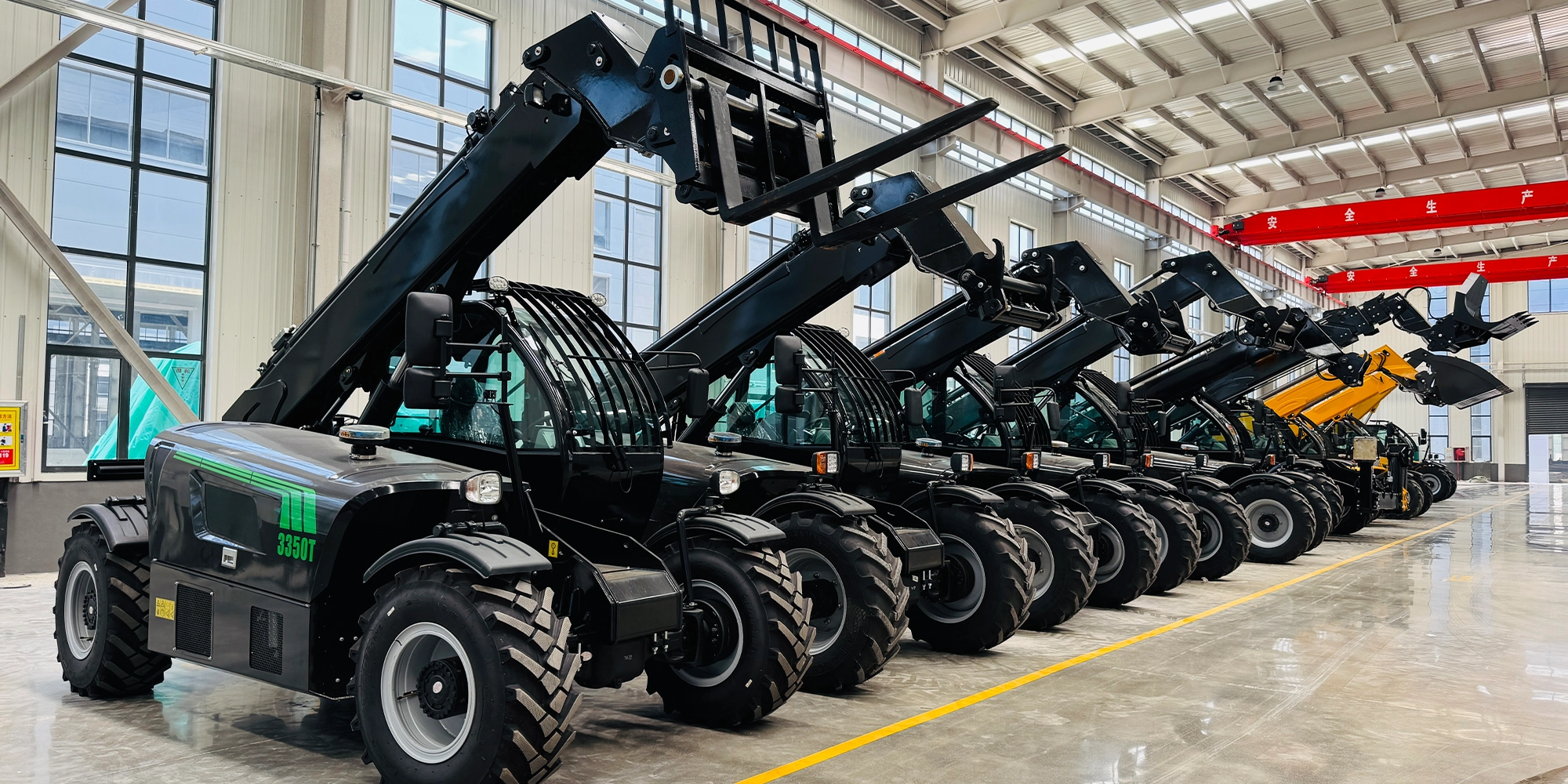
Telehandler was designed to address the limitations of traditional forklifts, such as their reliance on a vertical mast and restricted single-mode operation. Compared with a traditional forklift, which relies on a fixed mast, the telehandler achieves lifting through the variable length and angle of its boom, which is its core structural innovation.
It is widely recognized in the industry that the telehandler was pioneered by the British manufacturer JCB in 1977 with the iconic 520 Loadall. Following its launch, the product gained rapid popularity across Europe, with sales exceeding 1,000 units by 1980. This milestone solidified JCB’s leadership in the industry (a position it maintains today with an estimated global market share of approximately 30%).
As the market developed, additional manufacturers entered the sector. France’s Manitou, and Italy’s Merlo (1981) and Dieci (1983), entered the market with their own models. Their collective contributions significantly accelerated the industry’s expansion and maturation.

AS a high-quality telehandler, every component is designed with operational performance, stability, and safety. Only through the coordination of these systems can efficient material handling be achieved. The core components are primarily divided into five major systems, each playing an indispensable role.

This is the most distinctive core component and It is a key to achieve high-altitude and long-distance operations. It features a multi-section design constructed from high-strength steel, ensuring the ability to handle heavy loads when maintaining smooth extension and retraction.
The chassis is constructed from heavy-duty welded steel and supports all core components, including engine, hydraulic system, and telescopic boom. Chassis is equipped with front and rear axles. On most models, axles feature a swing function that ensures tires maintain contact with the ground on uneven terrain. To improve stability during heavy-load operations, the chassis is also equipped with outriggers to prevent tipping caused by rollover in the center of gravity.
Telescopic handler currently are primarily diesel-powered on the market such as Yuchai, Weichai, Cummins, and Perkins. These engines provide continuous and robust power for vehicle travel and hydraulic system operation while maintaining fuel efficiency. Models designed for European Union are also equipped with advanced exhaust treatment systems to meet environmental emission standards.
The extension and retraction of the boom, lifting, and the deployment and retraction of the outriggers are all driven by hydraulic pressure. The complete system includes hydraulic pumps, hydraulic cylinders, hydraulic lines, and hydraulic oil filters. Control system connects control levers to the hydraulic and power systems. Through electrical circuits and hydraulic valve assemblies, it precisely transmits the operator’s commands to the various actuators, enabling flexible control of equipment.
Cab is a fully enclosed structure that shields operator from wind and rain. Inside, a multifunctional joystick integrates controls for boom extension, lifting, and so on, with an intuitive operating logic. The cab also incorporates safety features such as fall protection and emergency stop buttons. Combined with large windows and a reverse camera to allow operator to clearly observe work environment and minimize blind spots.
Equipment’s tires and attachment interfaces also play an key role. Rubber tires adapt to various working surfaces, enhancing equipment’s mobility across different applications. Standardized attachment interfaces can quick changes between various attachments.
Working Capacity: 3.5t~7t
Max. Reach: 10m~12m~14m~18m
Emission Standards: StageⅡ~StageⅤ, EPA4
Working Capacity: 2.5t~4.0t
Max. Reach: 6m~7m
Emission Standards: StageⅡ~StageⅤ, EPA4
Working Capacity: 0.5t
Max. Reach: 3.35m
Emission Standards: StageⅤ, EPA4
Driven Type: Diesel/Electric
Lifting Capacity: 2.0~10t
Lifting Height: 3m~10m
Telehandler can effectively address the working limitation of traditional forklift depending on its telescopic boom, multi-attachment compatibility and superior off-road. It can be used in various working sites via changing attachments, suitable for multi-operational versatility and satisfy multi-industry on-site operation demands.

Telehandler is perfectly suited for the rugged outdoor environments of farms and ranches. In daily ranch operations, it can delivery bale directly, centralized stacking and distributed feeding.
It can be equipped with attachments to do silage slopping, feed distribution saving labor cost and reducing worker pressure.
Once baled, crop residues and forage can be efficiently managed in bulk. The telehandler excels in the high-volume handling, stacking, and logistics transfer of these materials, ensuring a rapid turnaround from field to storage.
In this application, the equipment is more fit for uneven terrain such as site perimeter and outdoor stockyards. As telehandler can drive stabily in rough terrain and keep excellent performance of any transmission whatever its unitized palletized loads, bulk materials or oversized loads.
Telehandler is suitable for complex material transfer and on-site operations and it can complete discharge of various construction materials and short transmission in the site,eliminating the need for re-handling.
It can integrate with mobile crane and tower crane to compete material feeding, supporting the large-scale lifting equipment. The machine also excels in daily material handling, construction waste removal, and general site maintenance to construction site clean and unobstructed access.
The operating logic of a telehandler is straightforward, and proper maintenance is essential. From startup to daily care, the entire process follows a sequence of steps where the key is to prioritize smooth operation and safety.
Drive to the work area, observe site conditions, and confirm workspace and material weight. Perform a ten-minute check: verify fluid levels (hydraulic oil, engine oil, coolant, and brake fluid), inspect tire pressure, ensure wheel lug nuts are tight, and check the boom for cracks or deformation.
Test safety devices, including the emergency stop button, load sensor, and reverse camera. Once confirmed, lower the outriggers[if so equipped] to level the equipment and ensure the chosen attachment is securely installed.
Align the attachment with the load, adjust the boom angle to make steady contact, and use the joystick to lift the material at a slow speed. Extend or retract the boom to move the load to the designated spot, lower it steadily, and release.
If the boom extends/retracts slowly or lacks lifting power, check for hydraulic contaminants or leaking lines. If the boom fails to respond, verify the control lever, solenoid valve, and wiring connections. Should unusual noises occur, inspect articulation points for lubrication or check internal sliders for wear.
CAUTION: Never work on hydraulic systems under pressure.
After use, retract the boom and outriggers, then shut off the engine. For regular care, lubricate moving parts weekly, clean the hydraulic and engine air filters monthly, and conduct an annual comprehensive inspection of the chassis and outriggers.
When storing, choose a level, dry location away from rain or direct sunlight. For long-term storage, disconnect the power supply and apply anti-rust treatment to metal components. Periodically start the equipment to ensure it remains in good working status.
If structural failures occur, do not attempt self-repair. Contact professional maintenance personnel immediately to avoid secondary damage. All operators must undergo professional training.
When selecting a telehandler, you shouldn’t only focus on price or brand. The key is to meet your own operational needs. If the equipment’s specifications are too high, it will result in a waste of resources, on the contrast, if they are too low, it will fail to meet operational requirements and even have potential safety hazards.

The lifting capacity need to match the daily weight of materials. It is recommended to leave a certain margin based on the maximum daily load. Boom length should be selected based on the required working height and reach. For example, warehouse shelving reaches 8 meters in height, so equipment should have a boom length of 8 meters or longer.
A high-quality telescopic handler can adapt to a variety of attachments. Common attachments include forks, buckets, hay forks, grapples, and lifting booms. When purchasing, you need to verify that the equipment’s hydraulic interfaces and mounting structures are compatible with required attachments. Some brands also offer customized attachments. Consult them according to your practical operational needs.
There are two main types: diesel and electric, which are suitable for different environments. Diesel models have powerful performance and are ideal for outdoor settings, such as construction sites, farms, and mines. They are mainstream choice in the current market. While electric models are quiet and produce zero emissions. They are more suitable for indoor environments or strict environmental and noise requirements.
Reputable brands offer greater assurance in terms of steel quality, hydraulic systems, and so on.
Timely repairs and adequate spare parts can reduce equipment’s downtime and ensure project progress when malfunctions occur. When purchasing, learn about the brand’s distribution of offline service outlets and supply lead time for spare parts.
In addition to the initial purchase cost, you also need to consider subsequent operating costs, including fuel/electricity expenses, maintenance costs, and spare part replacement costs. Some equipment may have a lower purchase price but entail high maintenance costs in the later stage. We recommend considering your own operational volume and service life. Choosing a telescopic handler that is truly suitable for your needs, rather than focusing solely on the upfront price.
A telescopic handler combines the functions of a forklift, small crane, loader and other equipment in one. It shorten time of equipment mobilization, scheduling and switchover. One team only need to operate one equipment and then they can complete various material handling tasks, which slashes labor requirements markedly.
A multi-functional telescopic handler cuts down on the costs of businesses purchasing multiple pieces of equipment, as well as associated maintenance and storage expenses. When it comes to labor, the machine’s automated operation reduces staffing needs and eliminates the risk of workplace injuries caused by manual material handling.
Traditional material handling, especially high-altitude operations, relies heavily on manual labor and is prone to safety incidents like falls and impact injuries. With a telescopic handler, the operator can complete all tasks from the safety of the cab, far away from hazardous areas.

The EPDAS T3007K telehandler boasts outstanding performance, precisely meets the material handling needs of various scenarios in the Philippines, and serves as a cost-effective, one-stop reliable solution.
Model:EP3.0Q
Customize:Adapt to local complex job site conditions
Location:Canada

Open construction site in Chile for steel structure and roof canopy installation requiring compact and high-efficiency construction equipment.
Capacity:Maximum load capacity 3 tons
Problems:Muddy terrain
Multi-function: lifting and auger operations on a telescopic boom
Unlike a standard forklift, a telescopic handler provides extended reach and greater lifting height. Telehandler forklifts are better suited for construction sites where materials need to be placed at height or over obstacles, while forklifts are mainly used for warehouse operations.
Choosing the right telescopic handler depends on lifting capacity, maximum height, terrain conditions, and attachment requirements. Compact telehandlers suit tight spaces, while heavy-duty models are ideal for large construction and industrial projects.
Most telescopic handlers are equipped with four-wheel drive and multiple steering modes, including front-wheel steering, four-wheel steering, and crab steering. These features improve maneuverability on tight or uneven construction sites and enhance overall operational efficiency.
Lifting height and forward reach depend on the model. Standard telescopic handlers offer lifting heights from 6 to over 18 meters, with forward reach capabilities of up to 10 meters. Selecting the right telehandler forklift ensures safe load placement at the required working height.
Telescopic handlers support a wide range of attachments, including forks, buckets, lifting hooks, work platforms, and bale clamps. Quick-attach systems allow operators to switch tools easily, increasing machine versatility across construction, agriculture, and industrial tasks.
Modern telescopic handlers include load moment indicators, overload protection, emergency braking systems, and stability control. These safety features help prevent tipping and ensure safe operation during lifting and material handling tasks.
Telescopic Loader: This machine focuses on scooping, loading, and ground-level material handling. It offers a moderate lift height and excellent agility. Telehandler: This machine is engineered specifically for high-altitude material placement and equipment installation.
Service Process: