
Theoretical vs. Actual Capacity: How to Choose the Right Concrete Mixer Pump and Avoid Costly Mistakes
2026-06-16 10:25:18
This article provides a comprehensive breakdown of the key differences between theoretical and actual concrete mixer pump capacity, and explains how real jobsite conditions affect performance. It also covers common selection mistakes, equipment configuration factors, and ROI considerations, helping contractors and equipment buyers choose the right model and avoid costly purchasing errors.
What is a Concrete Mixer Pump?
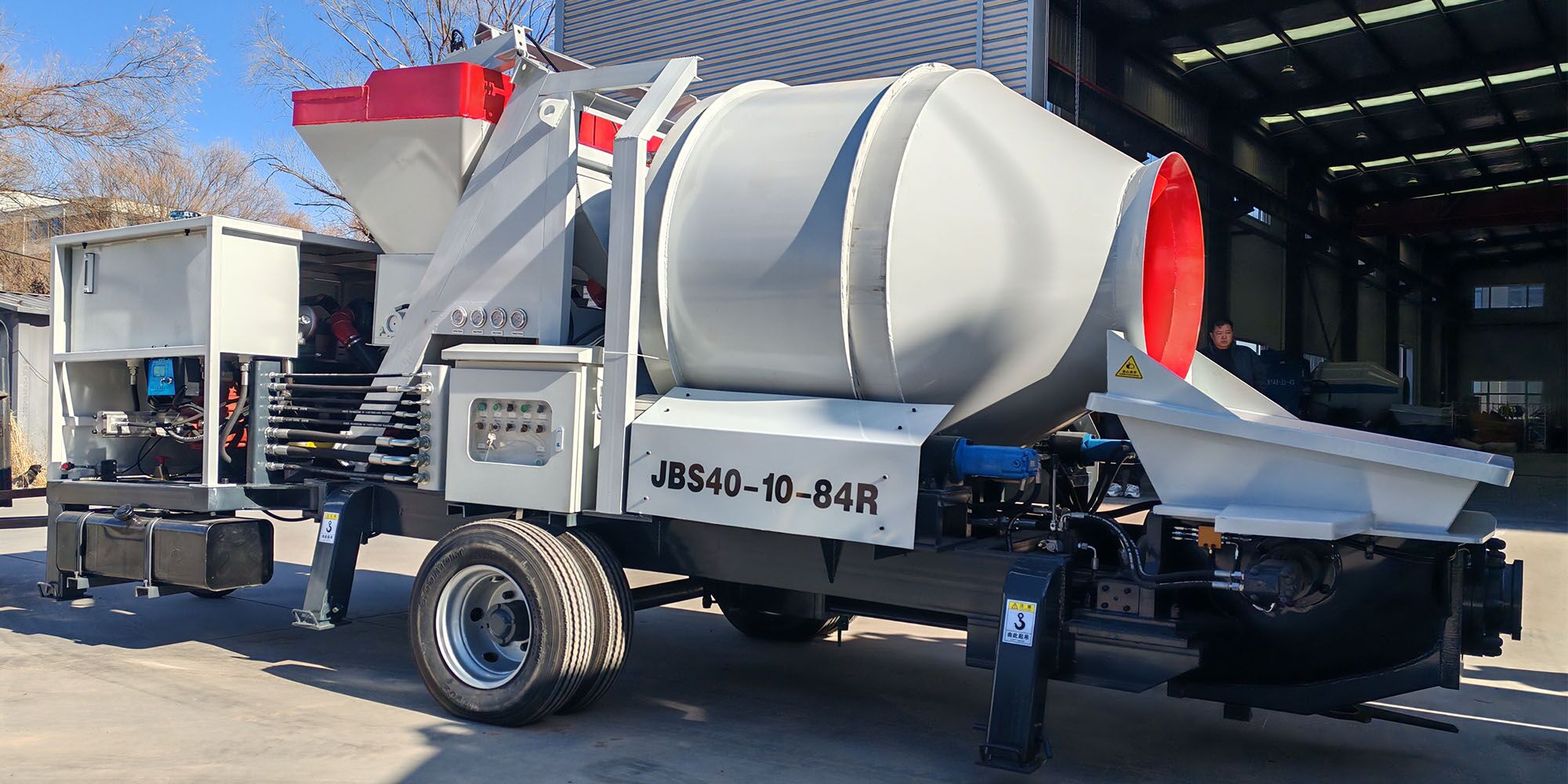
A concrete mixer pump is a fully automatic construction machine that integrates loading, mixing, and high-pressure pumping.
Simply put, it can directly complete the mixing of sand, gravel, cement, and water at the construction site. The mixed concrete meets standard requirements and does not need to be transferred.
The stable operation of the equipment relies on a full set of high-quality core accessories. The whole machine is equipped with imported Kawasaki and Rexroth main oil pumps. Matched with a Weichai diesel engine. In addition, the equipment is equipped with a high-precision 100μm suction filter and other high-quality components. The overall structure is robust and well-sealed, which effectively reduces pipe blockage, oil leakage, and downtime.
Main applications of Concrete Mixer Pump

Concrete mixer pumps are extremely adaptable and are not limited to a single project type. Whether it is civil construction, infrastructure engineering, or special site construction, they can play a vital role.
Civil residential and commercial building construction
It is the most common application scenario. For the construction and pouring of urban and rural self-built houses, low-to-mid-rise buildings, shops, and office buildings, the site space is often limited, and large-scale equipment cannot enter. A compact concrete mixer pump is small in volume and flexible in movement, which is perfectly suited for the pouring needs of narrow sites.
Road and municipal infrastructure projects
The advantages of the equipment are equally obvious. Concrete paving of rural highways, factory roads, and municipal auxiliary roads requires long-distance and continuous feeding. The equipment can realize uninterrupted mixing and pumping, preventing the solidification of concrete during transit, and ensuring the integrity and flatness of the road surface.
Construction of industrial buildings
Such as factories and warehouses has high requirements for a stable supply of concrete and a continuous construction workflow. The fully automatic operation mode of the concrete mixer pump can continuously output standard concrete, adapting to the pouring construction of large-area floors and foundation platforms.
Tunnels, underground projects, and coastal construction scenes
Their construction environments are relatively special. The internal space of a tunnel is narrow, ventilation is limited, and the operation of separate split equipment is difficult. The coastal site has soft terrain and high humidity, requiring high equipment stability to cope with complex outdoor working conditions.
Off-grid construction sites
They are the core advantage scenarios of diesel concrete mixer pumps. There is no stable municipal electricity supply in mountainous and rural field construction sites, and electric equipment cannot operate. Diesel mixer pumps can operate, unrestricted by the power supply, which is perfectly suitable for scattered field engineering construction.
Concrete Mixer Pump Types Comparison: Choose the Right One and Avoid Costly Mistakes
Concrete mixer pumps on the market can be classified in different ways. Different types equipment adapts to different construction scenarios. Choosing a suitable model can directly increase construction efficiency and avoid idle equipment waste.
| Classification dimensions | Types | Core characteristic | optimal working conditions |
| By power type | Diesel | Powerful performance, fully independent of the power grid | Remote construction sites such as fields, mountainous areas, and locations without stable power supply. |
| Electric | Powered by grid electricity, featuring low operating noise, reduced running costs, and zero exhaust emissions | indoor construction, urban areas, and municipal projects with strict environmental and noise requirements. | |
| By mobility | Wheel-type concrete mixer pump | with built-in wheels, allowing easy towing by a tractor and fast relocation between sites on flat terrain | open spaces and frequent site changes. |
| Crawler-type concrete mixer pump | strong adaptability,capable of directly handling rough terrain, and offering easy positioning | muddy, uneven ground or narrow and confined job sites. |
Pumpable Concrete Types and Mix Ratio Guidelines for Concrete Mixer Pumps
Many overseas buyers will ensure the adaptability of equipment’s aggregate size before purchase to match their construction materials. Concrete mixer pumps have a wide range of adaptability, covering most commonly used concrete materials in civil and infrastructure projects, except for ordinary cement mortar.
| Classification Dimension | Material Types | Core Standards & Requirements | Construction Troubleshooting Tips |
| Conventional Materials | Normal Concrete | C20 to C40 grade concrete | for houses, roads, and factories. |
| Special Functional Materials | Fine stone concrete, lightweight foam concrete, ordinary plastering mortar, floor screed mortar | Adapted to multi-scenario composite construction. | |
| Core Material Parameters | Aggregate Size (Primary Condition) | Maximum particle size: within 40mm | Oversized aggregate can easily jam pipelines and wear out the pumping system. |
| Slump | Maintained within the 100mm – 180mm range | Below 50mm, pipe plugging is highly likely to occur. Too high will cause segregation and reduce concrete structural strength. | |
| Water-Cement Ratio | Recommended to be controlled between 0.4 and 0.6 | Too watery will lead to segregation and bleeding.Too dry will increase pumping pressure. | |
| Not Recommended for Conventional Pumping | Special / High-Requirement Materials | C45 and above high-grade concrete, large-aggregate crushed stone concrete, high-fiber reinforced concrete | Conventional models are prone to insufficient pressure or uneven mixing. |
Equipment Transportation, Installation, and Site Deployment Plan of Concrete Mixer Pump
Overseas customers purchase equipment and pay great attention to on-site deployment issues such as transportation packing, installation, and site adaptation.
Transportation and packing
They are adapted to mainstream maritime specifications. Compact concrete mixer pumps can be loaded into 20GP standard containers, offering a smaller footprint and lower freight costs. The high-capacity model is suitable for 40HQ High Cube containers to avoid transportation damage to the greatest extent.
On-site installation and commissioning
The threshold for on-site installation and commissioning is extremely low. After the equipment arrives at the construction site, 2 workers can complete the whole machine positioning, pipeline docking, and hydraulic/electrical circuit inspection with truck-mounted crane and forklift.
Site and infrastructure
The site and infrastructure requirements are flexible. The equipment does not need a hardened concrete foundation. A flat and compacted hard surface can meet the operation needs. It can be adapted to field temporary construction sites and simple rural sites. The equipment covers a small area, and can be used in narrow alleys and small construction sites.
Electricity and pipelines
The deployment of electricity and pipelines is simple. The electric model is suitable for conventional 380V industrial electricity. The wiring method is simple. Supports customized configurations for different countries’ voltage and frequency standards, such as 460V or 440V. Pipelines can be flexibly assembled and extended according to the construction scenario. Vertical, horizontal, and corner pipelines can be quickly arranged.
Real Output of Concrete Mixer Pumps: Theoretical Capacity vs Actual Capacity
Many procurement customers directly compare equipment specification sheets to evaluate production capacity. In practical projects, there is a consistent disparity between the actual output volume and the theoretical parameters. It is a common phenomenon in the industry and a vital reference basis for model selection.
Theoretical vs. Actual Equipment Production Capacity
| Model | Theoretical Capacity | Real Capacity | Production Capacity Evaluation |
| Small-Scale Mixer Pump | 5 – 10 m³/h | 4 – 8 m³/h | Suitable for small, scattered repairs or tight-space construction. |
| Medium-Scale Mixer Pump | 30 – 48 m³/h | 22 – 26 m³/h (Peak does not exceed 30 m³/h) | The mainstream workhorse model, ideal for medium-to-large project volumes. |
Tips: The theoretical capacity is based on standard no-load test parameters. In real-world construction, an expected reduction in actual output due to various site variables is a normal industry phenomenon.
Four Core Factors Influencing Actual Job–site Production Capacity
| Core Influencing Factors | Actual Impact Mechanism | Job site Optimization & Improvement Tips |
| Manual Feeding Speed | Intermittent feeding directly disrupts the continuous mixing rhythm, lowering overall output efficiency. | Keep the batching area and feeding channels clear. |
| Operator Proficiency | Inexperienced operation increases equipment start-stop intervals and troubleshooting downtime. | Assign experienced and skilled operators to duty. |
| Pipeline Length & Layout | Longer pumping pipelines and more corner elbows increase system resistance, reducing the discharge speed. | Minimize the pipeline distance as much as possible and optimize the routing path. |
| Concrete Slump | Materials that are too dry or have poor fluidity will significantly lower hourly yield. | Strictly control the water-cement ratio to ensure the slump stays within the optimal range. |
Equipment Parameter Interpretation & Core Configuration Selection Guide
Key parameter interpretation
| Core Parameters | Theoretical Value | Actual Value (site condition dependent) | Model Selection & Troubleshooting Guide |
| Equipment Output | 30 m³/h / 40 m³/h 50 m³/h | 30-Type: 22 – 26 m³/h 40-Type: 30 – 35 m³/h 50-Type: 35 – 42 m³/h
| Affected by feeding speed, pipeline layout, and concrete fluidity. |
| Pumping Pressure | Depends on specific model configuration | Decreases with increasing conveying distance and pipeline bends | Choose conventional pressure for low-rise and short-distance pouring. A high-pressure version must be selected for tunnels, long-distance lines, and mid-rise buildings. |
| Max Aggregate Size | Standard models typically fit within 35mm | Exceeding the limit is strictly prohibited | Out-of-spec particle sizes will directly cause pipeline plugging, pump wear, or even fatal pipe bursting. |
| Hopper Capacity | Large Capacity / Small Capacity | Affects the interval downtime of continuous operations | Large hoppers reduce operational pauses and suit big projects. Small hoppers offer a lightweight body, perfect for scattered repairs. |
| Pipeline Diameter | Matched according to conveying requirements | Larger diameters reduce flow resistance | Larger pipe diameters lower the plugging rate but slightly decrease pumping pressure. |
How to Select Equipment Based on Job Site Conditions
- Evaluate distance and height:
For ordinary buildings with a 30-50 meters vertical pouring requirement, choose the standard model.
High-pressure pumping models are preferred for long-distance transportation such as tunnels and highways.
- Control the concrete slump:
The aggregate particle size must be compliant. The concrete slump should be maintained in the optimal range of 100mm-180mm. Below 50mm, it is very easy to block the pipe.
- Power and chassis selection:
Urban, indoor, stable power supply: Priority is given to electric models.
In the field, in mountainous areas, no grid power: Choose the diesel model.
The site is flat and frequent site transfers are required: Choose a wheeled chassis.
Muddy terrain, narrow site, uneven road surface: Choose a tracked chassis.
Common Equipment Faults and Daily Maintenance Tips of Concrete Mixer Pump

The failure rate of concrete mixer pumps is mostly related to inadequate operation and maintenance. Daily basic maintenance can greatly reduce the probability of failure and downtime, extending the service life of the equipment.
Pipe plugging
It is the most common problem, mostly caused by an improper concrete mix ratio, aggregate particle size exceeding the standard, and residual material accumulation in pipelines. Before construction, check the concrete slump and aggregate specifications to avoid non-standard materials entering the machine.
After the completion of each construction, the residual concrete in the pipeline must be thoroughly cleaned. If there is a slight blockage in the pipe, it can be cleaned by reverse pumping. If the pipe is seriously blocked, the machine needs to be disassembled and cleaned. Do not force the operation.
Insufficient pump pressure and uneven discharge
They are generally problems with the hydraulic system. Blockage of the hydraulic oil filter, malfunction of the hydraulic valve, and abnormal hydraulic oil temperature will all lead to unstable pump pressure.
Replace the filter element regularly, check whether the hydraulic oil hoses are leaking, pay attention to the operation status of the cooling system during operation, and ensure that the hydraulic system works at a stable temperature.
Daily maintenance skills
Daily basic maintenance is not complicated. After construction every day, clean up the residual materials in the mixing drum and pipes to keep the equipment clean.
Regularly check the wear and tear of bolts, switches, and hydraulic accessories. Replace wear parts in time. Add lubricating oil regularly according to the equipment instructions to ensure the smooth operation of the machine. Simple daily maintenance can effectively avoid most common faults.
Equipment Cost Breakdown and ROI Analysis
Many contractors hesitate to buy a concrete mixer pump because they focus heavily on upfront cost and the payback period. Currently, concrete mixer pump prices in the market vary within a relatively clear range depending on model type, power system, and configuration.
Four Key Factors Affecting Total Equipment Cost
| Core elements | Specific Impact Mechanism | Procurement recommendations |
| Core component brands | Using imported hydraulic main pumps, high-precision valve blocks, and branded diesel engines increases initial cost. | Prioritize high-end branded components to reduce long-term failure rates and maintenance costs. |
| Discharge capacity and productivity | Large-capacity and high-output models require higher material strength and power systems, resulting in higher prices. | Select equipment based on actual daily job site workload. |
| Chassis and mobility system | Crawler-type chassis structures are more complex than wheeled types | Crawler models for muddy, narrow, and rough terrain. Wheeled models for standard road conditions. |
| Cross-border logistics and additional costs | International shipping costs, export packaging, and overseas insurance are essential components of total equipment investment. | Request CIF or DDP quotations to include logistics and avoid hidden export costs. |
Concrete Mixer Pump Investment ROI Analysis
| Comparison Dimension | Traditional Construction Mode (Mixer + Concrete Pump Separation) | Integrated Mixer Pump Mode (Self-Owned Equipment) | Long-Term Rental Mode |
| Equipment & Labor Cost | Requires purchase of two machines | Only need one machine | No upfront equipment purchase cost |
| High labor demand for on-site material transfer | High level of automation | Total rental cost continuously accumulates | |
| Construction Efficiency & Project Progress | Slow Multiple material transfer steps | Fast Simultaneous mixing and pumping | unstable Equipment cannot be guaranteed on-demand |
| Investment Payback Period | Long payback cycle | Fast payback period. | Pure expense model with no asset accumulation |
| Long-Term Cost-Effectiveness Evaluation | Low | Very High | Low |
FAQS
The following are some of the most common questions from equipment buyers:
- How high and how far can the concrete mixer pump pump at most?
EPDAS concrete mixer pumps reach a vertical height of 50–70 meters. Parameters can be customized for ultra-high or long-distance pumping.
- What size of aggregate can the equipment handle?
It handles standard construction sand and stone aggregates. Pipe plugging can be effectively avoided as long as the standard concrete mix design is followed and the maximum aggregate size stays within the specified model limits.
- What is the actual output of a concrete mixer pump?
Actual output is typically 70%–85% of theoretical capacity depending on site conditions such as feeding speed, pipeline layout, and concrete slump.
Conclusion
The reason why the concrete mixer pump has become the mainstream equipment for small and medium-sized construction projects is that it meets the actual construction needs of the site. The integrated mixing and pumping design simplifies the construction process, reduces equipment and labor input.
In most cases, selecting the right model based on actual jobsite conditions has a greater impact on ROI than focusing only on the initial purchase price.Whether it’s controlling costs, accelerating schedules, or tackling complex job sites, this equipment provides stable performance. If you’re unsure which model fits your project, contact us anytime for an accurate quote and a tailored construction plan based on your specific site conditions and volume.
