
DHBT40 Concrete Pump | Ghana Medical Infrastructure Project Case
2026-09-16 10:02:52
1. Project Background
1.1 Ghana Pharmaceutical Enterprise Infrastructure Project
The owner of the project is a local pharmaceutical enterprise in Ghana. The overall factory project covers the main building of the factory, office buildings, and a wide range of internal road construction in the park.
There are many operation points on the construction site, and the conditions for concrete pouring are different in different areas. In the construction of the office building, there is a condition that the facade is poured upwards, and the concrete needs to be transported to a certain height. The roads of the factory and the park are mainly ground and low-rise pouring operations.
The concrete of the whole project is mixed and produced on site by the YHZM35 drum mobile mixing station, and then distributed to each pouring point through the pumping equipment. This article focuses on the practical application of the DHBT40 Concrete Pump in the project.
2. Project Requirements and DHBT40 Applications
2.1 High-level pouring of office buildings requires stable pumping capacity
In the main construction stage of the office building, there are many pouring points above the ground. Concrete cannot be directly delivered by tankers or hoppers, and needs to be pumped through the pipeline.
Compared with ground road pouring, pumping concrete upward will put forward higher requirements for the internal pressure of the pump and the state of continuous discharge. Once the pressure reserve is insufficient, it is easy to have on-site problems such as transmission interruption and pipe blockage.
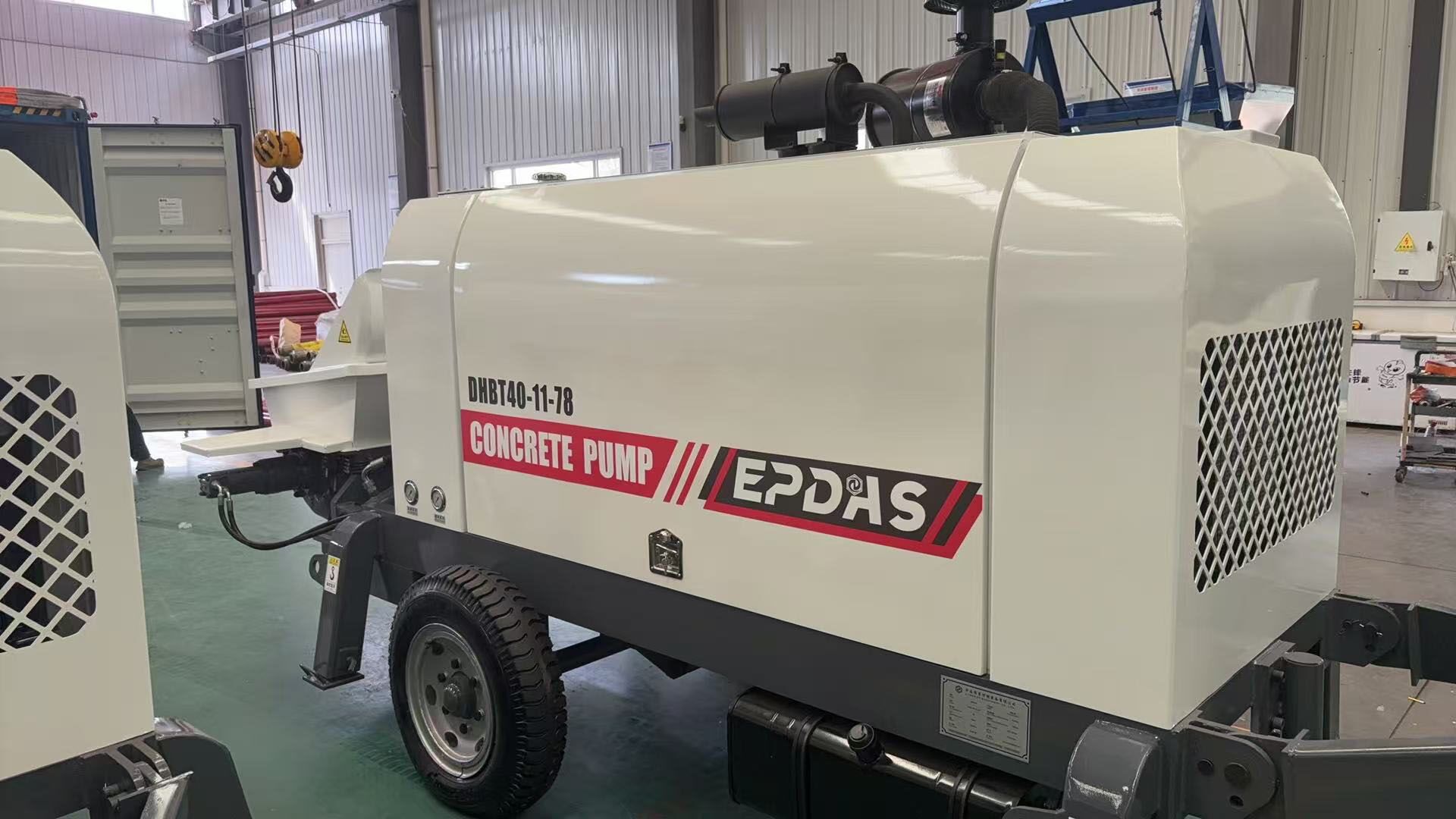
The EPDAS team sorted out the actual pouring height of the office building and the transportation distance after the pipeline arrangement, and then selected the DHBT40 Concrete Pump to be put into the project in combination with the concrete supply rhythm of the whole project.
2.2 Different construction areas need to arrange pumping equipment flexibly
The construction scope of the project is not only the office building, but also the factory building and the park road need a large amount of concrete pouring. The time of construction and pouring in each area is not completely synchronized.
If only one concrete pump is equipped on the site, all pouring tasks will be concentrated on this equipment. When the construction center of gravity is switched, it is necessary to disassemble the pipeline, move the pump, and then redeploy the pipeline for debugging.
When the pouring time of the two areas overlaps, a single pump can only give priority to one of them, and the operation in the other place can only wait for the pump to free up, which will restrain the overall construction rhythm of the site. Considering this reality, two DHBT40 concrete pumps were finally configured.
2.3 How to adapt two DHBT40 to different construction stages
On-site equipment can be arranged differently according to the progress of the project. The following are several actual use scenarios under the project plan.
In the centralized construction stage of the office building, one of the DHBT40 pumps is connected to the pipeline layout of the office building, which is specially designed to cope with the task of high-level pouring and focuses on ensuring the concrete delivery to the upper floors. When the main body of the factory carries out the pouring operation, another pump can be placed in the factory operation area. The pouring task of the factory is carried out independently and will not occupy the operation time of the pump serving the office building.
Entering the road construction stage of the park, the road surface pouring points are scattered. The two pumps can be flexibly allocated according to the pouring range of the day. The equipment configuration reserves the dispatching space. When a certain work surface needs to be concentrated, the site has the conditions to mobilize the pump to match the construction rhythm.
2.4 The mobile construction environment requires pumping equipment that is easier to redeploy.
The construction points in the whole factory are scattered, and the placement of the pump cannot be fixed from beginning to end. With the shift of the working surface, the position of the pump body and the conveying pipeline should be adjusted accordingly.
DHBT40 adopts a trailer-type chassis structure, which does not require a permanent installation foundation. The equipment is equipped with a diesel engine, so there is no need to rely entirely on the unstable external power supply of the construction site. The whole machine has a compact design, and it is convenient for short-distance relocation within the construction site.
2.5 DHBT40 and YHZM35 form a continuous concrete construction process
The whole set of on-site concrete operation links forms a clear division of labor: the YHZM35 drum mobile mixing station completes the concrete batching and mixing nearby, and produces concrete. The DHBT40 pump receives concrete and transports it to each pouring work surface through the pipeline.
This is also the idea behind the whole plan. Instead of delivering a single device, it is combined with the complete construction chain to form an equipment combination.
3. Main Technical Parameters of DHBT40
- Rated delivery volume: 40 m³/h
·Maximum theoretical conveying pressure: 8 MPa
·Maximum number of deliveries: 30 times / minute
·Valve form: S valve
·Conveying cylinder: 160 × 1000 mm
·Hoppervolume: 400 L
·Diameter of outlet: Φ125
·Conveying pipeline specifications: Φ125 / Φ100 / Φ80
·Diesel engine: 56 kW / 2200 rpm
·Main system oil pressure: 28 MPa
·Stirring system oil pressure: 14 MPa
·Maximum stirring speed: 40 rpm
·Volume of hydraulic oil tank: 260 L
The maximum conveying pressure of 8 MPa leaves a pressure margin for the upward conveying of concrete in the office building, and copes with helps cope with the pressure loss caused by pipeline elbows and vertical lifting.
The S-valve is equipped with a large-sized conveying cylinder, which is conducive to handling common aggregates on the construction site, maintaining continuous pumping, and reducing the probability of blocked pipes.
Diesel power adapts to the current situation of uneven power supply conditions of at overseas construction sites. It does not need to completely rely on the power grid of the construction site, and the location of equipment the equipment does not need to accommodate the power point.
4. Factory Inspection, Packaging and Transportation of Equipment
4.1 Pre-factory inspection
Before the equipment is shipped from the factory, the staff checks the main structure of the pump, the whole set of hydraulic circuit entire hydraulic system and the diesel power system one by one. Check whether each action cycle is normal, and confirm that there is no abnormality in the whole process of hopper mixing, direction change, push valve changeover and pumping, etc. Confirm that the status of the equipment meets the standard before entering the subsequent packaging process.
4.2 Protection of pumping system and key parts
The hydraulic components and electrical control boxes of the pump are parts that are easily damaged during shipping. They will be made into protective packages separately to do a good job of moisture-proof cushioning individually protected with moisture-proof and cushioning materials. Supporting conveying pipelines, joints, seals and other scattered accessories are uniformly sorted out and classified, and bundled for protection to avoid bumping and loss during ocean transportation.
4.3 Loading and fixing
Plan the container loading and placement scheme in combination with the trailer shape and center of gravity position of the two DHBT40. After the equipment is in place, use the rigging to be firmly tied and fixed use rigging to firmly tie and secure the equipment to avoid the risk of equipment displacement and shell bumping caused by sea transportation bumps shell damage caused by impacts during sea transportation. All supporting accessories are packed with the host main unit.
Project Summary
This set of equipment configuration does not directly apply the standard product list, but combines the height of the project building, the scattered construction points, and the current situation of on-site pouring time on-site pouring schedule to determine the equipment model and quantity.
The 40 m³/h concrete pump not only meets the working conditions of the upward pumping requirements for upward pumping of the office building, but also allows flexible equipment scheduling across different stages of factory and road construction, and adapts to the whole construction process of the Ghanaian pharmaceutical factory project.