Foundation Requirements of Stationary Concrete Batching Plant: Design, Key Considerations
The stationary concrete batching plant cannot be directly placed on ordinary ground, and a proper foundation is the prerequisite for stable operation. A suitable foundation should meet three core requirements: sufficient bearing capacity, overall stability and long-term durability.
In addition to bearing the self-weight of the equipment, the foundation also needs to bear the materials stored in the bins, the dynamic loads generated by the mixer, and external loads from loaders and concrete mixer trucks. The following focuses on the practical points of foundation design and construction and will not elaborate on the whole structure of the mixing station.
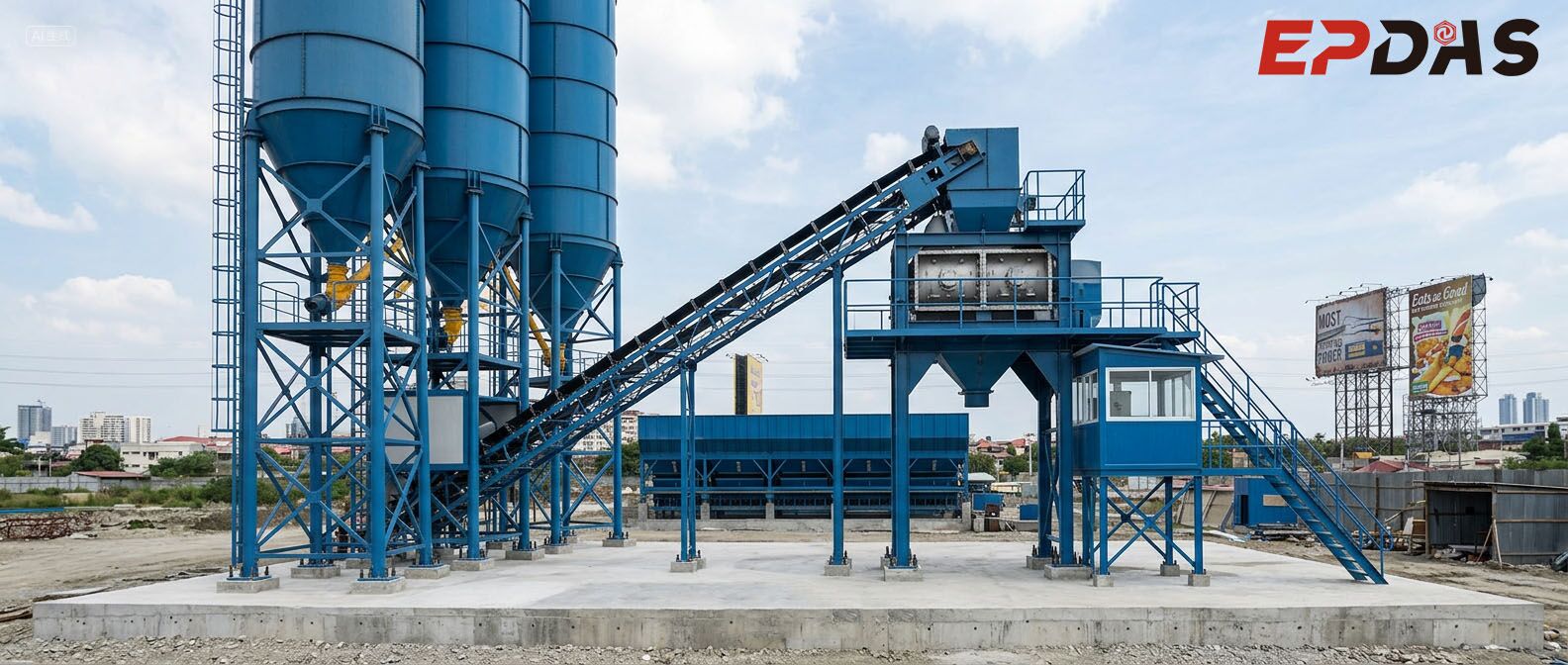
I. The reason why the mixing station must make a special foundation

The self-weight and sand and stone accumulation weight of all kinds of components are all supported by the foundation. The load distribution of aggregate silos, powder silos and the mixing host is uneven. The simple flooring cannot adequately distribute these loads and is very easy to settle locally.
Stirring, unloading, and belt start and stop continuously produce vibration. The foundation needs to have sufficient rigidity and stability to withstand the dynamic loads generated during equipment operation and control vibration and displacement.
Once the foundation is settled or deformed, it will cause the belt to be misaligned, the discharge port to be offset, and the measuring sensor to be damaged, which will directly affect the accuracy of the mix ratio. This is why the foundation cannot be simplified.
II. Five core rigid requirements of the foundation

a. The bearing capacity needs to account for the self-weight of the equipment, the static load of the material and the dynamic load of the operation, and the safety margin should be reserved.
b. The foundation should resist settlement, lateral tilt and continuous vibration. The height of the powder silo is large and the center of gravity is high. It is also necessary to focus on wind load, anchoring and overturning stability.
c. There is no unified standard for foundation depth or dimensions, which needs to be comprehensively determined in combination with equipment specifications, soil quality, load and local standards.
Soft soil foundations should be treated or an appropriate foundation type should be selected according to the survey results.
d. Concrete grade, reinforcement and embedded components are adjusted on demand, and large-scale equipment cannot uniformly apply the C30 concrete standard. The drainage design is very easy to be ignored.
e. Rainwater and water from equipment cleaning can soak the soil, soften the foundation, accelerate settlement and rebar corrosion. Drainage ditches and drainage slopes must be provided around the foundation.
III. Basic differentiation requirements of each region
The aggregate silo bears long-term material loads. The loader operation area also needs to consider repeated vehicle traffic and the durability of the ground.
The cushion layer and reinforcement should be designed accordingly to prevent large-scale settlement. The mixing host area should focus on controlling the foundation stiffness, integrity and construction joint layout to avoid affecting the operation of the equipment due to foundation deformation or construction quality problems.
The vertical load of the powder silo is large, and the open-air environment also exposes it to additional wind load. It requires an independent foundation to separately verify the anchoring and overturning stability.
The support points of the belt conveyor are scattered, and the key point is to control the difference in settlement between support points. Uneven elevations can easily cause the belt to run off track and tear.
The foundation requirements for light areas such as control rooms are relatively low. Operating equipment such as air compressors should be provided with suitable foundations based on their loads and vibration characteristics..
IV. The impact of soil quality on the basic plan
The bearing capacity of the hard layer is high, and the shallow foundation can meet the requirements.
The bearing capacity of silt and soft backfill soil is insufficient, and it is necessary to adopt treatment schemes such as soil replacement, foundation reinforcement or pile foundation according to the survey results.
Settlement may sometimes be addressed through minor adjustments, but differential settlement is more harmful. It can damage transmission components and crack the concrete foundation. When the groundwater level is high and the soil is saturated, the bearing capacity decreases significantly.
A gravel drainage layer should be added to the base to help prevent groundwater from affecting the foundation. A soil survey must be completed before construction.
Foundation design should not be based on equipment dimensions alone. It should also reflect site-specific soil and groundwater conditions.
V. Key check parameters before pouring
The contour of the equipment determines the length and width of the foundation, and the equipment load, foundation conditions and structural design jointly determine the foundation thickness and reinforcement requirements.
Accurately position the anchor bolts to avoid enlarging holes during installation; embedded steel plates and casings facilitate equipment connections.
Maintain a consistent foundation elevation to ensure the belt and weighing system remain level; plan drainage ditches to prevent water retention.
Reserve space for equipment maintenance around the foundation. When checking the parameters, also consider the overall layout of the factory.
VI. Equipment problems caused by construction defects
1. Insufficient bearing capacity of the foundation will cause continuous settlement, and the equipment alignment will continue to shift.
2. Uneven settlement may cause equipment tilt or connection offset, and further affect the normal operation of the metering, conveying and unloading systems.
3. Incorrect anchor bolt positioning may make forced installation necessary, increasing the risk of bolt damage.
4. Excessive surface unevenness can accelerate the wear of transmission parts.
5. Poor drainage can cause water to accumulate and soften the foundation.
6. Insufficient curing can cause the concrete to become loose and peel, significantly shortening its service life.
VII. Frequently asked questions
- Can the mixing station replace the concrete foundation with ordinary flooring?
Not recommended. Ordinary flooring usually cannot be specially designed to withstand the concentrated and dynamic loads of batching plant equipment. Long-term operation may cause settlement, cracking or deformation.
- What is the fixed value of the foundation burial depth?
There is no unified depth requirement. It is jointly determined by equipment production capacity, soil quality, silo height, and local codes and standards.
- Can the station be built on the soft soil site?
Yes, but a geotechnical survey should be carried out first. Then, soil replacement, ground improvement, pile foundations, or other suitable solutions can be adopted according to the requirements for bearing capacity and settlement.
- What basic forms are commonly used in mixing stations?
Common foundation types include reinforced concrete integral foundations, independent pier foundations, combined foundations, and pile foundations for soft soil conditions.
Conclusion
The foundation of the mixing station is not a simple concrete base plate, but a load-bearing structure designed around equipment loads, soil conditions, vibration, and drainage. Before civil construction, the foundation drawings should match the equipment configuration and site conditions. The overall plant layout should also be checked in advance to reduce rework later. Reasonable foundation design can reduce long-term maintenance costs and ensure stable concrete production.