
How Much Concrete Can a Drum Concrete Mixer Produce Per Hour?
2026-11-18 16:55:41
Many construction sites will encounter a real problem when configuring drum mixers. The parameters written on the equipment nameplate look good, but when the mixer is put to work on site, the actual material discharge speed often does not match the nominal value.
Many people directly treat the equipment’s stated capacity as its hourly output to arrange the construction plan. When the pouring operation is carried out, they find that concrete production can’t keep up with the pouring rate, which disrupts the process arrangement of the whole site. If you want to find out how much finished concrete a drum mixer can produce in an hour, you can’t just look at the advertised specifications, but also calculate it from the actual production process.
How to Calculate the Hourly Output of the Drum Mixer?
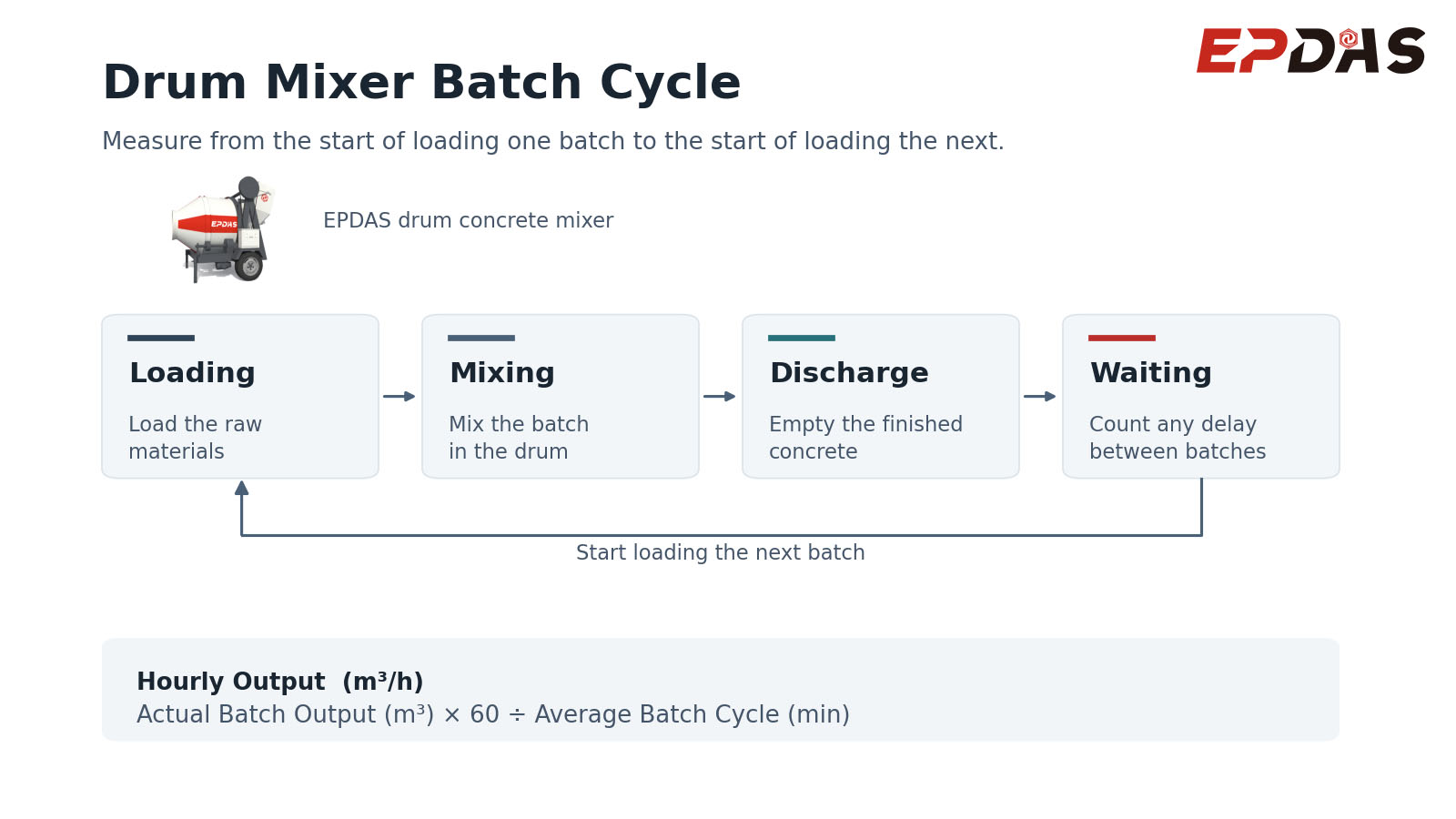
There is a simple formula for the hourly output of the drum mixer.
Hourly output (m³/h) = actual output of a single batch (m³) × 60 ÷ average single batch cycle (minutes)
There are two key values in the formula, which cannot be directly copied from the numbers on the product sample.
The first is the actual output of a single batch, which refers to the volume of finished concrete finally unloaded after each batch of mixing is completed. The parameters of the mixer on the market may list the total volume of the drum, the feeding capacity and the discharge capacity. These three values are not equivalent.
The second is the average single-batch cycle, measured from the start of loading one batch to the start of loading the next batch.
This covers the whole process: loading the raw materials, mixing in the drum, and discharging all the finished concrete, and the waiting gap between the two batches of materials. Using only the mixing time to calculate hourly output gives a result much higher than the level that the construction site can actually achieve.
Example of an On-Site Output Calculation
Take the same drum mixer as an example and assume it discharges 0.35 m³ of finished concrete per batch. We only need to change the cycle time of a single batch on site, so that we can intuitively see the difference in the production caused by the working conditions.

The following 3-minute and 4-minute cycles are a set of hypothetical examples, and the times shown for each stage are for reference only:
- With a loading skip, assume 40 seconds for loading, 100 seconds for mixing, and 40 seconds for discharge. With no waiting between stages, the batch cycle takes 3 minutes.
- With the same loading skip, assume the mixer waits for raw materials or for the receiving equipment to be ready. The time for each stage stays the same, and the extra minute of waiting extends the batch cycle to 4 minutes.
With manual loading, the batch cycle could take 5–6 minutes in another hypothetical scenario. The actual speed depends on the team and loading conditions.
| Production situation (example) | Average single batch cycle | Hourly output estimated according to this rhythm |
| Loading skip, no waiting between stages | 3 minutes | 7.0 m³/h |
| Loading skip, waiting for materials or receiving equipment | 4 minutes | 5.25 m³/h |
On the premise that the volume of each batch of the same equipment remains unchanged, the overall hourly output will decline significantly just because of the one-minute more waiting time at the site.
The sand and gravel aggregates are stacked in the loading position in advance, and the trolley or hopper to receive the material can be in place in time. There is almost no idleness in loading, mixing and unloading. The cycle of a single batch is stable at 3 minutes, and 7 cubic meters of concrete can be produced per hour.
The aggregate supply is intermittent, or the receiving tool is not in place in time when unloading. The mixed concrete stays in the drum until discharge. In this example, the cycle increases to 4 minutes and hourly output falls to 5.25 cubic meters.
These two sets of numbers are only for calculation reference. The results calculated will be different for different equipment and different construction sites.
What Circumstances will Slow Down the Production Speed of the Drum Mixer?

A complete batch of concrete production needs to go through three stages of loading, mixing and unloading, and the decline in output mostly occurs in these processes.
The loading stage is a very common source of slowing down. Sand and stone aggregates, cement and mixing water have not been prepared in advance. The drum has been emptied, but there are no raw materials to put in. The equipment can only idle in place and wait for the materials to enter the site. Loading with a skip is relatively stable. When manually loading, the rhythm of workers’ handling and shoveling is unstable, which will also lengthen the total time of a single batch cycle.
The mixing time should match the requirements of the concrete mix used on site, and cannot be compressed at will. The mixing time required for concrete with different mix designs and aggregates is different. When calculating the output, the actual mixing time performed on site should be used, not the machine’s theoretical minimum mixing time. Blindly shortening the mixing time will cause uneven concrete mixing, which will directly affect the pouring quality.
In addition to the delays involving workers and materials, the physical characteristics of concrete itself will also limit the output efficiency of the drum mixer. A drum mixer uses blades to lift the materials and let them fall under gravity to mix them. It is better suited to plastic and semi-dry concrete.
Low-slump concrete or coarse aggregate can affect mixing and discharge. Determine how much extra time is needed from a trial batch on the mixer being used. A stiff mix can discharge more slowly and leave more material on the drum wall and blades, which can further reduce hourly output.
The waiting in the unloading process is also easy to be ignored. The concrete in the drum has finished mixing and meets the requirements, but the receiving trolley or hopper is not yet in place under the discharge opening. The mixed materials cannot be unloaded, and the mixer cannot be loaded for the next batch, and the whole production process is stuck in this step. Changes in the mix design may also increase the time of mixing or unloading, indirectly reducing the overall output.
How to Check Actual Hourly Output and Select a Mixer
If you want to get the output data that fits the current situation of the site, you can directly do the on-site measurement. Select a representative period of time for the construction status, and continuously record the total volume of finished concrete discharged by the mixer within an hour. While recording, pay attention to which stage accounts for most of the waiting time, so as to facilitate the subsequent targeted adjustment of the on-site operation.
If the equipment has not been purchased yet, the two sets of information should be confirmed with the supplier during the purchase stage. Inquire about the actual volume of finished concrete discharged per batch of the equipment, and the complete single-batch production cycle, and at the same time ask about the on-site operation conditions corresponding to the manufacturer’s rated hourly output.
If the supplier only gives the mixing time, without including loading, unloading or waiting time, you must ask for the complete batch cycle, and then put it into the formula to calculate the output. After getting the sample parameters, focus on distinguishing the feed capacity and the nominal output capacity, and avoid directly using the feed capacity to estimate the output.
Use the estimated or measured output to arrange the on-site pouring plan. For the layout of the construction period, it is necessary to choose the discharge speed that the equipment can maintain for a long time under the normal working conditions of the site, and do not take the peak output under the ideal working conditions.
When selecting a mixer, allow for some capacity above the peak pouring demand. There will be material fluctuations, short-term equipment failures, changes in the concrete mix and other factors that can reduce output on site.
Example of a capacity allowance: The nominal hourly output of the equipment is 30% higher than the on-site peak pouring demand.
If the measured discharge speed does not meet the expectations, you can review the record later. Let’s see if the extra time is mainly consumed by waiting for materials, mixing longer than required, slow discharge due to the mix, or waiting for receiving equipment, and then adjust the on-site operation arrangement accordingly.