
How to Calculate Cement Silo Capacity: Assessing the Actual Storage Needs of a Concrete Batching Plant
2026-10-14 16:40:30
Many mixing stations choose cement silos and place orders directly according to the nominal capacity specified by the manufacturer. After it is put into production, they find problems: the silo cannot be filled, or the cement tanker arrives slightly late, and the inventory runs out, interrupting concrete production. The selection of a cement silo should not only be based on the nameplate, but also take into account on-site production and replenishment conditions.
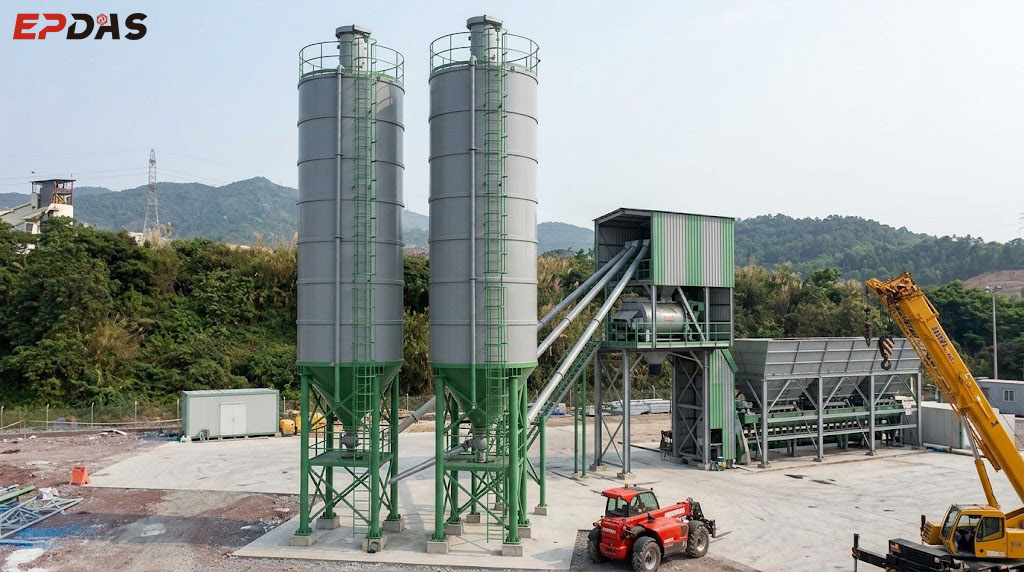
What Conditions Determine the Storage Capacity of the Cement Silo?
Avoid a common mistake: the maximum production capacity of the equipment is not equal to the actual output. The actual output is subject to orders, schedules and raw material availability, and the calculation shall be based on the estimated actual daily output.
The core on-site conditions that affect the required storage capacity mainly include the daily concrete output and cement consumption per cubic meter of concrete, the feeding frequency of bulk cement tankers, and the distance from the cement supplier. Finally, determine the target reserve days.

Calculate the Daily Cement Consumption
The daily cement consumption is the basis for the whole calculation, which is obtained by multiplying the daily concrete output by the cement consumption per cubic meter.
Formula: Cd = Qd × Cm
Cd: Daily cement consumption, t/day
Qd: Daily concrete output, m³/day
Cm: Cement consumption per cubic meter of concrete, t/m³
Pay attention to unit consistency. Most of the cement usage given in the mix proportions is kg/m³, which needs to be converted into tons and then substituted into the calculation; otherwise, the result will be wrong. The mix proportions will change at different stages of construction, and the cement consumption for blinding concrete and structural components is different.
The Tonnage of Cement Reserves Required for Calculation
After obtaining the daily consumption, multiply it by the set reserve days, which is the minimum reserve tonnage required by the project.
Formula: M = Cd×T
M: Target cement reserve, t
Cd: Daily cement consumption, t/day
T: Reserve days, d
It should be distinguished here: the calculated M is the material inventory required for production, which is not equivalent to purchasing a cement silo with the same nominal capacity.
The actual filling process requires sufficient headspace in the silo to prevent the material level from exceeding the limit, so the actual amount of cement that can be stored will be lower than the nominal capacity. The result is only used as a starting point for selection, and the effective storage capacity of the equipment needs to be checked again.
Distinguish Between Geometric Volume and Effective Storage Volume
Geometric volume refers to the total internal volume calculated based on the diameter and height of the cylinder. The effective storage volume is the space where cement can actually be stored under on-site working conditions.
The installation positions and roof structure of each level sensor are different, and the reduction in available space is different. Do not apply the general reduction coefficient found on the Internet. Prioritize confirming the effective storage volume and the corresponding tonnage given by the manufacturer, and do not just compare the geometric volume.
Complete Example
Known conditions: daily concrete output 300 m³; cement consumption 300 kg/m³; reserve for 3 days.
Daily cement consumption: 300×300÷1000 = 90t/day
Required reserve tonnage: 90×3 = 270t
270 tons represents the inventory level required to cover a three-day supply interruption, and does not mean that a cement silo with a nominal capacity of 270 tons should be purchased directly. Do not convert the tonnage into volume without verification. The bulk density of cement varies with its compaction state, so using an assumed density may lead to inaccurate results.
How to Determine the Reserve Margin?
There is no uniform fixed proportion of the reserve margin, which is determined by external conditions. If the supply is tight, the transportation distance is long, or there are delays caused by road construction and weather, the reserve should be increased appropriately. If the supply is sufficient and the replenishment process is fast, there is no need to leave too much surplus.
Considering the peak construction periods of the project, the peak output is higher than the daily output. But the reserve is not the bigger the better. If the cement is left in the silo for a long time, it is easy to be affected by moisture.
Choose a Single Large Silo or Multiple Small Silos
After the total reserve tonnage is determined, the silo configuration should be determined. If only one type of cement is used and the production load is stable, the conveying system of a single silo is simple, and the basic investment is lower.
The advantage of the multi-silo combination lies in the continuity of production. When a certain silo requires maintenance or experiences a material blockage, the rest of the tanks can still supply cement without causing the whole line to shut down.
If two or more types of cement are used, they must be stored separately. At this time, a multiple-silo configuration is required.
Selection Checklist
Before finalizing the specifications of the cement silo, review the following key points:
– Estimate the actual daily concrete output, and do not directly use the nameplate production capacity of the mixing station.
– The cement consumption per cubic meter based on the project’s actual mix proportions.
– Calculate the daily cement demand in tonnes.
– Set reserve days to assess the risk of transportation delays.
– The actual on-site replenishment frequency of bulk tankers.
– The effective storage capacity provided by the manufacturer, not the theoretical geometric parameters.
– Determine the safety reserve according to the supply and construction period.
– The number and layout of silos, taking into account the types of materials, maintenance and future production expansion.
The correct approach is to first calculate the reserve tonnage required by the project, and then match it to the actual available storage capacity of the equipment, instead of selecting the silo and then adjusting the production requirements accordingly. This can avoid insufficient inventory or low silo utilization after commissioning.
