
How to Choose a Spider Concrete Placing Boom and a Truck-Mounted Concrete Boom Pump
2026-11-11 16:32:26
In the concrete pouring operation, the spider concrete placing boom and the truck-mounted concrete boom pump rely on the boom with the end hose to complete the concrete placement. However, there is an essential difference in the structural logic of the two: the spider placing boom itself has no pumping power, and it must be connected to an external concrete pump for operation; the truck-mounted boom pump integrates the pumping unit and the placing boom into the truck chassis to form a complete integrated pouring machine.
The equipment selection should not only refer to the length of the boom or the quotation of the single machine. The pouring point, on-site traffic conditions, the frequency of equipment transfer, and the existing pumping equipment of the project should be comprehensively considered.
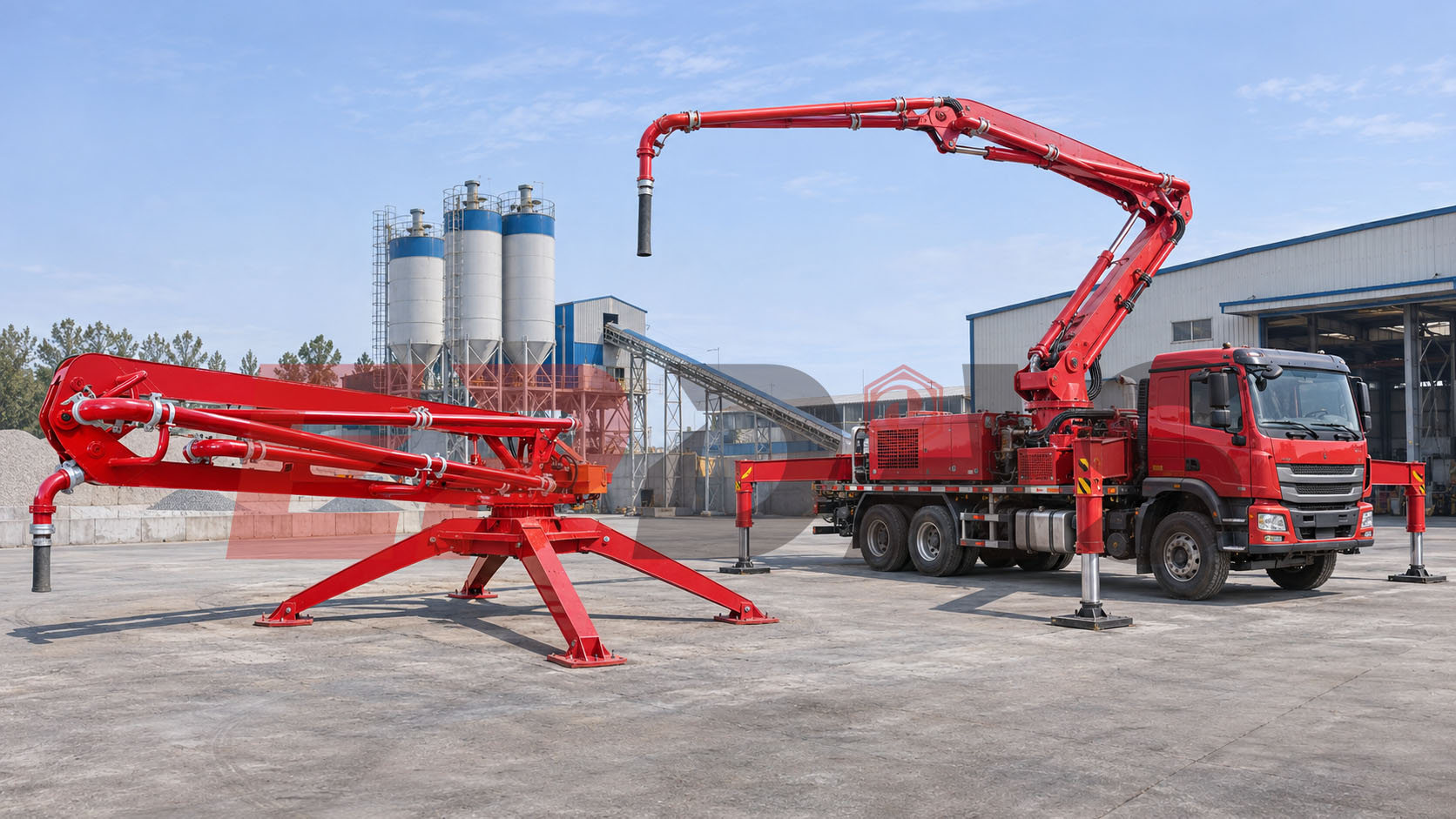
The Core Difference Between the Two Types of Devices
Spider-Type Concrete Placing Boom
The spider placing boom is equipment used solely for concrete placement. The whole machine is composed of a placing boom, a rotation mechanism, support legs and a concrete conveying pipe.
It does not provide concrete pumping power by itself, and must be connected to a trailer concrete pump or another suitable concrete pump during operation. Relying on the pressure generated by the external pump, the concrete is transported along the pipeline to the end of the boom and transported to the pouring surface.
The two concepts of placing radius and pumping distance are often confused on site. The placing radius represents the placement coverage of the boom rotation, and the actual conveying distance of concrete depends on the performance of the supporting pump and the pipeline layout, and the two cannot be equated.
Truck-Mounted Concrete Boom Pump
The truck-mounted boom pump takes the commercial vehicle chassis as the carrier, integrating the concrete pumping system and the foldable boom.
After the equipment enters the construction site, unfold the outriggers, adjust the posture of the folding boom, and you can directly carry out concrete placement. Pumping and placement are all integrated into the vehicle body, and there is no need to configure additional main pump equipment.
The parking position of the vehicle directly determines the pouring area that the boom can cover. Even if the nominal boom length is sufficient, an unsuitable parking position may still leave the working surface out of reach.

Comparison of Site Restrictions and Setup Conditions
| Comparison Item | Spider-Type Concrete Placing Boom | Truck-Mounted Concrete Boom Pump |
| Entry method | According to the specific model and manufacturer’s requirements, positioned through lifting or appropriate handling | The whole vehicle drives by itself, subject to road and entrance clearance restrictions |
| Support position | It can be placed on the floor slab, and the concentrated loads on the floor slab need to be reviewed | Most of them are arranged on the outdoor ground, requiring support pads and a safe distance from excavation edges |
| Prerequisite | Equipment delivery ≠ ready for operation; need to reserve the boom rotation space | The vehicle drives into the site ≠ ready for operation; must meet the outrigger support conditions stipulated by the manufacturer and the corresponding operating range requirements |
Entry Route and Equipment Placement
The truck-mounted boom pump relies on the chassis to enter the site by itself. There are rigid requirements for the width of the on-site road, the turning radius, and the clearance height of the entrance and exit. The road surface needs to allow the passage of the whole vehicle, and space must also be reserved for turning and parking.
The spider placing boom has no driving chassis. According to the specific model and manufacturer’s requirements, it is positioned by lifting or appropriate handling. In the building and floor slab areas where trucks cannot reach, the placing boom may be moved into position.
One thing is easy to ignore on the site: the equipment can be transported to the construction site, which does not mean that you can start work directly. Even if the machine enters the operation area, it is necessary to ensure that the supports are set up according to the manufacturer’s requirements, and the boom does not strike the surrounding components during rotation; otherwise the equipment cannot be put into use.
Supporting Ground and Setup Space
Both types of equipment rely on supports to distribute the load of the whole machine during operation, but the site adaptation requirements are different.
The spider placing boom is often placed directly on the completed floor slab, and the concentrated load at each support point must be accounted for under this condition. When the bearing capacity of the floor slab is insufficient, the project structural engineer should determine the load distribution, reshoring or other reinforcement scheme, and the equipment should be positioned after verification that the requirements are met.
The pad can distribute the local contact load, but this does not mean it resolves insufficient overall load-bearing capacity of the floor slab.
Truck-mounted boom pumps mostly operate on the outdoor ground. It is necessary to check the bearing capacity of the ground before entering the site, and a pad must be laid under the outriggers. Keep a safe distance between the outriggers and the edge of the foundation pit and ditch to prevent the risk of ground subsidence and slope collapse. The space occupied by the two types of equipment after the supports are laid out should be reserved in the construction layout in advance.
Comparison of Work Coverage and Placement Flexibility
Working Radius and Actual Pouring Coverage Area
The placing radius, boom length and working range marked in the equipment brochure need to be understood in combination with the manufacturer’s working range diagram. Whether these ranges can be fully used on site depends on the location of the equipment, support conditions and surrounding obstacles.
The placing radius of the spider placing boom refers to the maximum horizontal distance that can be reached by the rotation of the boom; the parameters of the truck-mounted boom pump include horizontal and vertical working ranges at the same time.
The actual pouring coverage is jointly affected by the placement point of the equipment, the contour of the pouring surface, and the movement limit of the boom. If the placement position of the same equipment is offset by 1–2 meters, the coverable operation surface will change, and the boom length in the brochure cannot be directly equated with the effective operation distance on site.
Obstacles and Operation Height Restrictions
The beams and columns, walls and ceilings at the construction site will constrain the unfolding of the boom.
The spider placing boom can be arranged close to the pouring surface and shorten the distance between the discharge hose and the working surface. However, when arranged on the internal floor slab of the building, the upper beam and slab components will limit the lifting angle of the boom, and upward movement will be constrained.
Most of the truck-mounted boom pumps are parked on the outside of the foundation pit or on the edge of the site, which is suitable for reaching over barriers and some structures to place concrete within the site. If scaffolding and pipelines on the site occupy the upper space, the lifting of the boom is limited, and the actual operating radius may be reduced.
Which Equipment Should Be Chosen for Different Pouring Conditions?
| Construction Conditions | Key Analysis |
| The site is open, and the vehicle can drive near the pouring area | The truck-mounted boom pump system is integrated, and concrete can be poured after it is in place, relying on the whole vehicle to complete the transfer, reducing the disassembly and installation workload of additional ground pipelines |
| The vehicle cannot get close, and concrete needs to be poured in internal floor slab areas or inside the building | You can consider using a spider placing boom with an independent pumping pipeline; the equipment is carried into the building, and the concrete is transported by an external trailer concrete pump through the pipeline to complete the placement |
| The project sites are scattered, and work needs to move between sites frequently | The truck-mounted boom pump can run to the next project by itself; the spider-type placing boom usually needs to be hoisted or transported. Whether to disassemble it depends on the equipment structure and transportation conditions, and each change of site may consume more labor hours |
| The same working surface needs to be poured repeatedly | The spider-type placing boom can be positioned for long-term use, and there is no need to readjust the position of the whole machine every time concrete is poured, provided the setup covers the required pouring areas, which is suitable for large base slabs and multi-batch floor slab pouring scenarios |
| High-rise building floor slab pouring construction | A spider-type placing boom can be transferred to the construction floor by lifting. It is necessary to check the bearing capacity of the floor slab, the concentrated loads of the supports and the lifting conditions, and match it with concrete pumps and vertical pipelines that meet the conveying height requirements. Whether the truck-mounted boom pump can directly cover the floor slab depends on its working range and on-site parking location. |
| Indoor areas or areas with insufficient overhead clearance | Check the height of the equipment, the clearance and movement range required for the unfolding of the boom, and do not judge whether operation is possible based only on the height of the folded equipment. |
Differences in the Cost of Equipment Use
| Cost Category | Spider Concrete Placing Boom | Truck-Mounted Concrete Boom Pump |
| Main configuration | Placing boom + trailer concrete pump + whole set of conveying pipelines | Complete boom pump, with auxiliary pipelines as required by the site |
| Relocation cost | Lifting or handling and transshipment; whether to disassemble it depends on the equipment structure and transportation conditions, and the labor hours depend on working conditions | The whole vehicle drives between sites, no need to disassemble the equipment body |
| Pipeline-related costs | It is necessary to lay and clean the conveying pipelines according to the on-site layout. Whether to dismantle them each time depends on the construction arrangement; pipeline priming and cleaning will take time, and generate corresponding material, water and residual material disposal costs | When placing concrete directly through the boom, it can usually reduce the laying and cleaning work of additional ground pipelines. |
| Maintenance | Two sets of independent maintenance systems for the placing boom and trailer concrete pump | Integrated maintenance of multiple components in the chassis, pumping system and boom |
Cost evaluation should not only look at the purchase or rental price of a single machine, but also account for the cost of all supporting resources required to complete the pouring operation.
If you choose a spider-type placing boom, the complete system includes the body of the placing boom, the supporting concrete pump, and a full set of conveying pipelines. At the same time, the cost of lifting and handling equipment should be included. If any required supporting equipment is missing, pouring cannot be carried out.
The main cost of selecting the truck-mounted boom pump comes from the rental or procurement of the whole pump truck, and only a small number of short auxiliary pipelines need to be added in some working conditions. The equipment has its own pumping unit, and there is no need to configure an additional main pump.
Placement, shifting and operation and maintenance will generate a lot of hidden costs.
When the spider placing boom is shifted, it usually needs to be hoisted or transported. Whether to disassemble it depends on the structure of the equipment and transportation conditions; before and after pouring, the conveying pipeline needs to be laid and cleaned according to the on-site layout, and whether to dismantle it each time depends on the construction arrangement.
In addition to labor input, pipe priming and cleaning will take up time, and generate corresponding material, water and residual material disposal costs. If the pipeline is not reasonably laid out, it will also bring the risk of blockage and work stoppages, which will actually affect the efficiency of on-site construction. The maintenance of the equipment is carried out separately, and the placing boom’s rotation mechanism, the boom structure and the supporting trailer concrete pump are maintained separately.
The truck-mounted boom pump relies on the whole vehicle to complete the transfer, and there is no need to disassemble the whole machine. When placing concrete directly through the boom, it can usually reduce the laying and cleaning of additional ground pipelines.
However, the composition of the equipment is complex. The automobile chassis, pumping system and boom steel structure need to be regularly inspected and maintained, and all these components must be covered by maintenance.
Simple Project Selection Checklist
When assessing a project, you don’t need to finalize the equipment directly. After sorting out the following questions, you can narrow down the scope of selection.
| Issues to Be Confirmed | Impact on the Selection |
| Do you have a suitable existing concrete pump on site? | If there is already a suitable trailer concrete pump, pairing it with a spider-type placing boom can save the investment in an additional pumping unit; if there is no existing pump, the rental or procurement cost of the pump should be added |
| Can large vehicles enter the site? Is there enough space to set up outriggers according to the manufacturer’s requirements? | If the conditions are not met, the truck-mounted boom pump cannot be put into on-site use even if the boom length parameters are excellent |
| Where exactly is the pouring area located and what obstacles are there around it? | Determine the location of the equipment and calculate the effective placement coverage actually required |
| Does the equipment need to be moved to different construction sites frequently? | Compare the time and labor required for driving the boom pump between sites with those required for lifting, handling and transporting the placing boom |
| What are the pouring quantity, construction period and expected number of equipment uses? | Account for the total investment of the whole scheme, evaluate the utilization rate of equipment, and judge the economy of leasing or equipment combinations |
For on-site selection, the core considerations are the traffic conditions of the site and the actual effective coverage of the equipment, along with the comprehensive performance of the whole pumping and placement system.
If you simply compare the length of the boom, or only compare the price of a single device, it is easy to find that the equipment cannot be adapted to the construction conditions after entering the site. The implementation of on-site condition verification in the early stage can help prevent problems in the construction stage.