
How to Choose the Length of the Concrete Boom Pump Arm Frame?
2026-11-09 17:27:28
How to Choose the Length of the Concrete Pump Arm Frame?
Even when both projects involve three-story buildings, conditions can be completely different from one construction site to another. Some construction sites have plenty of space, and the pump truck can be parked directly beside the building. The boom can then be raised into position over the pour area. However, on many projects, excavation barriers and site roads limit where the pump truck can park, and the pump truck can only be parked on the road far away from the building.
The buildings in the two projects are about the same height, but the requirements for the boom’s horizontal reach are completely different. When choosing the length of the boom, you can’t just look at how many floors the building has, but must also consider the actual parking position of the pump truck to judge whether the boom can reach all the points that need to be poured.
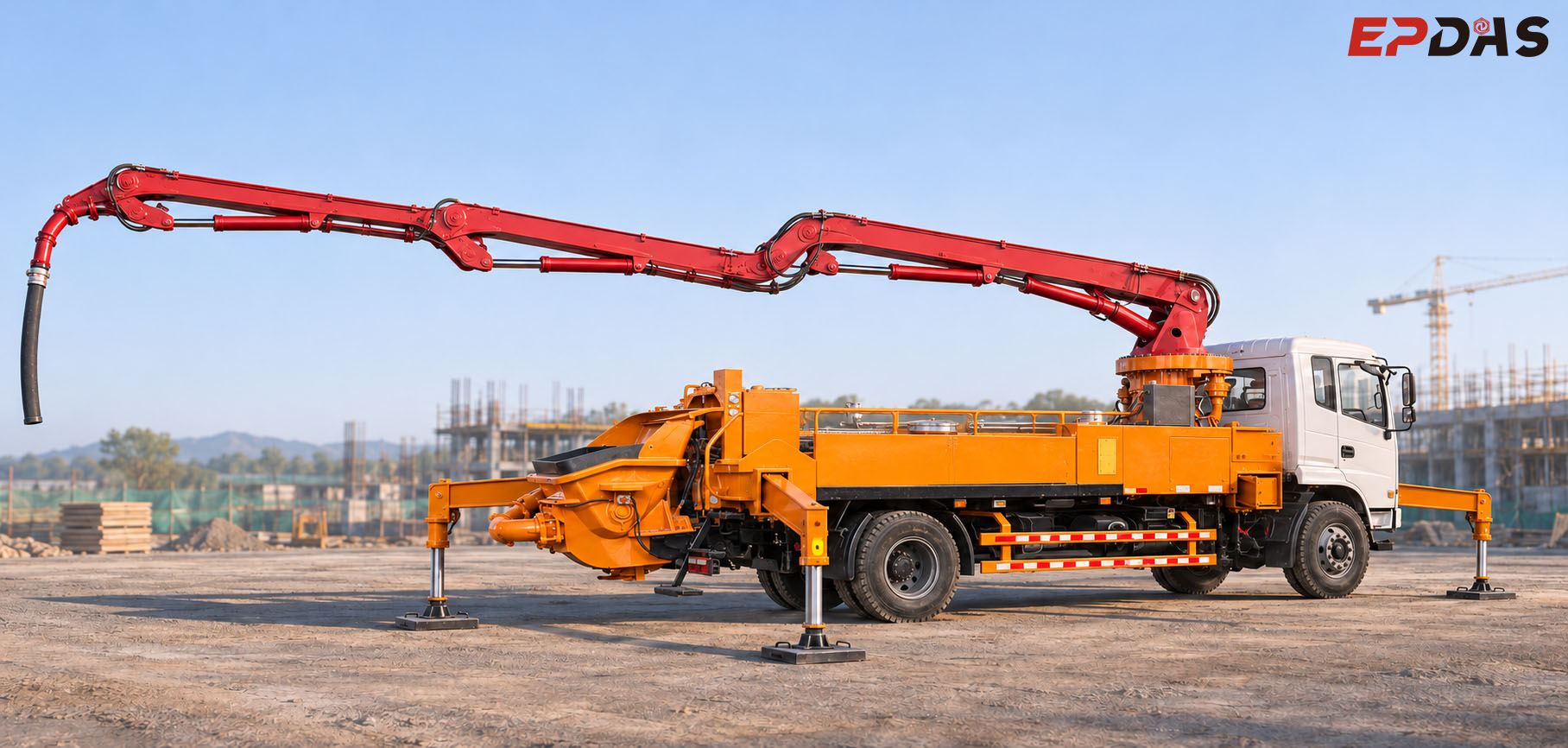
Understand the Relevant Parameters of Pump Arm Length: Rated Arm Length, Vertical Height, Horizontal Extension Distance
When buyers and site crews read the equipment specification sheet, it is easy to mix up several figures.
37 meters, 48 meters and 62 meters are nominal size designations used by manufacturers to distinguish models. The specific meaning and measurement reference should be checked in the model’s specification sheet. Some manufacturers list vertical reach, gross horizontal reach and net horizontal reach separately. Do not directly equate this nominal value with the actual pour height or the maximum horizontal distance that the boom can reach.
The manufacturer’s specification sheet lists the maximum vertical reach and maximum horizontal reach separately. The maximum vertical height and the maximum horizontal distance correspond to different boom positions. When selecting a model, the horizontal reach corresponding to the target height should be checked on the working range diagram.
When selecting a model, you can’t combine the two maximum values. Assuming that a single pour point can be reached at both maximums will give an incorrect result. Use the manufacturer’s boom working range diagram to determine what is within reach.
In addition, do not ignore the hose at the end of the boom when selecting the model. Standard end hoses are typically 3–4 meters long, and concrete is discharged through the hose. When working in a narrow space or around obstacles, allow for the hose’s movement when checking clearances, and check the hose dimensions for the specific model to avoid collision between the hose and the surrounding components.

What Information Can Be Obtained by Reading the Working Scope Diagram of the Arm Frame?
The working range diagram of the boom is the most practical reference drawing for model selection.
The horizontal axis of the drawing represents the horizontal distance, and the vertical axis represents the vertical height. The outlined area shows the boom’s geometric reach. Most people only pay attention to the upper half of the drawing.
If the pour area in a basement or excavation is below the level where the pump truck is parked, check the lower part of the diagram for the horizontal reach at the required depth.
Calculate the Actual Required Scope of Operation at the Construction Site
Determine where the pump truck can really stop
Before looking at the reach figures, go back to the project site and mark the possible setup locations of the pump truck on the site plan.
The building setback and the locations of the site entrances and exits should be taken into account, and the space needed to fully extend the outriggers should be reserved. Some locations have room to park the truck but limited space to extend the outriggers. Whether this setup location can be used depends on the outrigger configuration allowed for the specific model.
A construction site often has more than one feasible setup location. Mark each available position. Later, check which pour areas the boom can reach from each setup location and which pour points are out of reach. Only the space available on site for outrigger extension is recorded here, and there is no need to select an outrigger configuration in advance.
Mark key pouring points and on-site obstacles
Identify all the key pour points for the project.
These include the highest pour point of the building, the pour point farthest from the truck’s setup location, and points below the level where the pump truck is parked, such as those in excavations or on base slabs. Note the horizontal distance and height difference of each pour point relative to the parking position of the pump truck.
In addition to the pour points, the on-site obstacles should also be marked. The exterior walls, scaffolding, temporary protective canopies, and temporary partition walls on site can obstruct boom movement.
Some pour points are within the published limits for horizontal distance and height when checked separately, but still fall outside the boom’s working range. Here, you can compare the folding configuration, unfolding height and boom path around obstacles of the candidate models to judge whether the boom can reach the pour point while clearing the obstacle.
Check whether the pouring point can be reached on the arm range map
The key pour points recorded on site are marked on the boom working range diagram for the specific model, using the measurement reference shown on the manufacturer’s drawing.
A point inside the reach envelope is geometrically reachable. You still need to check restricted areas, the outrigger configuration and the boom’s travel path. Many manufacturers’ drawings mark restricted areas separately, so check whether any pour points fall in those areas before deciding whether the pour is feasible.
For pours below truck level in an excavation or basement, in addition to checking whether the base slab pour point can be reached, check whether the middle and end sections of the boom can clear the upper edge of the excavation and its barriers. In many cases, the pour point can be reached, but the boom may hit the excavation enclosure as it swings. This risk cannot be judged from distance and elevation readings alone. Check the boom’s travel path as well.
Check the folding action of the arm frame and the operation status of the asymmetrical leg
Even if the pour point is within the range shown on the drawing, it is necessary to confirm that the boom can unfold, articulate and reposition within the available space on site.
A pour can involve several locations. The boom needs to move back and forth between multiple pour points, and it must clear the building and scaffolding along the entire path.
When the site is narrow and the outriggers cannot be fully extended, use a partial-extension or asymmetric outrigger setup only if the manufacturer allows it for that model. There are differences in the electronic control systems used by different pump truck manufacturers. With the outriggers partially extended, some models allow pouring on only one side of the truck and block boom movement into the restricted side.
Restricted outrigger extension reduces the boom’s permitted working area. In this scenario, the working range diagram for the standard outrigger setup no longer applies. It is necessary to use the working area specified for the restricted outrigger setup and recheck all the pour points.
Select the Appropriate Arm Length According to the Actual Conditions of the Construction Site
Don’t choose a boom length based solely on the number of stories. Two five-story buildings may require very different boom lengths if one site has plenty of space and the other requires the pump truck to be parked far away. Use the common site conditions below to narrow down the candidate models for your project.
| Site conditions | What to check |
| The site is open, the pump truck can be parked close to the building, and the pour points are close together. | Check shorter-boom models first, allowing for clearance and room for the end hose to move. |
| The pump truck can only be parked along the road or outside the excavation, far from the building. | At the target pour height, check the available horizontal reach on the model’s working range diagram. |
| The boom needs to reach over a wall or into a lightwell to complete the pour. | Compare the folding configurations of different booms to evaluate the path needed to clear the obstacle and the remaining working space beyond the obstacle. |
| A deep excavation or basement base slab pour below truck level. | Check the horizontal reach at the required depth, and check whether the boom clears the pit enclosure as it swings. |
| The pour points are scattered, and there are multiple possible setup locations. | Compare the total cost of using a longer boom from one setup location with using a shorter boom from several locations. |
When two boom pump models can reach all the pour points, weigh other practical factors. Check whether the truck can get through the site access route, how much space the outriggers need, and how many times the truck will need to be repositioned during the job.
If you are not sure, you can send the site plan, possible pump truck setup locations, the horizontal distance and height difference for each key pour point, and the locations of any obstacles to the equipment supplier. Ask the supplier to check your layout against the boom working range diagram for the specific model to reduce the on-site problems caused by choosing the wrong model.