
How to Compare the Twin-Shaft Mixer and the Vertical Shaft Mixer Through a Material Trial
2026-11-11 17:23:58
When buying a twin-shaft or vertical shaft mixer, many people will directly refer to the parameters given in the equipment brochure, or listen to the manufacturer’s introduction of the equipment structure. However, data on paper cannot fully reflect the performance of real materials on site.
With the same mix design, if the aggregate moisture content, fiber addition or pigment ratio are changed, the actual output gap between the two mixers will be amplified. A material trial involves moving the raw materials from the production site to the trial mixer and making a selection judgment based on the actual material performance. The core of the trial is not to see if the material “looks evenly stirred with the naked eye”, but to verify whether the mixer can solve the real problems encountered in one’s own factory.
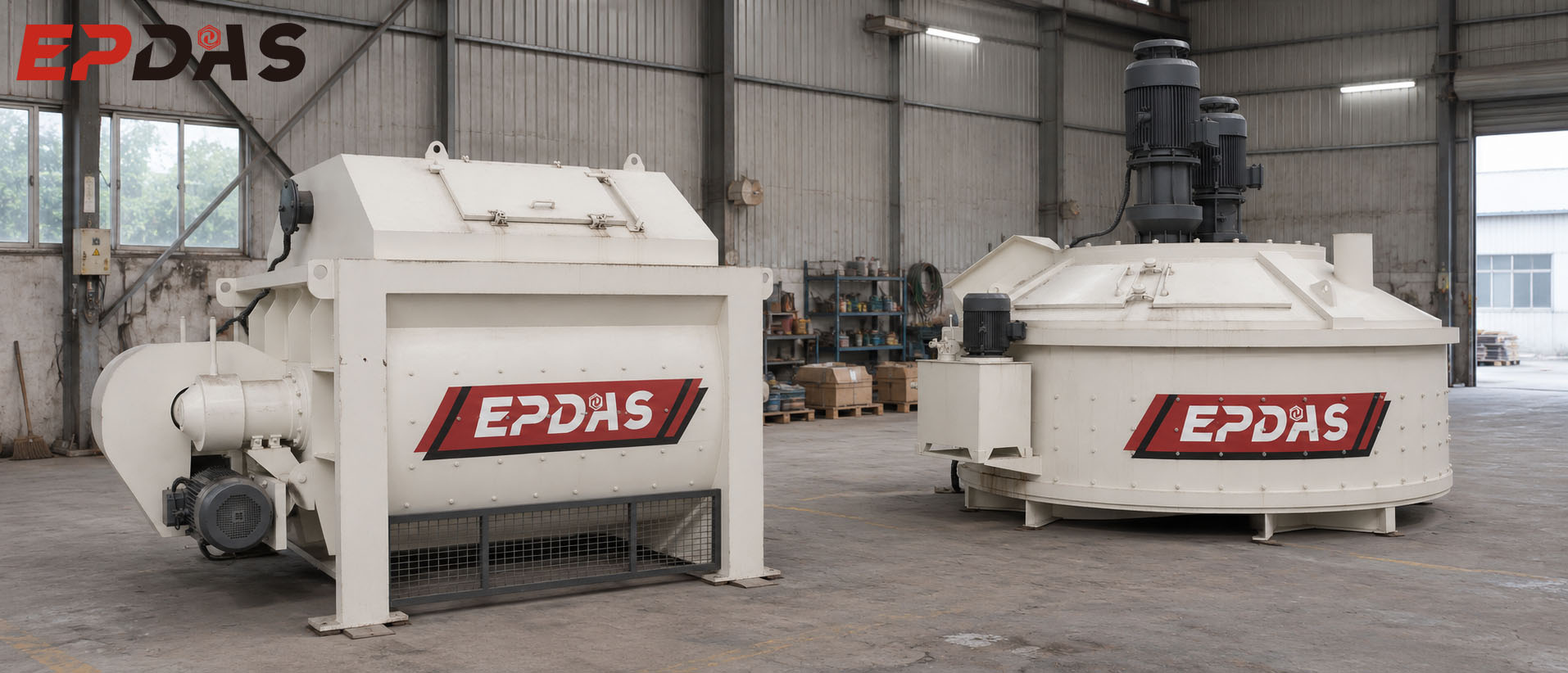
Build Comparable Test Conditions
If you want to get a reference-worthy conclusion, the most important thing is to smooth out the external variables as much as possible. If the raw materials, loading volume and operation process are inconsistent, the final performance difference may not come from the structure of the mixer itself.
All raw materials of the same batch are preferred, and aggregates, cementitious materials and various admixtures should remain consistent. The moisture content of the aggregate will affect the actual total water content of the material. Before the test, the moisture content test should be completed, and the added water quantity should be corrected according to the test results, so that the actual total water content meets the mix design requirements of the workshop’s regular production.
The state of the raw material itself should also be recorded in writing, including the feed temperature and the aggregate particle grading. When the test results are reviewed later, these conditions are background information that cannot be ignored.
Key reminder: Distinguishing between nominal volume and actual working capacity is the first step to avoid misjudgment during the trial. Many buyers will confuse these two values and directly take the nameplate volume as the basis for feeding.

When the rated working capacities of the two mixers are close, try to use the same single batch feeding weight for comparison. If there is a large difference in the capacity of the two devices, record the actual loading weight and loading ratio for each trial.
Underloading or overfilling will cause the mixing effect to deteriorate. The material defects caused by improper loading should not be attributed to the structural form of the mixing shaft.
The operation process of feeding also needs to be unified. Record the order of addition of each component, whether water and additives are put in once or added in stages, and keep the operation of the two sets of tests consistent.
The starting and ending points of stirring timing should also be aligned in advance. For example, timing starts when all solid raw materials have been loaded and ends when the discharge gate opens; the two devices execute exactly the same timing rules.
The experiment can be carried out in two stages. In the first stage, the same set of process parameters is completely shared to complete the basic comparison. In the second stage, the process parameters of each mixer are adjusted separately for optimization. The two sets of experimental data must be kept separately, and cannot be mixed together for comparison of advantages and disadvantages.
Comparison of Stirring Performance Under Different Stirring Times
The mixing uniformity is the core assessment item of the trial, but it is easy to misjudge if you only focus on the surface material inside the mixing tank. The material near the chamber wall may look smooth and uniform, while small lumps of dry powder may still remain inside the mix.
Samples need to be taken according to the pre-agreed sampling position. In combination with the characteristics of the formula, pay attention to the dry material gathering area, remaining powder clumps, the dispersion of the pigment, and whether the fibers are tangled or clumped.
The appearance is only used as an auxiliary basis for judgment, and priority should be given to the corresponding detection methods to quantify the uniformity. When relying only on visual observation, judgment standards vary between people.
Set multiple groups of different mixing durations, carry out independent batch tests separately, and take samples according to the same method, complete the test within the agreed time, and record the results for comparison. In this way, the stirring time that can meet the quality threshold can be found.
Some mixers can reach the qualified standard in a short time. If the mixing cycle continues to be extended, the quality of the material will hardly change. With some equipment, the sample still does not reach the preset target even after a long mixing time. Through testing at different mixing durations, it can be clearly seen whether the extension of the mixing time can really improve the quality of the finished product.
The material stability throughout discharge cannot be ignored. For the same batch of materials, there may be obvious differences in the material status of the front section, middle section and back section of the discharge.
Collect the samples in the early, middle and last stages of the discharge respectively, and compare the workability, appearance, and previously agreed detection indicators of the samples. Material that remains at the bottom of some mixing tanks and is difficult to mix can cause the quality of the finished products output at the end of unloading to decline. This problem can only be found by segmented sampling.
Record the total time required to unload the whole batch of materials. After the shutdown, isolate the power source, and then check the residual materials at the bottom of the mixing chamber, the chamber wall and the position of the discharge opening.
Key points: The residual amount has a great impact on production lines with frequent changeovers. If the factory needs to frequently switch the formula and change colors, the amount of residue in the machine will directly determine the degree of cross-contamination between batches. If the amount of residue is large, more cleaning hours need to be invested in each changeover. This part of the actual impact should be included in the assessment.
Production Efficiency Evaluation Under the Premise of Quality
The number of seconds of stirring is not equal to the actual output speed of the whole batch. The complete production cycle of a batch of products covers the whole set of feeding, mixing and unloading.
Note the time consumed by each link of the two mixers separately, and also consider the compatibility of the equipment with upstream and downstream processes. For example, whether the unloading speed can match the feeding rhythm of the next process, and whether the height of the feeding port is suitable for the existing loading equipment.
The premise of production capacity comparison is that the finished product must meet the preset quality standards, and the mixing time of unqualified materials cannot be used for this comparison. Some equipment can complete mixing in a short time, but the output materials do not meet the quality standards, and this time has no practical reference value.
If the on-site conditions allow, record the energy consumption of each batch and convert it into the electricity consumption per unit of acceptable finished product. It is necessary to distinguish between the data measured on the test bench and the theoretical energy consumption given by the equipment manufacturer. The theoretical values of the laboratory are often different from the actual test results.
Record the man-hours required to replace materials, switch colors, and clean the mixing chamber. The time-consuming cleaning of the production line with frequent changeovers will continue to occupy the overall production time.
It should be noted here that the cleaning time obtained in the trial stage is only the data of the short-cycle test. The buildup and adhesion caused by long-term continuous operation cannot be fully simulated through several trials. Do not directly use trial cleaning data to predict the operation and maintenance costs of the equipment in the next few years.
Verify the Repeatability and Draw the Final Comparison Conclusion
A single trial batch can be strongly affected by random factors. After the parameters are determined, multiple batches of repeated tests need to be carried out continuously.
Observe whether there will be obvious fluctuations in the quality of the finished product and the whole production rhythm between multiple batches. If there are big fluctuations between the batches of a certain indicator, you should review the test conditions. Check whether the raw material condition has changed or the feeding operation has been inconsistent.
Summarize all the actual measurement data into a comparison table and compare them horizontally item by item, which can quickly locate the respective strengths and weaknesses of the two devices.
Material Trial Results Comparison Table
| Comparison items | Twin-shaft mixer | Vertical shaft mixer | Remarks |
| Actual single batch feed quantity and loading ratio | Actual measurement value to be filled in | Actual measurement value to be filled in | Record the actual feeding weight, the corresponding working volume and loading ratio separately, and indicate the conversion basis to rule out the effects of underloading and overloading. |
| Stirring time required to achieve the target quality | Actual measurement value to be filled in | Actual measurement value to be filled in | Take the shortest stirring time that just meets the acceptance criteria, and do not use unnecessarily prolonged mixing data. |
| Mixing uniformity test results | Actual measurement value to be filled in | Actual measurement value to be filled in | Base the assessment mainly on the test data, using appearance only as an auxiliary reference. |
| Sample consistency throughout discharge | Actual measurement value to be filled in | Actual measurement value to be filled in | Compare the differences between samples taken at the beginning, middle and end of discharge to judge whether there is deterioration of the material discharged last. |
| Unloading time and material remaining in the machine | Actual measurement value to be filled in | Actual measurement value to be filled in | Check for residue on the mixing chamber wall, chamber bottom and discharge opening after shutdown and power isolation; give this item greater weight for frequent color or product changeovers. |
| Complete single-batch cycle time | Actual measurement value to be filled in | Actual measurement value to be filled in | It includes the whole process of feeding, mixing and unloading, which is used to calculate the real production capacity. |
| Energy consumption per unit of acceptable finished product | Actual measurement value to be filled in | Actual measurement value to be filled in | Compare the unit energy consumption under working conditions that meet the same quality requirements; the data of unqualified batches shall be kept separately and shall not be mixed with data from qualified batches. |
| Material and color changeover and cleaning time | Actual measurement value to be filled in | Actual measurement value to be filled in | These are short-term trial data and cannot be directly equated with the long-term production cleaning cost. |
| Stability of multiple batches of repeated tests | Actual measurement value to be filled in | Actual measurement value to be filled in | Observe fluctuations in the indicators across consecutive batches and evaluate the stability of equipment operation. |
Key reminder for final selection: all judgments should return to the production target and quality threshold set at the beginning. This comparison result is only applicable to the formula used in this test, the loading ratio, and the whole set of trial conditions. No single mixing structure has an advantage with all materials and under all production capacity conditions.
Under some formulas, the performance of the twin-shaft mixer is more suitable for the demand. After replacing the aggregate and increasing the proportion of fibers, the vertical shaft mixer can get a more stable finished product. Writing the trial limitations into the final conclusion can avoid misjudgment in subsequent selection.