
Stationary Concrete Batching Plant Buying Guide: Selection, Cost, Installation, and Project Planning
2026-08-05 16:09:51
Many engineering contractors face several critical decision-making challenges when planning a concrete production line.
- Not clear how much production capacity the equipment the project actually matches,
- Which type of batching plant is better suited to their project conditions,
- When estimating the initial investment, only the host cost is considered, ignoring the supporting and operating expenses,
- Before the on-site construction of the factory, the complete site, environmental assessment and infrastructure conditions were not fully evaluated.
From the perspective of engineering practice, this guide explains the complete process from project demand determination, equipment selection, cost measurement, site planning to landing and commissioning, helping the purchaser avoid common mistakes in the planning stage and finalize the fixed-type mixing station plan suitable for themselves.
1. Do You Really Need to Invest in a Stationary Concrete Batching Plant for Your Project?
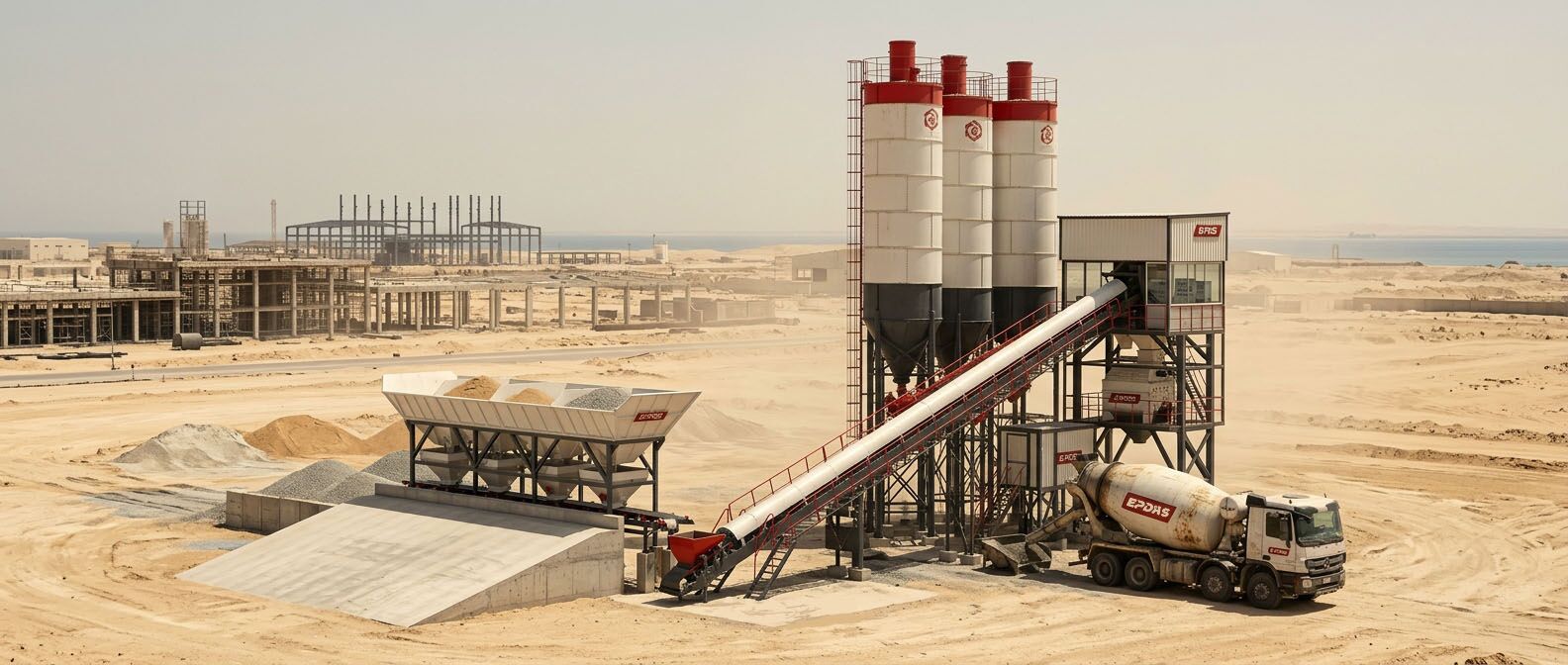
Many purchasers will directly compare the equipment parameters, but ignore the most basic question: whether the current project conditions are worth investing in a fixed mixing production line. It will be safer to sort out the pain points and applicable scenarios of self-built fixed stations first, and then make a procurement decision.
1.1. Without a self-built mixing station, what practical problems will contractors encounter?
Concrete supply stability cannot be independently controlled.
For long-term projects such as large-scale roads, bridges, dams, and industrial parks, daily concrete consumption is extremely high. Relying entirely on the supply of external commercial mixing plants, it is easy to be limited by the production capacity and transport vehicle scheduling of the other party. During peak periods, transport vehicles queue up and the pouring process is forced to stop. The construction schedule can only passively accommodate the delivery rhythm of the commercial mixing plant, making it difficult to complete construction milestones on time.
Long-distance transportation increases comprehensive construction costs.
Most concentrated production areas for raw materials, sand, stone, and cement are located outside the project boundary, with a transport distance of several kilometers or even over a dozen kilometers from the external mixing plant to the construction site. Each round-trip transit mixer incurs additional expenses such as fuel, vehicle depreciation, and driver labor. Meanwhile, long-distance concrete transport is prone to slump loss, requiring on-site water or admixture adjustments, which further increases material loss.
Concrete mix ratios and finished product quality are difficult to control.
Contractors can only communicate the basic mix ratio in advance and cannot supervise the entire weighing process of aggregates, powders, water, and additives. Mix ratio deviations caused by moisture fluctuations and powder inventory variations across different aggregate batches cannot be synchronized in real time. Following pouring and forming, component strength and density are prone to batch-to-batch variations.
1.2. Which project scenarios are suitable for choosing a stationary concrete batching plant?
The stationary concrete batching plant is a permanent concrete production facility. The whole set of equipment weighing, mixing, and dust removal systems are completely configured. The weighing accuracy and continuous production capacity are much higher than those of the mobile types. It is suitable for projects that meet all or most of the following conditions:
- The construction site is fixed, the project cycle exceeds one year, and there is a long-term continuous demand for concrete pouring;
- The single-day and monthly concrete consumption is stable and the total volume is large, such as the construction of highways, cross-river bridges, water conservancy dams, and large-scale residential or commercial complexes;
- It features an independent prefabricated component factory, which maintains long-term mass production of concrete pipes, roadside stones, prefabricated floor slabs, permeable bricks, and other components, and imposes strict requirements on the consistency of the mix ratio;
- There are stable sand, stone, and cement supply channels in the local area, and it is planned to operate the commercial concrete market for a long time and supply surrounding small construction sites;
- The engineering standards enforce rigid specifications for the homogeneity and measurement error of concrete, and prohibit large fluctuations in the strength and slump of the finished product.
On the other hand, if the construction period is short, the construction site needs to be changed frequently, or the site is restricted in size and only used temporarily for a short time, the stationary batching plant is not cost-effective, and it may be more economical to consider a mobile concrete batching plant instead.
2. How to Adapt the Stationary Concrete Batching Plant to Different Types of Engineering Projects

The core requirements of different track projects for mixing stations are completely different. There are obvious differences in the focus of equipment configuration, and unified standard selection N cannot be used when purchasing.
2.1. Large-scale infrastructure projects: the configuration logic of highways, bridges, and dam mixing stations
The single pouring volume of road, bridge, and water conservancy projects is large, and it often takes dozens of hours of continuous discharge. The core of the equipment is to ensure stable and continuous production capacity.
When pouring box beams, dam bodies, and piers in this kind of project at once, the mid-term shutdown and maintenance will directly cause the scrapping of the poured concrete, so the twin-shaft concrete mixers are commonly selected for their high output capacity and continuous operation capability.
The construction sites of infrastructure projects are mostly far away from urban areas, and the volume of raw materials entering the site is large. The aggregate warehouse can be divided into 4 to 6 bins, and different specifications of aggregates such as gravel, medium sand, and fine sand can be stored separately to avoid mixing.
At the same time, the whole system needs to be equipped with complete closed dust removal equipment, so that the pressure of on-site construction dust diffusion control and environmental protection inspection is minimized.
2.2. Stationary Concrete Batching Plant for Ready-Mix and Commercial Concrete Production
The core demand of the commercial concrete batching station is to provide a stable supply of multiple batches throughout the day for the surrounding scattered construction sites and small construction projects, with a high daily departure frequency and higher requirements for automation control.
The fully automatic PLC control system is standard, which can store hundreds of sets of concrete formulas with different standards. There is no need to manually adjust the weighing parameters to switch the ratio, which reduces the errors caused by manual operation.
If the site allows, it can be matched with a dual-mixer layout, ensuring that there will be no material outages during the peak hours of construction in the morning and evening.
The number of powder storage silos increases as needed. In addition to ordinary cement silos, special storage tanks for mineral powder and silica ash can be configured separately, along with supporting independent weighing hoppers to meet the needs of high-standard and special commercial concrete production.
The factory must be equipped with wastewater recovery, and sand and stone separation equipment, to recycle the sewage and residual aggregates generated by the daily cleaning of transit mixers. Long-term operation can reduce the loss of raw material procurement.
2.3. Selection points of supporting mixing stations in prefabricated component factories
The measurement accuracy requirements of prefabricated component production are higher than those of ordinary construction sites. The size of the components is uniform, and the ratio error of each batch of concrete will directly affect the demolding strength and surface smoothness of the finished product.
The mixing system often adopts planetary mixers or other high-performance mixers depending on the component type and concrete requirements, which mixes more evenly, completes the integration of powder, aggregates, and additives in a short time, and adapts to the high-frequency mass production of small prefabricated parts.
It is recommended to install the aggregate weighing, cement, and water weighing mechanisms separately, rather than directly fixed on the mixer frame, so as to reduce the interference of vibration on the load cell sensors during equipment operation and stabilize the weighing values.
3. Comparison of the Core Differences Between Stationary Concrete Batching Plant and Mobile Concrete Batching Plant
Many purchasers are entangled in the trade-off between the two equipment. There is no absolute superiority or inferiority between the two. It only depends on the project cycle, site and production capacity demand matching. The following table clearly distinguishes the core usage differences:
| Contrast dimension | Stationary concrete batching plant | Mobile concrete batching plant |
| Applicable project cycle | Long-term fixed site projects for one year and above | Short-term construction site, temporary construction site for 3-6 months |
| Difficulty of equipment relocation | Split the whole machine and re-cast the foundation; relocation costs are high and the cycle is long. | The entire trailer is integrated, transfer disassembly processes are minimized, and landing takes a short time. |
| Theoretical hourly production capacity | 25-240 m3/hr [depending on model] | 15-100 m3/hr [depending on model] |
| Site infrastructure requirements | hardening site independent equipment foundation, occupying a larger area. | Simply level the ground, with no need for a thick permanent foundation. |
| Core advantages | High measurement accuracy, durable accessories, continuous and stable discharge, deep customizability | Flexible transfer, low early-stage infrastructure investment, rapid deployment |
| Adapt to the scene | Commercial mixing plants, prefabricated factories, dams, high-speed rail, and other long-term large-scale projects | Municipal emergency repairs, small residential construction, and scattered short-term point projects |
4. How to Determine the Production Capacity Specifications of the Stationary Concrete Batching Plant for the Adapted Project

Production capacity is the first core indicator of procurement. Many purchasers only refer to the theoretical hourly output of equipment and ignore the actual working conditions of the site. Either the production capacity is insufficient to slow down the construction, or the procurement of large-capacity equipment causes funds to be idle.
4.1. Measure the production capacity and first account for the average daily concrete demand of the project
Do not directly match the equipment according to the total cubic volume of the project, but focus on disassembling the single-day peak pouring consumption.
For example, the high-speed roadbed has a steady pouring volume of 200 m³ in a single day, but the centralized pouring of a box beam can reach 800 m³ in a single day. Peak demand serves as the core basis for production capacity selection.
At the same time, combining daily effective production time, the construction site is restricted by traffic regulations and night construction controls. The actual daily discharge time is mostly 8 to 10 hours, which cannot be calculated based on 24-hour full-load operation.
In addition, a 10%-20% expansion margin should be reserved. This ensures that when adding ancillary structures or widening the construction surface in the later stages of the project, the equipment does not need to be upgraded immediately.
4.2. Adaptation project types for different production capacity tiers
Small production capacity: 30-60 m³/h
It is suitable for small-scale township housing construction projects, minor municipal road maintenance, and small-scale prefabricated component processing workshops. The overall equipment occupies a small area, and the supporting aggregate storage layout typically features 3 to 4 bins. It predominantly utilizes a single-shaft mixer. Early equipment procurement and infrastructure investment are lower, so a stable daily output of 200-500 m³ is fully sufficient.
Medium-sized production capacity: 90-120 m³/h
This is the primary model for urban standard commercial residential developments, medium-sized municipal bridges, and county-level commercial concrete batching plants. The twin-shaft forced mixer is the standard configuration, featuring a high degree of automation. It can simultaneously supply 3 to 5 transit mixers for continuous discharge, balancing stable production with cost-effective equipment investment. It is the most widely circulated specification in the market.
Large-scale production capacity: 180 m³/h and above
Selected for cross-river bridges, water conservancy dams, large-scale industrial parks, and major commercial enterprises. Operating dual mixing units in parallel, equipped with multi-position, large-capacity aggregate silos and multiple powder storage silos, these systems can cope with continuous pouring tasks of thousands of cubic meters in a single day, complete with fully integrated automation and environmental protection support systems.
4.3. Additional conditions that need to be taken into account in the selection of production capacity
The concrete categories produced daily by the project will affect the actual discharge efficiency. Mixing high-standard, fiber-reinforced, and permeable concrete takes more time. Under the same theoretical capacity, the actual hourly discharge will decrease, requiring an appropriate increase in specifications during selection.
If the available land area of the factory is limited, the large-capacity equipment supporting aggregate bins, powder silos, and transit mixer turning areas will occupy a larger space. When a site is too small to accommodate complete supporting facilities, the production capacity specifications can only be lowered.
If local environmental protection control standards are strict, a full set of enclosures, dust removal, and soundproofing equipment will occupy part of the site, requiring installation space for environmental protection equipment to be reserved simultaneously when planning production capacity.
5. Core Factors Affecting the Overall Procurement Cost of Stationary Concrete Batching Plants
In the procurement stage, it is easy to have a budget gap if you only ask about the host quotation. The total price of the whole production line is superimposed by multiple parts, and the price difference between different configurations is very large.
- The theoretical production capacity of equipment directly determines the basic equipment cost
The higher the hourly output, the higher the specifications of the weighing, stirring, conveying, and storage units of the whole set, and the consumption of raw materials, steel, motors, and sensors will increase, causing the basic price of the equipment to rise accordingly.
The procurement cost of the 120 m³model of the same brand will be nearly twice as high as that of the 60 m³model, and the multiple sets of cement silos and long-distance belt conveyors supporting large-capacity models will also increase the budget separately.
- The configuration difference brought by the mixing host type
The mainstream mixing hosts on the market have different adaptation conditions, and there is an obvious difference in procurement costs: the twin-shaft forced mixer is the most versatile, featuring fast mixing speed and good homogeneity. It is standard equipment for medium and large mixing stations, and the procurement cost of the whole machine is higher than that of the single-shaft model.
The planetary mixer provides accurate measurement and a uniform mixing effect. It is mostly used for special concrete in prefabricated components. The internal transmission structure is precise, and the equipment cost of the whole machine is 1.3 to 1.6 times that of the twin-shaft model of the same volume.
- The level of automation control widens the investment gap
Semi-automatic control only supports basic manual feeding and concrete mix recipe storage, with many manual intervention links, making the cost of the whole electrical control system the lowest.
The fully automatic PLC computer control system can store dozens to hundreds of sets of ratios, automatically complete the whole process of weighing aggregates, powders, and water-reducing agents, and support remote data viewing and production record export functions. The procurement cost of electrical control modules is higher, but it is also the core configuration required for long-term operation to save labor.
- All kinds of optional supporting systems increase the budget
The basic functions include mixing, cement weighing, water weighing, aggregate weighing, while the following supporting equipment for powder handling and systems are all optional items:
- Powder storage system: The more cement silos, mineral powder silos, and silica ash silos are added, the higher the cost of supporting screw conveyors, material level indicators, and arch-breaking devices;
- Environmental protection complete set of equipment: Pulse baghouse dust collectors, fully enclosed insulation panels for the entire machine, soundproofing enclosures, and transit mixer cleaning, sand-aggregate separation, and wastewater recovery systems;
- Special weighing unit: Multi-group independent weighing hoppers for admixtures;
- Transportation adaptation structure: Hot-dip galvanized structural framing for the whole machine, modular containerized designs suitable for 40-foot open-top or flat-rack containers for export.
In addition, the logistics costs of equipment transportation from the manufacturer to the project site, on-site professional installation and commissioning labor, and the reserve of wearing spare parts in the later stage need to be included in the early procurement budget.
6. Site Selection, Layout Requirements, and Installation Conditions for Stationary Concrete Batching Plants
After the equipment quotation is determined, site planning and infrastructure construction are key steps prior to production. Unreasonable site planning will directly reduce long-term production efficiency and increase time losses associated with raw material transshipment and mixer truck entry and exit.
6.1. Core conditions to consider in the site selection of the mixing station
The factory area should be as close as possible to the raw material supply points of sand, stone, and cement to shorten the access distance for aggregate transport vehicles and reduce fuel costs and material transit times.
Surrounding roads must accommodate two-way traffic for large aggregate transport trucks and concrete transit mixers, with reserved queueing areas at the entrance to prevent congestion during peak hours.
Verify the water and electricity supply capacity of the site simultaneously. The total power demand of the mixing plant’s motors, air compressors, and heating equipment is substantial, requiring the local power department to match transformer capacity in advance. Stable water supply is also essential for daily cleaning, admixture dilution, and concrete mixing.
Site selection should avoid the upwind direction of residential areas to lower dust and noise control pressure, streamline the environmental impact assessment and approval process, and reduce future environmental rectification investments.
Local environmental regulations, dust control requirements, and wastewater discharge standards should also be evaluated before finalizing the site.
6.2. The overall planning logic of the factory space
The site is divided into four independent, non-interfering areas: aggregate storage and bin area, powder silo and mixing host core production area, transit mixer loading and turnaround waiting area, and raw material transport truck unloading area.
Sufficient operational space for loaders is reserved in front of the aggregate bins. Loaders can load materials without frequent turning, which reduces mechanical fuel consumption and waiting times.
Cement and powder silos are concentrated at the rear of the mixing host, shortening the conveying distance of the screw conveyors and lowering the probability of powder blockages.
At least two transit mixers should be able to park simultaneously in front of the loading port—one loading while the other waits—to prevent long queues during single-vehicle operations.
Expansion spaces are reserved in the corners of the site. If aggregate bins, cement silos, or production capacity upgrades are required later, land re-expropriation and major restructuring will not be necessary.
6.3. Rigid requirements for equipment foundation construction
The operation of a complete stationary concrete batching plant generates continuous vibrations. Simple hardened ground cannot meet long-term usage requirements, and reinforced concrete independent foundations must be poured separately.
Equipment foundations should be designed according to the manufacturer’s structural requirements and local construction standards, with settlement joints established between different footings to prevent ground cracking caused by equipment vibrations.
Foundations beneath weighing load cells must be kept strictly level. Following pouring, the concrete must undergo standard curing to reach its design strength before equipment installation. Foundation tilt will directly cause persistent weighing errors and uncontrolled concrete mix ratios.
Wind-resistant anchor bolts and pre-embedded parts are added to the cement silo foundations to prevent the storage tanks from shaking or tilting during high-wind weather, ensuring strict adherence to outdoor open-air construction standards.
7. Common Pitfalls in the Planning Stage of Stationary Concrete Batching Plants Projects
Most production lines suffer from low efficiency, frequent failures, and compliance hurdles during early operation. The root cause lies in decision-making mistakes made during the initial planning stage. Proactive avoidance can significantly reduce later rectification costs.
7.1. Mistakes in the selection and judgment of production capacity specifications
Relying solely on the current average concrete consumption of the project while ignoring construction peaks and future capacity expansion demands leads to purchasing undersized equipment. During pouring peaks, hourly discharge cannot keep up with construction speed, forcing frequent site stoppages to wait for concrete.
Conversely, some purchasers blindly buy ultra-large capacity equipment. When average daily consumption is low, the equipment runs under low loads for extended periods. This leaves procurement and infrastructure capital idle, while equipment depreciation increases the unit cost per cubic meter of concrete produced.
7.2. Unreasonable site layout and planning
When aggregate bins, transit mixer entry and exit points, and raw material unloading lanes intersect, loaders, aggregate transport trucks, and concrete mixers compete for space. Severe internal congestion within the factory area prolongs turnaround times for every batch.
Failing to reserve installation space for environmental protection equipment creates a crisis when later environmental audits require dust collection, sand-aggregate separation, and wastewater recovery systems. With no spare space available for restructuring, operators are forced to encroach upon core production areas, further compressing operational space.
7.3. Lack of a supporting environmental compliance plan
Focusing solely on the production function of the mixing host in the early stages—while omitting complete dust collection and wastewater recovery systems—results in fugitive dust across the factory area and direct wastewater discharge.
Neglecting soundproofing causes nighttime production noise to exceed regulatory standards. Following complaints from surrounding residents, operators are forced to hastily install acoustic enclosures or restrict production schedules, which directly compresses daily effective discharge time and undermines overall supply efficiency.
8. Understanding the Total Cost of Ownership (TCO) Across the Entire Life Cycle of Stationary Concrete Batching Plants
Evaluating whether a set of mixing stations is cost-effective requires looking beyond the initial equipment purchase price. The total life-cycle holding cost consists of three major components. Comprehensive measurement is essential to accurately assess long-term investment returns.
8.1. Initial one-time investment costs
Equipment acquisition: Purchase payments for the complete mixing station host, powder silos, conveying systems, and environmental protection support equipment.
Logistics and handling: Transportation expenses from the manufacturing plant to the project site, along with crane and lifting costs.
Infrastructure and site preparation: Site land leasing or acquisition expenses, reinforced concrete equipment foundations, and factory road hardening expenditures.
Installation and commissioning: Professional on-site equipment installation, commissioning, and pre-service training expenses for operating personnel.
Compliance and environmental construction: Expenditures for environmental impact assessments, administrative procedures, production safety permits, and factory environmental protection supporting infrastructure.
8.2. Daily continuous operating costs
Energy consumption: Electricity costs generated by the daily operation of mixing plant motors, air compressors, and heating equipment, which constitute the highest proportion of long-term operating expenses.
Labor remuneration: Monthly salaries for dedicated equipment operators, loader drivers, and equipment maintenance technicians.
Consumable parts: Regular replacement procurement costs for mixing blades, liner plates, shaft seals, conveyor rollers, and load cells.
Utility and maintenance materials: Daily factory water and electricity consumption, replacement filter bags for dust collection equipment, lubricating oil, antifreeze, and insulation consumables.
8.3. Hidden costs caused by downtime
Unplanned maintenance: Failing to replace worn parts in a timely manner or design defects in infrastructure leading to sudden equipment failure. During full production line shutdowns, on-site concrete supply is interrupted, causing construction delays and labor idle losses.
Quality defects and rework: Uncalibrated weighing systems and equipment vibrations causing mix ratio deviations. If batch concrete strength fails to meet standards, component scrapping and structural rework lead to total raw material losses.
8.4. Long-term service and spare parts availability
Long-term operating costs are also affected by spare parts supply and after-sales support. A reliable supplier should provide stable spare parts availability to reduce equipment downtime caused by delayed component replacement.
Professional technical support, remote troubleshooting, and timely maintenance response can help operators quickly identify problems and restore production, minimizing losses caused by unexpected shutdowns.
Compared with equipment suppliers that only focus on initial pricing, manufacturers with comprehensive after-sales service capabilities can significantly reduce long-term operation risks and improve the overall return on investment.
Overall, the initial investment for purchasing fully configured equipment featuring reinforced structural framing and independent weighing system designs will be higher. However, such equipment offers a lower failure rate, stable weighing performance, and an extended replacement cycle for consumable parts. During the long-term operational stage, this approach saves significant maintenance and downtime loss expenses, resulting in a lower overall total cost of ownership (TCO).
9. FAQs
- How long is the normal service life of a stationary concrete batching plant?
Under proper maintenance and normal operating conditions, many stationary concrete batching plants can achieve a service life of around 10–15 years.
When structural steel components such as aggregate bins and cement silos undergo hot-dip galvanizing anti-corrosion treatment, their outdoor open-air service life can be extended by an additional 3 to 5 years.
Conversely, daily neglect of maintenance and long-term unserviced high-load operation will significantly accelerate equipment aging.
- How long is the installation cycle of a stationary concrete batching plant?
Medium-sized conventional models (60-120m³/h): Once foundation concrete curing is complete, the entire process of equipment lifting, pipeline wiring, electrical control integration, and commissioning can be completed in 20 days.
Large-scale dual-host models (180 m³/h and above): Featuring multiple cement silos and complete environmental protection systems, the installation and commissioning cycle takes 30 days.
Containerized export models: Utilizing standardized modular parts splitting, on-site assembly speeds are generally faster than traditional welded-frame models.
- How much land area is required to build a stationary concrete batching plant?
Typical footprint:
Small fixed station (60 m³/h): Excluding open-air raw material storage yards, the core equipment area covers approximately 800 to 1200 ㎡.
Medium-sized standard mixing station (120 m³/h): Equipped with 4 aggregate bins, 3 cement silos, and a transit mixer turning area, the overall layout requires about 2000 to 3000 ㎡.
Large-scale production line (Dual-host 400m³/h): Including sand-aggregate separation, wastewater recovery systems, and large-capacity aggregate silos, the overall factory footprint needs to exceed 5000㎡.
- Does the stationary concrete batching plant support on-demand customized configurations?
Mainstream manufacturers routinely adjust complete system proposals to suit specific project working conditions.
Customizable elements include the number and individual volume of aggregate bins, mixing unit capacity, the number of cement silos, winter thermal insulation packages, multi-group independent weighing for admixtures or mineral powder, full machine dust enclosure, and modular container export structures.
Conclusion
If you are planning to purchase a stationary concrete batching plant and don’t know how much production capacity your project should adapt to, what supporting systems should be selected, or need to measure the site layout and overall investment budget.
Contact EPDAS to get a customized stationary concrete batching plant solution based on your project capacity, construction period, and site conditions.

