
Telescopic Handler: Should I Buy It or Rent It? Cost and Actual Use Reference
2026-10-30 17:25:09
In the face of telehandlers, there is no universal standard answer to whether you should buy or rent. Choosing to rent can reduce the initial capital investment without the responsibilities of long-term equipment ownership, but the total expenses accumulated by continuous rental will also gradually increase. If you choose to purchase, you will have to bear a large upfront expense, and the responsibility for ongoing maintenance and repairs will also fall on you. The advantage is that the equipment can be used by you over the long term.
When making a decision, many people will simply compare the purchase price of the equipment with the daily rent. However, the length of the project cycle, the actual utilization rate of the equipment, the supply situation in the local rental market, and the equipment maintenance capabilities of your own team will all affect the final decision. It is more reliable to weigh these factors against your own business and the current conditions of the project.
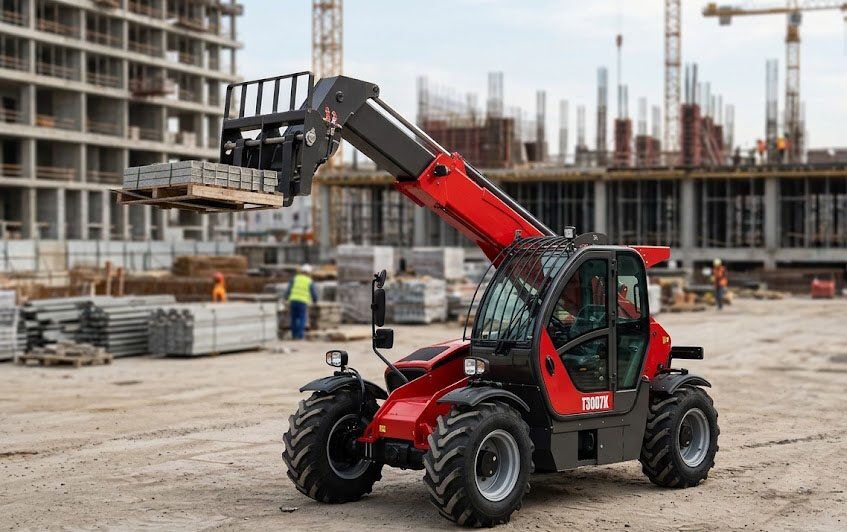
Under what circumstances is it suitable to rent a telehandler?
The core value of renting is to help enterprises avoid the risk of equipment sitting idle and the responsibilities that come with long-term equipment ownership. It is more suitable for temporary, seasonal, or operational scenarios with large demand fluctuations.
Short-term construction projects
Many infrastructure, road repair and temporary construction projects will only use telehandlers at certain construction stages. The equipment is mainly used to complete material handling, cargo loading and unloading or work at height. When this part of the work is completed, the equipment will no longer be needed in the short term.
If the equipment is purchased directly, it is likely to sit idle after the project is completed. Not only will it generate no income, but it will also continue to incur the expenses of storage and maintenance. Renting will be more suitable for the actual needs of this kind of one-time short-term project with a clear time frame.
Seasonal or occasional demand for use
The demand for telehandlers in some businesses is only concentrated in a certain period of the year. In agriculture, the harvest season will generate a large volume of material handling work; in the warehousing and logistics industry, the volume of goods handled will increase sharply during the peak season, and the volume of handling will also rise temporarily.
The normal daily operations of such enterprises do not require the continuous use of telehandlers. If they purchase a piece of equipment specifically for this purpose, it will sit idle for most of the year. Renting equipment only when the workload increases avoids the need to buy a whole machine for occasional use.
The demand of the project is uncertain, and there will be changes.
The preliminary planning of some projects has not been fully finalized, and the type of equipment needed in the future cannot be determined for the time being. At different stages of construction, different requirements will be set for the load capacity and lifting height of the equipment. It is also possible that the scale of the project will be temporarily expanded and additional equipment will be required, but no one can predict whether there will be similar operations in the future.
The rental model can provide flexibility in changing equipment models. If one project requires a model with a greater lifting height and the next requires a larger load capacity, you can switch models directly without being limited by the fixed parameters of your own equipment.
Limited available funds in the early stage
The working capital of construction enterprises often gives priority to raw material procurement, labor costs, and other essential expenses. Spending a large amount of money at once to buy a telehandler will directly squeeze cash flow. Renting does not require a one-time purchase payment, which can relieve the pressure on initial funds.
However, it should also be noted that as the rental period gets longer, the rent will continue to increase. We can’t just look at the low initial investment and ignore the total expenditure associated with long-term rental.
Under what circumstances is it appropriate to buy a telehandler?

The advantage of purchasing equipment is not only saving the rent paid repeatedly. What’s more important is gaining the right to use the equipment, the autonomy to dispatch it, and full control of the equipment itself.
High-frequency, continuous and stable equipment use
If there is a fixed material handling task every week and every day, the telehandler is an essential piece of equipment on site. The utilization rate of the equipment remains high, and if you continue renting for many years, the accumulated rent will become substantial.
Owning the equipment also saves the communication process of repeatedly coordinating with the lessor and handling the delivery and return of the equipment. You don’t have to go through the rental process again every time you start a new project.
Multiple projects under construction at the same time
Many engineering enterprises carry out multiple construction projects at the same time. An owned telehandler can be transferred between various construction sites and put into operation on different projects. The equipment can continue to generate value, and there will be no long periods of idleness after purchase.
Having your own equipment is also convenient for you to unify the planning and allocation of equipment according to the overall construction schedule, so as to reduce the constraints imposed by external rental resources.
You need to have access to the equipment at any time.
Some businesses have unexpected operational needs, and the equipment needs to be available at short notice. If you rely on external rental, you will be subject to the inventory and availability of the local lessor. In the peak season, you may have to queue up to wait for the equipment to become available.
Owning the equipment can give you more control over scheduling and help you cope with temporary repairs, temporary adjustments of the construction plan, and emergency operational needs. However, we should also look at it objectively. Owned machines can also experience faults and downtime. Purchasing does not mean completely avoiding the risk of equipment downtime.
Want to independently control the equipment configuration and operation and maintenance for a long time
After purchasing, you can choose suitable forks and various supporting accessories according to your own long-term working conditions. The operation and adjustment of the equipment can be adapted to the working habits of your on-site workers. The maintenance plan can also be set by yourself without being subject to the maintenance standards of the lessor.
When the equipment is getting older, you can also decide whether to keep it, refurbish it, or sell it directly, and manage this part of the fixed assets flexibly.
Buy or rent: comparative analysis of total cost
In this part, setting aside the question of which option suits which situation, we will break down the various expenses that will actually be incurred under the two options. Many mistakes in decision-making come from comparing only the apparent prices and ignoring many hidden costs.
What are the costs of buying a telehandler?
Initial purchase price
The price difference between a new machine and a used machine is obvious. In addition, the rated load of the equipment, the maximum lifting height, and various optional attachments will directly increase or decrease the purchase price.
If you don’t choose to pay in full and instead choose an installment and financing plan, the corresponding interest costs should also be included in the overall cost calculation.
Ownership and operating-related expenses
After the equipment is bought, a series of fixed expenses will continue to be generated. These include regular maintenance, routine overhauls, and replacement and repair costs after parts become worn or damaged. Equipment insurance, site storage and security, and transportation fees for transferring equipment between various construction sites are all ownership costs.
Fuel is directly consumed during on-site operation, and this cost arises whether the equipment is rented or bought. This part is not included in this comparison.
Depreciation and second-hand resale residual value
As soon as the equipment is put into operation, its working hours will continue to increase, and the value of the machine itself will decrease. Whether daily maintenance is properly carried out will directly affect the second-hand resale price. At the same time, market fluctuations will also affect the resale value of the equipment.
When calculating the actual ownership cost, the residual value cannot be ignored. When the machine is no longer in use, part of the investment can be recovered.
What are the costs of renting a telehandler?
Basic rental rate
Rental providers set different rates according to daily, weekly, and monthly rental periods. For the same equipment, the daily rate calculated from a long-term monthly rental is often more cost-effective than a separate daily rental. You can’t simply use a single day’s rent to calculate the overall cost of a long-term rental.
All kinds of additional rental fees

In addition to the basic rent, other additional charges will be listed in the contract. These may include the transportation fee for delivering and collecting the equipment, the deposit paid in advance, and insurance for the rented equipment. If the equipment is damaged during operation, compensation may be required. If the project period is extended, renewing the rental will also incur additional expenses.
All additional items need to be carefully read and confirmed in advance.
Hidden costs linked to equipment supply
Even if the rent budget is sufficient, there will be losses caused by equipment availability. During the business peak season, the suitable models on the market may already be rented out, leaving us with no choice but to stop work and wait for equipment to become available. If the project is temporarily delayed, the rental period may have to be extended, increasing the total expenses. The condition of equipment and the level of supporting services provided by different rental providers vary, which will also indirectly affect the progress of the operation.
Practical level: how to compare the total cost of the two
For cost calculations, the two options should be compared over the same estimated period of use, so that the results can provide a meaningful reference.
| Cost item | Purchased equipment | Rental equipment |
| Initial expenditure | Full payment for equipment / installment down payment | Rental deposit + first rental payment |
| Financing-related costs | Loan interest and financing fees | Generally not involved |
| Maintenance and overhaul | All costs are borne by the owner. | Responsibilities are divided according to the rental contract |
| Insurance | Equipment insurance purchased by the owner | Responsibilities are divided according to the rental contract |
| Transportation between construction sites | The owner arranges and pays for transportation | Responsibilities are divided according to the rental contract |
| Storage and custody | The owner bears the cost of on-site storage. | There is no need to store the equipment after returning it. |
| Asset residual value | Part of the investment can be recovered when the equipment is sold. | No residual asset value |
To calculate the actual ownership cost of purchasing, you need to include the purchase price, financing fees, maintenance, insurance, transportation and storage, and then deduct the estimated residual value from the second-hand resale. To calculate the total cost of renting, you need to calculate the total rent, add transportation fees for delivering and collecting the equipment and various additional service fees, and also take into account the additional expenses caused by the extension of the construction period.
Don’t directly divide the purchase price by the single-day rent, calculate a theoretical number of days and then conclude that you should buy after that point. There are huge differences in geography, working conditions and the equipment market, and there is no universal break-even point.
If you decide to buy: choose a new or used machine
When it has been determined that purchasing equipment is suitable, the next step is to consider the next question: whether to choose a new or used machine. There is no absolute superiority or inferiority between the two options. It depends on your working conditions and budget.
When is the best time to buy a new machine?
The business requires high-frequency and long-term uninterrupted operation of the machine. You want to know the equipment’s full history and avoid the unknown risks associated with previous damage. New machines can generally come with the original factory warranty and after-sales support, depending on the terms of the sales contract.
There are special operational requirements on the site, and specific equipment and special parameter configurations need to be customized. Once the equipment is shut down, the whole construction or production chain will be affected, and the business cannot afford long-term downtime and repairs.
When is a used machine more suitable?
There is an obvious limit on the procurement budget, and I don’t want to bear the high initial investment of a new machine. The performance parameters of the equipment match the on-site operational requirements, and the visible wear is acceptable. You should be able to get complete equipment maintenance records and know the past work history of the machine. At the same time, you can accept possible future maintenance costs and reserve the corresponding budget.
Key points that need to be checked when buying a used machine

There is no need to disassemble the machine for an in-depth fault inspection. Only a few core areas need to be checked to initially identify potentially risky machines. Check the working hours of the whole machine and review the historical service and maintenance records. Check the structure of the telescopic boom, observe whether there are traces of deformation and welding repair, and check for structural wear. During the test run, focus on checking the operating status of the engine and hydraulic system. The transmission and braking system also need to be fully tested.
Confirm that all safety devices and operating control parts are functional. At the same time, ask about the history of major repairs and parts replacements.
The low price of second-hand equipment does not mean that the overall operating cost is lower. Potential maintenance expenses, unexpected downtime risks and remaining service life should be included in the evaluation, and we can’t judge based on price alone.
Before finalizing the plan, these realistic conditions should also be considered.
We have already discussed usage scenarios and cost calculations, but in reality, there are still many external conditions that will affect the final choice. This part will no longer repeat the advantages and disadvantages of buying and renting, and will focus on those practical constraints that are easily ignored.
Local rental market and equipment supply
Even if renting is more cost-effective after calculation, the actual situation of the local market should be confirmed first. Are there any service providers nearby that can provide telehandlers? Can you rent a model that meets the requirements for load capacity and lifting height?
You should also confirm whether the lessor provides equipment transportation and offers on-site support after a breakdown, or directly replace the machine with backup equipment. During the construction peak season, the availability of this kind of equipment is often tight. If local resources are scarce, even if renting is cost-effective in theory, the actual implementation will be hindered.
Transportation conditions and on-site conditions of the construction site
The transportation distance of the equipment to and from the construction site will affect actual transportation costs. You also need to consider whether the access roads and entrances to the construction site can accommodate large machinery.
If the business requires frequent cross-site transfers, the time and cost of transportation will continue to increase. The load-bearing capacity, slope and size of the working space of the construction site will also limit the use of certain models. These on-site conditions will indirectly affect the actual experience of buying or renting.
Difficulty in obtaining repair support and spare parts
Many people ignore after-sales resources when making decisions. Are there any local maintenance technicians who are familiar with telehandlers? How easy is it to obtain commonly used spare parts when they are damaged? After the machine fails, how long will it take to receive an on-site repair response?
If you choose to buy the equipment, does the team have the resources for regular maintenance? If you rent, you should confirm whether the service provider can quickly repair or replace the equipment when it fails. When local maintenance resources are limited and you own the equipment, it means that you have to bear the pressure of breakdowns and downtime alone.
Equipment needs in the coming period
Don’t make a decision based on the current project alone. After the completion of this project, will the future business continue to use telehandlers? Can the business volume remain stable in the future?
Does the enterprise have a business expansion plan? Will it increase the frequency of equipment use? In future projects, will the operational requirements change? Do you need equipment with greater lifting height and load capacity, or will you need to replace the equipment with other supporting equipment? Only by considering the future business plan can we avoid buying a machine that soon fails to meet business needs.
Conclusion
For short-term and occasional operational needs, renting is often a more practical choice. In situations of high-frequency and long-term continuous use, purchasing equipment is more likely to provide better long-term value.
Under the premise of a limited budget and a tendency to purchase, second-hand telehandlers can also be considered after a thorough equipment inspection. Even if the cost calculation favors renting, the availability of local equipment should be verified first to avoid a situation where no equipment is available in the peak season.
In the end, whether to buy or rent, you can’t simply compare the purchase price with the rent. The final decision should be based on the actual utilization rate of the equipment, the total cost over the entire period of use, and the long-term business planning of the enterprise.