
What is the Reason for the Inability to Lift the Teleshandler?
2026-10-30 17:41:42
There is an abnormal lifting of the telescopic boom forklift, and the on-site operators often encounter two completely different phenomena. One is that the lifting action of the big arm becomes very slow, but the goods can be lifted to the target height under the light load. This kind of phenomenon is usually related to the supply of hydraulic flow. The other is that the lifting speed looks normal. As long as a certain weight load is hung, it can’t be lifted, and the big arm stops directly. In this case, the priority is given to insufficient system pressure and internal leakage problems.
It should be noted that there will be cross-cutting situations in actual failures. For example, the wear of the hydraulic pump will not only slow down the flow rate, but also make it impossible to maintain the working pressure under load. The two symptoms may occur at the same time.
Don’t lock a certain type of part directly based on action performance alone. Many on-site personnel will confuse these two situations, directly determine that the hydraulic pump is broken, blindly replace the accessories, and finally the problem still exists. The weak lifting is not necessarily the damage of hydraulic parts, but it is also possible that the actual operation has exceeded the load range allowed by the equipment. Next, in combination with the actual working conditions of the site, we will sort out all kinds of triggers that will cause a decline in lifting ability, and at the same time give a set of fault judgment ideas that can be implemented.
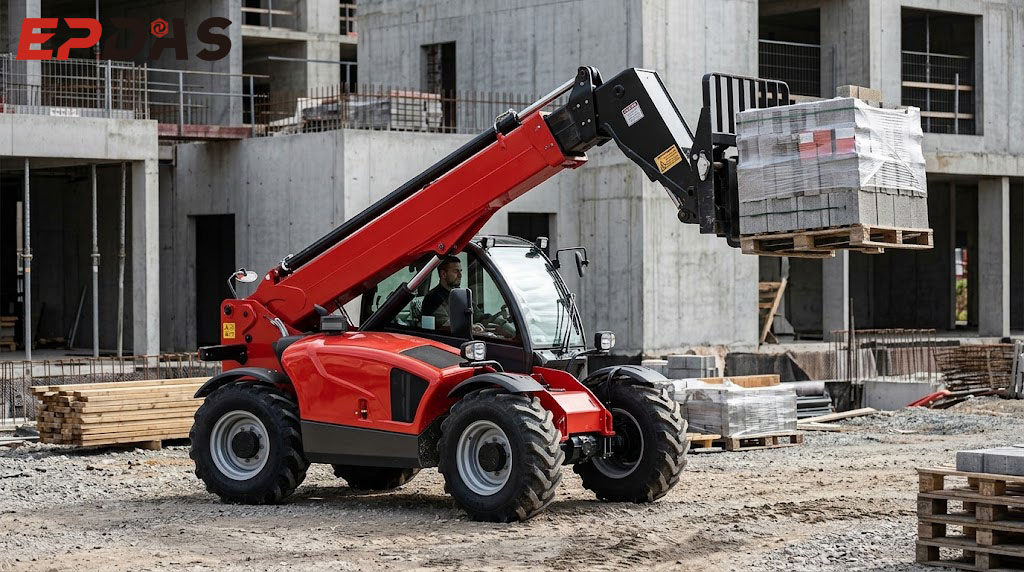
The actual load exceeds the rated carrying capacity of the forklift
The root cause of many on-site cases of inability to lift is not the failure of the equipment, but the operating conditions that have exceeded the capacity boundaries of the equipment itself. Each telescopic boom forklift is equipped with a load curve, and the bearing capacity is not a fixed value. The longer the arm is extended and the higher the lifting height, the safer the load allowed by the equipment will decrease.
When calculating the load on site, you can’t just calculate the weight of the goods themselves. The self-weight of forks, slings and other additional fittings should also be included in the total load. Many construction sites only account for the weight of the goods and ignore the weight of the equipment. The actual total load has exceeded the limit, and the equipment shows the phenomenon of not being able to lift.
If the arm extension angle and operation position change, the corresponding rating of the load curve will also change. For the same piece of goods, the big arm can be easily lifted when it is completely retracted. Once the arm is stretched out, it will be hard to lift. In this case, do not disassemble the hydraulic parts directly, but check the load table and the actual operating position first.

The hydraulic oil level is insufficient or the oil state is wrong
Hydraulic oil is the medium for transmitting power in the whole hydraulic system. The abnormal state of the oil itself will directly weaken the lifting performance.
Low hydraulic oil level
The oil level in the oil tank is too low, and it is easy to inhale air when the oil pump sucks oil. After the oil is mixed with bubbles, the system output will become unstable, the arm lift will be soft, and it will be accompanied by abnormal sounds.
Incorrect hydraulic oil viscosity
The wrong selection of oil viscosity can also cause trouble. When the ambient temperature is low, if the oil with too high viscosity is used, the oil flow resistance will increase, and the flow supply will not keep up; if the temperature is too high, the oil will become too thin, which will aggravate the leakage inside each valve and cylinder.
Hydraulic oil contamination
Long-term use of oil and liquid will cause pollution, and impurity particles are suspended in the oil and liquid. Fine particles will wear out the seal and valve core, slowly causing internal leakage. Water entering and mixing with other brands of oil will also destroy the oil performance and slowly reduce the lifting capacity of the whole machine.
The hydraulic filter is blocked and the oil supply pipeline is blocked
This part mainly depends on the oil supply circuit of the hydraulic pump, that is, whether the oil can flow smoothly into the hydraulic pump.
Suction filter blockage
If the oil-absorbing filter is not replaced for a long time, the accumulation of impurities causes blockage, the oil supply flow of the pump inlet is limited, and the vacuum of the inlet is increased, which is easy to cause cavitation, which directly causes insufficient flow of the whole machine. The intuitive manifestation is that the lifting and other hydraulic movements slow down.
Return oil filter blockage
The return oil filter is in the return channel of the oil liquid returning to the oil tank, and its blockage will not directly limit the oil inlet of the hydraulic pump. However, it will raise the oil return back pressure of the system. If the filter bypass valve fails, the additional back pressure will also put an additional burden on each actuator.
Oil suction pipeline blockage or air leakage
The flattening of the oil suction pipeline, the aging and bulging inside the pipeline, or the squeezing and deformation of the pipe joint seal will cause the inlet oil supply of the pump to be blocked.
Here, it is necessary to distinguish between two different phenomena: the oil suction pipeline is not tightly sealed, and the external air infiltration into the oil is mixed with air, which will bring action shaking and noise; and the pump inlet throttling is serious and the pressure is too low, and the oil itself vaporization to form bubbles, which is cavitation, which will impact and damage the internal parts of the pump.
Both can happen separately or accompanied. This kind of failure is different from the breakage of the high-pressure oil pipe. It occurs in the front-end oil supply path of the pump. Most of the failures are that all hydraulic movements slow down, not only the arm lifting is affected.
Hydraulic pump wear or insufficient pump output capacity
The hydraulic pump is the power source of the whole hydraulic system, which converts the mechanical energy of the engine into hydraulic oil pressure and flow. The wear of the pump itself or the insufficient power supply at the driving end will cause a decrease in the lifting capacity.
Internal hydraulic pump wear
The internal parts of the pump are worn out for a long time, and the gap is getting bigger. Part of the oil will flow back directly inside the pump body, and the outward output flow and pressure will be reduced. As soon as the load comes up, there will be motionless lifting, and at the same time, multiple hydraulic actions will be slow to respond.
Engine power supply and drive connection
It is necessary to distinguish between the damage of the pump body and the failure of the power source. The hydraulic pump is driven by the engine. The load of the hydraulic pump itself will increase the engine load, and it is normal for the speed to drop slightly under load.
If there is an abnormally obvious speed drop during the operation of lifting, accompanied by engine smoke, running shaking, or multiple hydraulic functions are weak at the same time, the power output status of the engine and the driving connection parts of the hydraulic pump should be checked at the same time, and it cannot be directly determined that the hydraulic pump has been damaged.
The overflow valve is working abnormally
The overflow valve is responsible for limiting the maximum working pressure of the whole hydraulic system. When the system pressure reaches the set value, the overflow valve will open the pressure relief to protect the pipeline and parts from overpressure damage.
Incorrect pressure setting
The preset pressure of the overflow valve is too low, and the system will turn on the pressure relief in advance before it reaches the working pressure required for operation. Even if other parts are in good condition, they cannot produce enough lifting force to carry the rated load.
Valve core stuck or worn
The valve core is stuck by the impurities in the oil, and the valve mouth cannot be completely closed. The pressure oil continues to overflow from the valve back to the oil tank, and the system pressure cannot rise.
The same phenomenon will also occur if internal leakage is formed after the core is worn out.
Typical characteristics of overflow valve failure: light load lifting is basically normal. After the load increases, the lifting directly fails. The lifting speed does not necessarily slow down, that is, there is not enough force to lift heavy objects.
Internal leakage of lifting hydraulic cylinder
The lifting cylinder relies on the hydraulic pressure difference on both sides of the piston to generate thrust, and the internal seal of the cylinder is worn out, and internal leakage will occur.
Piston seal wear
After the wear and age of the piston sealing ring, the oil on the high-pressure side will bypass the seal and flow directly into the low-pressure cavity of the cylinder, that is, the oil will bypass the inside of the cylinder.
There are no traces of oil leakage on the outside, but the cylinder thrust continues to decay.
The greater the load, the more obvious the internal leakage. It looks normal to lift the big arm without load, but it can’t be lifted when the heavy load is hung.
Boom sinking after shutdown
After the shutdown, the arm slowly sinks by itself, which cannot be attributed only to the cylinder piston seal. The stuck leakage of the load-retaining valve (hydraulic lock), or the internal leakage of the lifting circuit of the main control valve, will also cause the arm to drift slowly.
Many people will look for traces of oil leakage on the outer wall, but the internal leakage of the cylinder belongs to the internal oil and liquid of the cylinder block, and the oil leakage cannot be seen from the external joint, which is easy to be ignored.
Main control valve failure
The main control valve distributes the pressure oil to each actuator, and the lifting, stretching and tilting of the big arm are all controlled by it.
Valve spool wear and internal leakage
The core is worn, the impurities are stuck, and the gap between the core and the valve hole becomes larger, which will form internal leakage. Part of the pressure oil is not sent to the lifting cylinder, but directly flows back to the oil tank in the valve body, and the lifting thrust is consumed.
Pilot control or electrical signal abnormality
The pilot control oil circuit or electrical control signal is abnormal, and the valve core cannot be fully opened to the working position. The oil-liquid flow cross-section is insufficient, the flow supply is limited, and the lifting action will slow down.
Failure does not necessarily affect the whole operation. If only the lifting circuit of the big arm is affected, and the rest of the rotation, legs and bucket actions are all normal, the scope of investigation can be narrowed down to the valve core corresponding to the main valve.
The hydraulic hose is leaking or the circulation of the pipeline is obstructed
This section is aimed at the high-pressure working circuit pipeline, that is, the high-pressure oil line from the hydraulic pump to the cylinder.
External hydraulic oil leakage
The outer layer of the hose is broken, the joint is loose, and there is external oil leakage. The high-pressure oil is directly lost, the pressure flow to the cylinder becomes less, the lifting force decreases, and the traces of hydraulic oil leakage can generally be seen on the ground.
Internal hose blockage
There is also a more hidden problem: the outer layer of the oil pipe looks intact, but the inner rubber layer is peeled off and peeled. The peeling rubber will block the oil path and limit the flow of oil and liquid. There is no abnormality in appearance, but the amount of oil through the pipeline is limited.
Pipe joint blockage
The deformation of the sealing ring inside the pipe joint and the impurities stuck in the joint position will also cause a local throttling effect. If the single lifting circuit pipeline is blocked, it usually only affects the lifting of the big arm, and the rest of the hydraulic function of the whole machine will not be disturbed.
The mechanical resistance of the arm assembly is too high
Lifting weakness is not all hydraulic problems. Mechanical jamming brings additional resistance, which will also make the equipment show lifting effort.
Wear and deformation of telescopic arm sliders
The wear, deformation or insufficient lubrication of the wear-resistant sliders between the telescopic arms will mainly interfere with the telescopic movement of the arm frame. The mechanical resistance in the arm lifting process will increase when the pin shaft, bushing wear, lack of lubrication or assembly misalignment of the hinged joint position is lifted.
Pin shaft and bushing friction
The pin shaft part lacks oil for a long time and is dry grinding. The frictional resistance during the movement of the arm has increased significantly. The hydraulic system needs to overcome additional mechanical resistance, and it will feel unable to lift under the same load.
The characteristics of large mechanical resistance: when lifting, you can hear the abnormal sound of metal friction, and the movement of the big arm is stuck, which is not a smooth and uniform movement. Even if the hydraulic pressure parameters are all normal, the equipment is still hard to lift.
How to diagnose the weak lifting of the telescopic forklift
Don’t disassemble and replace the parts when you come up. First, narrow down the scope of troubleshooting through the fault phenomenon, and distinguish whether the fault is a common problem of the whole machine or only concentrated in the boom lifting loop.
Initial troubleshooting based on overall machine performance
| Malfunction performance | Give priority to checking the direction |
| All hydraulic movements are weak. | Engine power, hydraulic pump, oil-absorbing oil supply circuit, hydraulic oil state |
| Only the lifting function of the big arm is weak. | Lifting circuit, main control valve corresponding to valve core, lifting cylinder, load holding valve |
| Multiple actions weaken as soon as the load is added. | Hydraulic pump output performance, system pressure control, engine power output |
Further troubleshooting based on specific symptoms
Then further positioning in combination with specific symptoms:
| Malfunction performance | Give priority to checking the direction |
| The lifting action is very slow. | Oil flow, hydraulic pump output, oil suction filter blockage, oil suction pipeline, engine speed |
| The speed is normal, and the heavy load can’t be lifted. | Check the load condition, system pressure, overflow valve setting, cylinder and valve internal leakage |
| After the big arm is still, it slips down by itself. | Lifting cylinder seal, load holding valve, main control valve lifting circuit internal leakage |
| The movement of the big arm is shaking and the operation is not smooth. | Oil and liquid mixed into air, boom mechanical jam and friction resistance |
First, confirm whether there is an overload operation, and then observe whether all hydraulic functions are abnormal or local loop failures. Then lock and check the direction according to the table above.
If there are conditions, it can be connected to the hydraulic pressure gauge, read the actual pressure value in the no-load and load-on state of the system, and compare it with the standard value of the equipment manual.
Tip: The above is only a preliminary judgment clue, and you can’t make a direct conclusion based on the phenomenon alone. The final confirmation of the fault point should be verified in combination with the pressure gauge reading and disassembly inspection.
Under what circumstances should the equipment operation be stopped immediately?
When there is a lifting failure, do not reluctantly continue to work. Continued use in some working conditions will bring safety risks.
Uncontrolled boom drop
The arm fell uncontrollably and suddenly fell without warning. Whether it was carrying goods or not, it would be stopped immediately. In this case, there is a risk of cargo falling.
High-pressure hydraulic oil leakage
There was obvious hydraulic oil jet leakage at the scene. High-pressure hydraulic oil can pierce the skin, and oil leakage will quickly consume the pressure of the system.
Abnormal hydraulic pump noise
The hydraulic pump continues to emit sharp whistling and metal grinding sounds, and there is a high probability of cavitation, insufficient oil absorption or internal parts wear. It needs to be stopped immediately for troubleshooting, and continuous operation will further aggravate the damage to the parts.
Hydraulic system high-temperature alarm
The hydraulic system repeatedly alarms at high temperature. If the oil temperature continues to be too high, it will accelerate the aging of the seal and cause chain leakage failure.
Load management and overload alarms
The equipment continues to pop up load management and overload alarms. Even if you subjectively feel that the goods are not heavy, you should stop the lifting operation and re-account for the actual load. If any of the above phenomena occurs, place the goods firmly on the ground, turn off the engine, carry out maintenance, and do not continue to work with faults.
Conclusion
The lifting capacity of the telescopic arm forklift has decreased due to the cross-load conditions, hydraulic oil, pump valve cylinder pipeline and mechanical structure.
Some malfunctions look close, but the root cause behind them is completely different. Slow lifting is usually biased to the problem of flow supply; heavy loads can’t be lifted, which is more related to system pressure and internal leakage, and the two types of symptoms may also occur at the same time.
The order of overhaul is very important. First, exclude simple and easy-to-check items such as overload, oil and filter, and then gradually delve into the core components such as pumps, valves and cylinders. Replacing the expensive hydraulic pump directly may not solve the problem, and it will also incur unnecessary cost of accessories. If necessary, use the pressure gauge to read the actual pressure, relying on the actual measurement data, rather than simply relying on subjective phenomena to make judgments.