
Why Does The Slump Loss Occur During The Transportation Of Concrete Mixer Trucks?
2026-11-17 16:36:19
Many construction sites have encountered such a situation: the outbound sampling and testing of the batching plant, and the concrete slump fully meets the requirements of the order. But after the concrete is transported by mixer truck to the construction site, the mixture becomes obviously thick, the unloading speed slows down, and even cannot be pumped normally.
The decline in on-site slump is the result of the superposition of multiple factors of time, environmental temperature, raw material performance, on-site dispatch and vehicle operation. You can’t directly judge that the mixer truck is faulty based on the state of the mixture seen at the construction site alone.
What Is Going On Inside Concrete During Mixer Truck Delivery?
After the concrete is loaded into the mixing drum, the hydration reaction of cement will not stop. Even if the mixer truck keeps stirring at low speed, the cement particles will continue to react chemically with water, and the fluidity of the mixture will gradually change over time.
The mixing drum keeps rotating, and the core function is to prevent the separation of concrete and the settling of the aggregate, and to maintain the uniformity of the overall material. However, continuous stirring cannot block the hydration of cement, and it cannot completely lock the initial slump.
The decrease in the slump does not mean that the concrete has reached initial set. The slump loss is not entirely caused by the evaporation of water in the drum. In many cases, it is the hydration that consumes free water, or the aggregate continues to absorb water, so that the mixture slowly thickens.
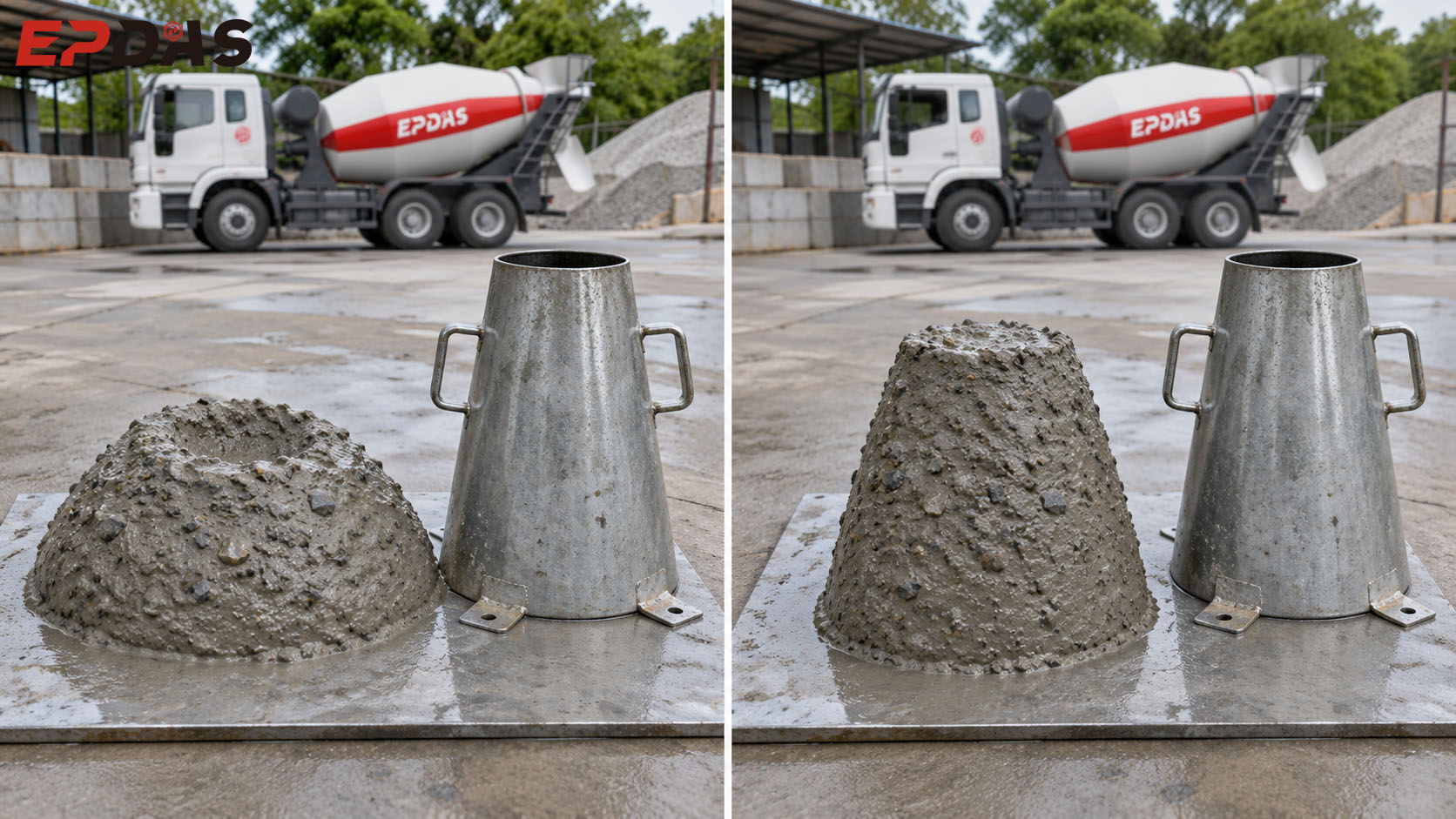
What Conditions Will Accelerate The Slump Loss During Mixer Truck Transportation?
Transportation Time And On-Site Waiting Time
To calculate the total residence time of concrete, you can’t just look at the mileage on the road. Starting from the contact of cement and water, driving on the road, waiting in line at the gate of the construction site, waiting for unloading after arrival, all the time should be included.
The batching plant is very close to the construction site, and the actual driving distance is very short. If the process connection at the construction site is not in place, the mixer truck can only wait in line for unloading for a long time when it arrives at the site, and there will still be a relatively obvious decline in slump.
There is no common standard for safe transportation distance. Whether the slump can be maintained depends on how the slump retention time of this set of mix proportions matches the actual working conditions of the project site. The allowed time limit from adding water and mixing to unloading should be determined according to the standards adopted by the project, the contract requirements and the verification results of the mix proportions.
90–120 minutes cannot be a unified requirement for all projects.

Concrete Body Temperature And High Temperature Weather
The rise in ambient temperature usually accelerates the slump loss. The ambient temperature is not equal to the temperature of the concrete itself.
The exposure of aggregates to heat and the high temperature of mixing water will directly raise the output temperature of the concrete. In the high temperature season, the output temperature control target should be determined according to the delivery or placement temperature required by the project, combined with the temperature rise during transportation.
The output temperature should not be confused with the unloading and placement temperature. Even if the weather outside is not very hot, the high temperature of the concrete body will also accelerate hydration and shorten the window for the mixture to maintain the flow state.
The dominant factor in the slump loss caused by high temperature is that the rate of cement hydration reaction accelerates with temperature. The evaporation of water in the drum is only a secondary influence.
Aggregate Water Content And Continuous Water Absorption Characteristics
During the production of the batching plant, the amount of water added will be adjusted according to the water content of the aggregate. If the moisture content is not detected accurately, the actual free water volume will deviate from the intended amount.
Some porous aggregates have strong water absorption. If they are not fully pre-wetted before production, they will continue to absorb the free water inside the mixture after being loaded into the mixer truck.
It is necessary to distinguish between two different situations. One is that at the moment when the concrete leaves the batching plant, the amount of mixing water is not enough. The other is that the state is qualified when leaving the station. The aggregate continues to absorb water during transportation, and the slump is slowly lost later. The investigation direction of the two is completely different.
Insufficient Slump Retention And Admixture Compatibility
The outbound detection slump meets the standard, which only means that the initial flow degree meets the conditions. It does not mean that this mix can maintain its slump throughout subsequent transportation and waiting.
Different brands and batches of cement, plus mineral admixtures such as fly ash and ground granulated blast-furnace slag, can have very different compatibility with water reducers and slump-retaining admixtures. Some mixes look good in the initial state, but the slump retention is weak, and the fluidity declines rapidly after a period of transportation.
It is not enough to test the initial slump. When trying to mix, it is necessary to simulate the actual temperature conditions of the project, estimate the transportation and waiting time, observe the state of the mixture after the corresponding time, and then determine the mix proportions of the final production.
How Will The Mixer Truck Equipment Itself And Operation Affect The Stability Of Slump?
The mixer truck will not accelerate the cement hydration reaction out of thin air. However, the hardware status of the vehicle and the driver’s operation will change the actual performance of the concrete after arrival at the site, resulting in uneven discharge conditions between different mixer trucks carrying the same mix.
During transportation, low-speed stirring should be maintained according to the requirements of the vehicle manufacturer to reduce material sedimentation and stratification. Don’t use high-speed stirring for a long time. Continuous high-speed mixing may change the temperature, air content and working performance of concrete, and will also aggravate equipment wear.
Each mixer truck has a rated stirring capacity. If the vehicle is overloaded, the material in the drum has insufficient space to turn over, the blades cannot drive the material to circulate fully, and the uniformity deteriorates.
Blade wear or drum wall accumulation can lead to uneven mixing and sampling distortion, but this does not necessarily indicate overall slump loss.
Stagnant water may be retained in the mixing drum. If the water is not drained after washing and concrete is directly loaded, the residual water will be mixed into the concrete. On-site water addition without measurement will directly change the water-to-cementitious materials ratio. With the same set of mix proportions, the discharge conditions of different truckloads may become very different.
How To Locate Where The Slump Loss Occurs?
If the on-site slump is insufficient, the scope of investigation can be narrowed in combination with the on-site phenomenon.
| On-site performance | Priority verification direction |
| Multiple mixer trucks carrying the same mix proportions generally show obvious slump loss | Mix design, raw materials, admixture compatibility, concrete exit temperature |
| The problem is concentrated in long-distance transportation or truckloads that require a long queue on site | Total cumulative time from cement and water contact to on-site inspection |
| The working conditions are close, but one mixer truck repeatedly has abnormal slump | Actual loading tonnage, stirring speed record, residual water in the tank, and material accumulation in the drum |
| Slump test results already fluctuate significantly at the batching plant before dispatch | The correction process of aggregate water content, the measurement system of powder and water, and the mixing process in the station |
| Samples taken at different stages of discharge from the same mixer truck show a large difference in slump | Sampling position, testing operation process, uniformity in the mixing drum |
To carry out comparative investigation, it is necessary to establish a data ledger. Record the slump of each truckload leaving the station, the actual measurement of slump on site, concrete temperature, loading time, vehicle arrival time at the construction site, on-site waiting time, and whether any adjustments have been made on site.
When comparing before and after, the sampling position and detection techniques should be as consistent as possible to exclude data errors caused by human operation.
From Production To Delivery, How To Reduce The Slump Loss During Transportation
Before production, test slump-retention performance according to the estimated transportation time, likely on-site waiting time and seasonal temperature conditions. At the same time, do a good job of testing the water content of the aggregate, and correct the mixing-water quantity in time.
Before concrete leaves the plant, check the two key indicators of slump and temperature. At the same time, check the mixer truck that is about to be loaded to confirm that the water in the drum has been discharged.
During transportation, the driver should keep stirring at low speed according to the specifications. Plan reasonable transportation routes, control the departure rhythm, and reduce the accumulation of mixer trucks entering the site.
Before the mixer truck enters the construction site, make sure that the pump truck, operators and pouring work surface are all ready. Reduce the waiting time after the mixer truck arrives.
The Actual Measurement Of The Concrete On-Site Slump Is Low. How To Deal With It At The Site?
When the mixer truck arrives at the site and the measured slump does not meet the construction requirements, check the delivery documents first. Compare the actual slump, concrete temperature and total transportation and waiting time with the technical requirements of the order.
On-site adjustment must be evaluated by the project quality or technical person in charge to confirm whether adjustment is allowed and which adjustment method is allowed.
It is strictly forbidden to add water without permission at the construction site. Uncontrolled water addition can increase the water-to-cementitious materials ratio beyond the design limit and reduce concrete strength. If adjustment is necessary, the technical personnel of the concrete supplier should determine the adjustment plan in consultation with the person in charge of project quality. When adjusting with admixtures, products that have been proven to be suitable should be used, and the supplementary dose should be controlled. After addition, mix fully according to the applicable standards and the requirements of equipment and admixtures, then take a new sample to test the slump. All operations should be completely recorded and archived.
Even if the slump value is restored to the specified range through the admixture, it does not mean that all the acceptance indicators of concrete are automatically met.