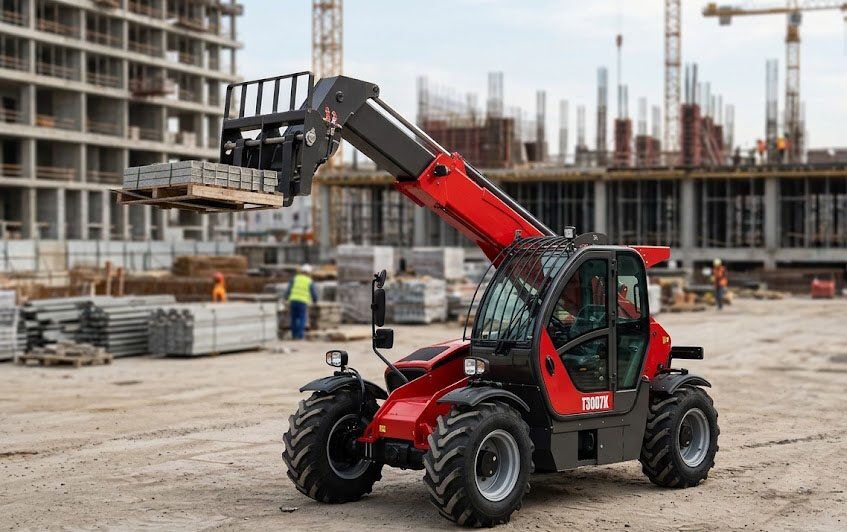
This guide compares the costs, practical uses, and ownership responsibilities of buying and renting a telehandler. It explains when renting suits short-term or seasonal projects, when buying makes sense for frequent use, and how to evaluate new and used machines. Local equipment availability, maintenance support, transportation, and resale value are also considered for your specific operation.
Knowledge
- 2026-10-30
- 2026-10-29
Telehandler performance can be affected by electrical faults, hydraulic problems, steering issues, and engine overheating. This guide explains how to recognize common symptoms, identify possible causes, and carry out preliminary checks safely. It also covers warning lights, fault codes, and situations that require professional maintenance, helping equipment operators understand potential problems and make informed decisions before returning the machine to service.
- 2026-10-28
This guide explains how forklifts work, the main types available, and their applications across different industries. It covers key components, lifting capacity, operating costs, safety, and maintenance, helping readers understand the differences between forklift models and identify the equipment best suited to their loads, site conditions, and daily handling requirements.
- 2026-10-27
Self-loading concrete mixers operate in demanding construction environments where mechanical and hydraulic faults can affect productivity and safety. This article explains how to identify equipment abnormalities, assess potential causes, and take appropriate corrective measures. It provides practical troubleshooting guidance to help operators recognize problems early, reduce unnecessary repair costs, minimize downtime, and maintain reliable equipment performance throughout daily construction operations.
- 2026-10-27
Learn how to clean a self-loading concrete mixer after each use to prevent hardened concrete buildup and maintain reliable operation. This guide explains practical cleaning procedures for the mixing drum, discharge chute, front loading hopper, water supply system, and exterior. It also covers hardened concrete removal, essential safety precautions, common cleaning mistakes, and a final checklist for routine equipment maintenance.
- 2026-10-20
This article explains how cement feeding systems work and how to select suitable equipment for different material handling and batching requirements. It compares screw and belt feeders in terms of conveying mechanisms, material suitability, and flow rate factors, while examining the differences between volumetric and gravimetric feeding in measurement accuracy and process control. It also covers key selection considerations and combined feeding systems for reliable cement conveying and precise batching.
- 2026-10-15
Installing a cement silo requires more than preparing a suitable site. This guide helps you identify potential installation problems related to site conditions, foundation stability, lifting clearance and equipment connections, so you can prepare the site properly and reduce the risk of delays, misalignment and unsafe operation.
- 2026-10-14
Choosing the right cement silo requires more than matching its rated capacity to a project's needs. This guide explains how to estimate actual cement storage demand, calculate the required reserve, and assess usable capacity to help prevent material shortages and avoid unnecessary storage capacity.
- 2026-10-12
Choosing a concrete batching plant involves more than comparing equipment specifications. The right choice depends on how well the equipment fits your project conditions, operational plans, and long-term investment goals. This guide provides a practical framework for evaluating mobile and fixed batching plants, helping contractors and project managers make informed decisions based on actual site requirements and future use.
- 2026-10-10
Having trouble with your concrete batching plant? This article provides practical troubleshooting guidance to help you identify the causes of common equipment faults, check the right components, and avoid misdiagnosis. It also covers preventive maintenance tips to help reduce unexpected downtime and keep your batching plant running reliably.